Public-domain ebook
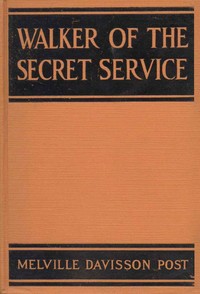
Walker of the Secret Service
Language: en310 downloads on Project Gutenberg
Subjects
In: Crime, Thrillers and Mystery·Adventure·Novels
Public-domain ebook sourced from Project Gutenberg #62740.
Public-domain ebook
Language: en310 downloads on Project Gutenberg
Subjects
In: Crime, Thrillers and Mystery·Adventure·Novels
Public-domain ebook sourced from Project Gutenberg #62740.
The opening · free to read
Near the entrance of the great circus tent there was a little man in a canvas chair. He sat at the end of the long alley, which was hung with painted signs.
Nothing had escaped me.
I had no money to see any wonder, and so had to be content with what was displayed outside. It was early in the morning. The grass before the tents had not yet been trodden down; few persons were about, and I had the marvels of this fantastic alley to myself.
I had advanced slowly along every foot of it, and now I stood just beyond the roped-off entrance to the big tent, and the little man in the canvas chair.
There was something in the appearance of this man that drew my eye. He sat in the chair as though every muscle were relaxed, his eyes closed, his head drooping. Now and then he put up his hand and pressed the fingers over his face. It seemed a habit, as though his face had the sensation of being swollen.
No one disturbed him. He had been there for some time. I had noticed him at the end of the alley when I arrived, precisely in this posture, as of one worn out with some exertion.
I was looking at him as I had looked at the painted signs when the canvas of the big tent was thrust up and a man came out. He was a big young man in the overalls of a mechanic and he had some device in his hand like a dome-shaped metallic box.
He went directly to the man in the canvas chair.
“Mooney,” he said, “there’s something wrong with this damned thing; make it go.”
The little man opened his eyes without moving a muscle of his body. Then he put out his hand, took the metallic device, rested it on his knee, flicked a penknife out of his waistcoat pocket, and with a screw-driver blade took a plate off at the bottom of the thing. Then he adjusted something deftly inside, replaced the plate and returned the device to the mechanic.
It had taken only a moment; his fingers had moved with the precision of a pianist, and he had scarcely changed his position.
I had been greatly interested and had drawn a little closer. And when I looked up, the eyes of the big mechanic were on me; he had a hard, determined face and a sharp, piercing eye. I felt that he easily summed me up and had the measure of me. The little man in the canvas chair spoke as the mechanic turned away.
“White,” he said, “who’s it goin’ to be?”
“I don’t know yet,” replied the mechanic. “I’ll look ’em over.”
Then he disappeared under the circus tent.
I realized now that I was very close to the man in the canvas chair, and I stepped back across the green alley. A little group of tent hands were speaking as I came up.
“I wonder why they stick,” one of them was saying. “They can’t get much out of the boss for fixing these jimcracks.... The big one’s an expert mechanic and the dope Jimmy’s a wizard.”
It was late in the afternoon when I again saw the big mechanic.
The crowd from the circus was scattering. I had nowhere to go and was standing idly in the road when the man came up. He looked me over very carefully.
“Young fellow,” he said, “you don’t seem to be in much of a hurry; perhaps you could take a note over to the Red Sign Bar.”
I explained that I was a stranger in the town, but he pointed out very definitely how I could find the way.
“You will go into the bar,” he said, “and go straight through to the back room. There you will find the tired man who fixed the dynamo. Give him this note.”
He handed me a blank envelope sealed, and half a dollar. I needed the half dollar, for I was hungry. I had not a cent in the world and I had walked that afternoon ten miles into the town.
It was not possible to mistake the directions. I followed the road the circus wagons had made from the meadow where the tents were stretched, to the town. One could not miss the main street through it.
Presently I found the Red Sign Bar. The bar was crowded, so my passage was not marked. I opened the door at the end and went into a room.
Immediately the man sitting at the table sprang up.
On the table before him were a number of railroad folders and a map, and he was making some calculations on a blank sheet of paper.
He was the same man whom I had seen in the canvas chair in the alley of side shows before the big tent of the circus. But he was visibly changed. He was like a cat, incredibly active. His hands were in his pockets and he did not move after he was on his feet.
I closed the door and, going forward, put the envelope on the table.
“A gentleman out at the circus,” I said, “sent you this letter.”
He sat down with the same soft, quick feline motion, tore the envelope open with his finger and read the contents. But I had the feeling that while his eyes were on the paper they were also very carefully on me. Then suddenly he spoke.
“Do you know why White picked you?”
“Picked me for what?” I said.
He folded the paper over his finger and, reaching across the table, showed me the lower half of what the note contained.
It was written in pencil in a large clear hand:
The same baby that we spotted at the Junction goes to the tank at 10:15 to-night. She always takes a drink at this trough. I think there is money in her clothes, and here’s a fellow to help.
White.
He whisked the note back into his pocket.
“So you are going to help us,” he said. “You look like a husky youngster.”
I was completely puzzled, but, as you will presently realize, I was ready for almost any adventure. My first clash with organized society had left me bewildered, and ready for any revenge that might present itself.
The book keeps going
Reading is free forever. Sign up and watch scenes appear while you read.



Scenes Storieta drew for other classics.
New illustrated classics
Once or twice a month: the latest books to get full character casts, scene art, and free comic editions. No account needed.