Public-domain ebook
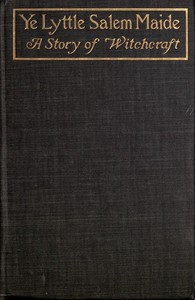
Ye Lyttle Salem Maide: A Story of Witchcraft
Language: en391 downloads on Project Gutenberg
Subjects
In: Historical Novels·Novels·American Literature
Public-domain ebook sourced from Project Gutenberg #62815.
Public-domain ebook
Language: en391 downloads on Project Gutenberg
Subjects
In: Historical Novels·Novels·American Literature
Public-domain ebook sourced from Project Gutenberg #62815.
The opening · free to read
Over two centuries ago a little Puritan maiden might have been seen passing along the Indian path which led from out Salem Town to her home. It was near the close of day. The solemn twilight of the great primeval forest was beginning to fall. But the little maid tripped lightly on, unawed, untroubled. From underneath her snowy linen cap, with its stiffly starched ear-flaps, hung the braid of her hair, several shades more golden than the hue of her gown. Over one arm she carried her woollen stockings and buckled shoon.
A man, seated near the path on the trunk of a fallen tree of such gigantic girth that his feet swung off the ground, although he was a person of no inconsiderable size, hailed her as she neared him. “Where do you wend your way in such hasty fashion, little mistress?”
She paused and bobbed him a very fine courtesy, such as she had been taught in the Dame School, judging him to be an important personage by reason of his sword with its jewelled hilt and his plumed hat. “I be sorely hungered, good sir,” she replied, “and I ken that Goody Higgins has a bowl o’ porridge piping hot for me in the chimney corner.” Her dimpled face grew grave; her eyelids fell. “When one for a grievous sin,” she added humbly, “has stood from early morn till set o’ sun on a block o’ wood beside the town-pump, and has had naught to eat in all that time, one hungers much.”
“And would they put a maid like you up for public punishment?” cried the Cavalier. “By my faith, these Puritans permit no children. They would have them saints, lisping brimstone and wrestling with Satan!”
“Hush, hush!” cried the little maid, affrighted. “Ye must not say that word lest the Devil answer to his name.” She pointed to where the sunset glimmered red behind the trees. “Do ye not ken that when the sun be set, the witches ride on broomsticks? After dark all good children stay in the house.”
“Ho, ho!” laughed the stranger; “and have you a law that witches must not ride on broomsticks? You Puritans had best be wary lest they ride your nags to death at night and you take away their broomsticks.”
“Ay,” assented the maid. “Old Goody Jones is to be hanged for witchery this day week. One morn, who should find his nag steaming, flecked with foam, its mane plaited to make the bridle, but our good Neighbour Root. When I heard tell o’ it, I cut across the clearing to his barn before breakfast, and with my own eyes saw the nag with its plaited mane and tail. Neighbour Root suspicioned who the witch was that had been riding it, but he, being an o’er-cautious man, kept a close mouth. Well, at dawn, two days later, he jumped wide-awake all in a minute,—he had been sleeping with an eye half-cocked, as it were,—for he heard the barn door slam. He rose and lit his lantern and went out. There he saw Goody Jones hiding in a corner of the stall, her eyes shining like a cat’s. When she saw he kenned her, she gave a wicked screech and flew by him in the form o’ an owl. He was so afeared lest she should bewitch him, that he trembled till his red cotton nightcap fell off. It was found in the stall by our goodly magistrate in proof o’ Neighbour Root’s words.”
The Cavalier’s face grew grim. “Ay,” he muttered, “the Lord will yet make these people repent the innocent blood they shed. Hark ye, little mistress, I have travelled in far countries, where they have the Black Plague and terrible diseases ye wot not of. Yet this plague of witchery is worse than all,—ay, even than the smallpox.” He shrugged his shoulders and looking down at the ground, frowned and shook his head. But as he glanced up at the maid’s troubled countenance, his gloom was dispelled by a sunny smile. He reached out and took her hand, and patted it between his big warm palms.
“Dear child,” he said, “be not afeared of witches, but bethink yourself to keep so fair and shining a conscience that Satan and his hags who work by the powers of darkness cannot approach you. We have a play-actor in England, a Merry Andrew of the town, a slender fellow withal, yet possessed of a pretty wit, for wit, my little maid, is no respecter of persons, and springs here and there, like as one rose grows in the Queen’s garden and another twines ’round the doorway of the poor. Well, this fellow has written that, ‘far as a little candle throws its beams, so shines a good deed in a naughty world.’ Many a time have I catched myself smiling at the jingle, for it minds me of how all good children are just so many little candles shining out into the black night of this evil world. When you are older grown you will perceive that I spake true words. Still, regarding witches, I would not have you o’er bold nor frequent churchyards by night, for there, I, myself, have seen with these very eyes, ghosts and wraiths pale as blue vapour standing by the graves. And at cockcrow they have flown away.” He released her hand. “Come now,” he said lightly, “you have not told me why you were made to stand on a block of wood all day.”
“Good sir,” she replied, “my punishment was none too heavy, for my heart had grown carnal and adrift from God, and the follies and vanities o’ youth had taken hold on me. It happed in this wise. Goodwife Higgins, who keeps our home since my dear mother went to God, be forever sweethearting me because I mind her o’ her own little girl who died o’ the smallpox. So she made me this fair silken gown out o’ her wedding-silk brought from England. Ye can feel for yourself, good sir, if ye like, that it be all silk without a thread o’ cotton in it. Now, Abigail Brewster, whose father be a godly man, telled him that when I passed her going to meeting last Sabbath morn, I switched my fair silken gown so that it rustled in an offensive manner in her ears. So the constable came after me, and I was prosecuted in court for wearing silk in an odious manner. The Judge sentenced me to stand all day on the block, near the town-pump, exposed to public gaze in my fine raiment. Also, he did look at me o’er his spectacles in a most awesome, stern, and righteous fashion, for he said I ‘drew iniquity with a cord o’ vanity and sin with a cart-rope.’ Then he read a stretch from the Bible, warning me to repent, lest I grow like those who ‘walk with outstretched necks, mincing as they go.’” She sighed: “Ye ken not, sir, how weary one grows, standing on a block, blinking o’ the sun, first resting on your heels, then tipping forward on your toes, and finding no ease. About the tenth hour, as I could see by the sun-dial, there comes Abigail Brewster walking with her father. When I catched sight o’ him I put my hands over my face, and weeped with exceeding loud groans to show him I heartily repented my wickedness in the sight o’ God. But he, being spiritually minded at the time, had no thought for a sinner like me and went on. Now, I was peeking out betwixt my fingers, and I saw Abigail Brewster had on her gown o’ sad-coloured linsey-woolsey. Her and me gave one another such a look! For we were both acquainted like with the fact that that sad-coloured linsey-woolsey petticoat and sacque were her meeting-house clothes, her father, as I telled ye, having no patience for the follies o’ dress. Beshrew me, sir,” added the little maid, timidly, “but I cannot refrain from admiring your immoderate great sleeves with the watchet-blue tiffany peeping through the slashes.”
“Sit you down beside me, little mistress,” said the Cavalier, “I would ask a question of you. Ho, ho, you are afeared of witches! Why, see the sunset still glimmers red. Have you not a wee bit of time for me, who am in sore perplexity and distress?”
“Nay, nay, good sir,” she rejoined sweetly, “I be no afeared o’ witches when I can assist a soul in sore distress, for as ye telled me, a witch cannot come near one who be on a good errand.”
She climbed up on the trunk and seated herself beside him, swinging her sturdy, bare feet beside his great high boots.
“Can you keep a close mouth, mistress?” asked the Cavalier.
She nodded. Irresistibly, as her companion remained silent a moment in deep thought, her fingers went out and stroked his velvet sleeve. She sighed blissfully and folded her hands in her lap.
“I was telled by a countryman up the road that there is a house in your town which has been recently taken by a stranger. ’Tis a house, I am informed, with many gables and dormer windows.” The speaker glanced sharply at his companion. “Do you hap to know the place?”
“Yea, good sir,” she replied eagerly; “the gossips say it be a marvel with its fine furnishings, though none o’ the goodwives have so much as put their noses inside the door, the master being a stern, unsocial body. But the Moorish wench who keeps his home has blabbed o’ Turkey covers and velvet stool cushions. Ye should hear tell—”
“What sort of looks has this fine gentleman,” interrupted the Cavalier; “is he of lean, sour countenance—”
She nodded.
“Crafty-eyed, tall—”
“Nay, not so tall,” she broke in; “about as ye be in height, but not so great girth ’round the middle. The children all run from him when he strolls out at even-tide, tapping with his stick, and frowning. Our magistrate and minister hold him in great respect as one o’ wit and learning, with mickle gold from foreign parts. The naughty boys call him Old Ruddy-Beard, for aught ye can see o’ his face be the tip o’ his long nose ’neath the brim o’ his beaver-hat and his red beard lying on his white ruff. Also he wears a cape o’ sable velvet, and he be honoured with a title, being called Sir Jonathan Jamieson.”
During her description the Cavalier had nodded several times, and when she finished, his face was not good to look at. His eyes, which had been so genial, were now cold and shining as his sword.
“Have I found you at last, oh mine enemy,” he exulted, “at last, at last?”
Thus he muttered and talked to himself, and his smile was not pleasant to see. Glancing at the little maid, he perceived she was startled and shrank from him. He patted her shoulder.
“Now, hark ye, mistress,” he whispered, “when next you pass this man, say softly these words to greet his ears alone: ‘The King sends for his black powder.’”
“Perchance he will think me a witch and I say such strange words to him,” she answered, drawing away; “some say no one be more afeared o’ witches than he.”
The Cavalier flung back his head. His laughter rang out scornfully. “Ho, ho,” he mocked, “afeared of witches, lest they carry off his black heart! He be indeed a lily-livered scoundrel! Ay, care not how much you do fright him. At first he will doubtless pretend not to hear you, still I should not be surprised and he pause and demand where you heard such words, but you must say naught of all this, e’en though he torment you with much questioning. I am on my way now to Boston Town. In a few days I shall return.” He tapped her arm. “Ay, I shall return in state, in state, next time, little mistress. Meanwhile, you must keep faith with me. Let him not suspicion this meeting in the forest with me.” He bent his head and whispered several sentences in her ear.
The book keeps going
Reading is free forever. Sign up and watch scenes appear while you read.



Scenes Storieta drew for other classics.
New illustrated classics
Once or twice a month: the latest books to get full character casts, scene art, and free comic editions. No account needed.