Once upon a time there probably were men who had neither armor nor arms. They did not last long, for wild animals or other men with stones or sticks in their hands killed them and ate them up. The first men about whom we know anything definite already had weapons of stone. Arms and, later, armor have accompanied man throughout his history.
The first obvious weapons were stones, roughly shaped to make them more effective. Such are not to be found in the City Art Museum, but we do have examples of the next type to develop, the weapons of the bronze age.
Bronze is a mixture of copper and tin, and it was invented a very long time ago, and in many different places. It was known in ancient Egypt, in the Far East and in Europe. Two thousand years before Christ the Chinese were making bronze arms and domestic and ceremonial objects of all sorts, and were making them so beautiful that such objects are considered proper exhibits for an art museum. We have a very fine collection of ancient Chinese bronzes, exhibited in the Museum’s Chinese galleries, and among them are numerous weapons. The earliest include axes and dagger-axes (Fig. 1). These date from the Shang Dynasty, (ca. 1523-ca. 1028 B.C.) This too is the period of a bronze helmet (Fig. 2) in the form of a hood with smooth sides which come down well over the cheeks, while leaving the front of the face exposed. Helmets of almost precisely this form, but made of steel, were worn in Italy in the fifteenth century, more than two thousand years later! This helmet has a small plume-holder at its very top, and is peculiar in having, as its only decoration, a pair of eyes embossed in relief on the forehead.
From the Ordos region of Siberia, where a primitive culture lasted for a very long time, comes a particularly fine ceremonial dagger (Fig. 3) of bronze with inlays of turquoise. From China again, dating throughout the thousand years before Christ, come numerous bronze weapons now in the Museum’s Study Collection, including swords, daggers, and, from about the beginning of the Christian Era, most ingenious mechanisms for the crossbow (Fig. 4) a weapon which was not known in Europe until many centuries later.
An Etruscan grave has yielded the large bronze disk of Fig. 5. On stylistic grounds it is believed that this originated not in Etruria, but on the other, Eastern, shore of Italy in Picenum, in the second half of the seventh century before Christ. It was probably the central reinforcement of a large leather shield.
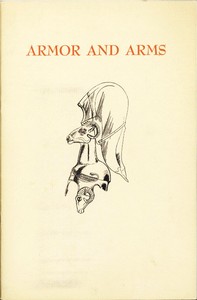
But of all the specimens of antique armor and arms in this (and possibly in any other) museum, none surpasses the helmet shown in our frontispiece. This helmet, together with fragments of armor, a shield rim and a spear point, all now in the Museum, was found in a tomb near Metaponto, in Southern Italy, where once there was a Greek colony. It is believed to date from about the middle of the sixth century B.C. The helmet is of bronze, the upper part of the bowl formed as the neck and head of a ram. This is surmounted by a great crest of silver, resting on a support of ivory. The cheek pieces of the helmet have rams’ heads in profile embossed in relief. The eyes, the horns of the main ram’s head, the ivory crest holder and part of the silver crest are restorations, but enough original fragments of the crest were found with the helmet to indicate exactly how the crest was shaped. Moreover the existence of such metallic crests is verified by a bronze statuette of similar origin (Fig. 6).
At first glance, the helmet proclaims itself a great work of sculpture, and proves that arms and armor can properly belong in a museum of art. How very well this piece deserves its place here is still more apparent on close examination. It seems incredible that so long ago a craftsman could, without any of our modern tools, have formed from a single plate of bronze such a deep and difficult forging as this helmet bowl. It is equally amazing that, in a period still considered as archaic, his artistic imagination could have produced so naturalistic yet so noble a rendition of an animal form. The technical skill and taste of the engraving and embossing are also noteworthy: the suggestion of locks of hair around the forehead, the eyebrows which terminate as snakes’ heads, the suggestions of skin texture on the rams’ heads. It is indeed one of the world’s masterpieces of armor.
Although the Greeks made their armor out of bronze, they did have knowledge of iron, at least as early as the fifth century B.C. But it was extremely difficult for them to prepare, as they had not yet discovered efficient methods of smelting it from iron ore, so that what little they had was very precious. It could not be spared for making armor, but was restricted to edged weapons where a relatively small amount of this hard new metal could be most effective. The Romans too used iron, and as their technical skill improved they used more and more of it.
After the Roman empire was overwhelmed by the barbarian hordes from the North the making of fine arms languished. It did not cease; occasionally discoveries are made of beautifully inlaid sword pommels and shield bosses belonging to the so-called “dark ages”. Sword blades too turn up occasionally, skillfully constructed of many layers of alternately hard steel and soft iron, so that they may retain a keen cutting edge yet still be tough rather than brittle.
(Steel, you will remember, is not a separate metal; it is just iron which contains from about .5% to about 2.5%, of carbon. This gives it the peculiar property that if it is heated to redness and quickly cooled, it becomes much harder than before. It also becomes more brittle. If hardened steel be heated a second time, not red hot but to a much lower temperature, and again chilled, the hardness is reduced somewhat, while the brittleness is reduced a great deal; the metal becomes tough and suitable for making into tools. This second heating and chilling is called “tempering”. Contrary to popular belief, “to temper” steel does not mean “to make it harder”. It means “to make fully hardened steel somewhat softer and much tougher”. If the iron has too much or too little carbon it cannot be hardened at all; if there is too little it is very soft and malleable and is called “wrought iron”. If there is too much carbon it is harder than mild steel, but is very brittle indeed; this is called “cast iron”.)
Chain Mail
Except for the rare finds just mentioned, we know little about the armor and arms of the period from the fall of Rome to about the twelfth century. The paintings, drawings, and statues which have survived suggest, but give no clear information. We have reason to believe that armor was made of small plates of iron attached to cloth or leather garments, or of chain mail, a fabric made of interlinked rings of iron wire. Towards the end of this period we know that chain mail was extensively employed, for it often appears, especially in England, on the engraved brass plates attached to the tombs of important people of the time (Fig. 7). The Museum has a small collection of paper impressions of these “brasses” which are well worthy of study by anyone interested in early armor. Some are exhibited on the walls of the armor gallery.
Chain mail is more interesting than it appears at first glance, and the Museum’s specimens deserve to be looked at carefully. In the first place, it was made of wire. Nowadays wire is so common that we think nothing of it; it is produced by the mile with automatic machinery. But in medieval times wire was scarce and valuable, for every bit of it had to be made by hand. At first this was done with the hammer: a billet of iron was pounded with a hammer held in one hand, while the other kept the billet rotating so that its diameter became less and less until it was small enough to be made up into links of mail. Of course, only short bits of wire could be made in this way and the diameter was naturally irregular. It was slow and tedious work, but the earliest mail was so made. Later it was found that a rod of iron could be pulled by tongs through a hole in a hardened steel plate, thus reducing its diameter and giving it a uniform thickness. By drawing it through a number of holes of progressively smaller diameter, the wire could be made quite thin and entirely uniform. Then such wire could be wound in a coil around an iron rod, and the coil then cut lengthwise with a chisel or saw giving a large number of links all of the same size. All later chain mail was so made. Such links were interlaced, each link with four others, to form a fabric much like that of a lady’s mesh bag. However, if the ends of the links were simply brought together the fabric would not be very strong. An arrow or dagger point could easily spread open a link, and penetrate to the wearer’s body. So all good chain mail was strengthened by having the ends of every link overlapped, slightly flattened, and then riveted. In that part of the world we now call “Middle East”—where the Mohammedan and Hindu cultures flourished—the rivet was a separate piece of fine wire. European chain mail is more of a mystery—principally because there is so very little old European chain mail still in existence. The probability is that a separate rivet was used as in the Eastern mail, but that its insertion was more skillfully performed. However, some scholars feel that European chain mail was welded or was riveted by a swaging process, that a special tool in the form of tongs or a pair of dies forced a small part of the lower end of the link of chain mail through a slit in the upper end and then riveted it over. Careful microscopical research on sections of links of mail could doubtless solve this problems, but who wants to cut off links from a rare and precious genuine, documented piece? As yet it may be said that no such ingenious swaging tool has been discovered, nor have we any unquestionably contemporary illustrations which would prove this theory.
In places where special strength was required, as around the throat, the rings were made of the same size but of heavier wire, which was flattened by hammering in the neighborhood of the rivet. In this way the overlapping of the rings became so close that not even a needle could penetrate the fabric (Fig. 8). In other cases, unflattened rings were used, but strands of leather were drawn through the rows, giving additional rigidity and protection. It is believed that this practice accounts for the appearance of what is known as “banded mail” in numerous monuments and engraved brasses.
Chain mail was a good protection against cuts and stabs, but it had a number of serious disadvantages. In the first place, it was expensive. Even the most skillful armorer could make it but slowly. The mail cape of Fig. 8 contains about 44,235 links, each separately forged and riveted; some complete coats of mail contain over 200,000! Forgeries of antique chain mail are practically non-existent, for they would cost more to make than genuine specimens, rare as they are, would be worth today.