Public-domain ebook
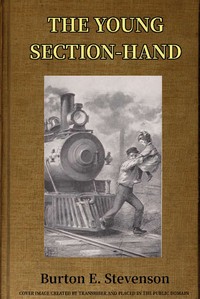
The Young Section-Hand
Language: en362 downloads on Project Gutenberg
Subjects
In: Adventure·Novels·American Literature
Public-domain ebook sourced from Project Gutenberg #62830.
Public-domain ebook
Language: en362 downloads on Project Gutenberg
Subjects
In: Adventure·Novels·American Literature
Public-domain ebook sourced from Project Gutenberg #62830.
The opening · free to read
“Excuse me, sir, but do you need a man?”
Jack Welsh, foreman of Section Twenty-one, on the Ohio division of the P. & O., turned sharply around at sound of the voice and inspected the speaker for a moment.
“A man, yes,” he said, at last. “But not a boy. This ain’t boy’s work.”
And he bent over again to sight along the rail and make sure that the track was quite level.
“Up a little!” he shouted to the gang who had their crowbars under the ties some distance ahead.
They heaved at their bars painfully, growing red in the face under the strain.
“That’ll do! Now keep it there!”
Some of the men braced themselves and held on to their bars, while others hastened to tamp some gravel solidly under the ties to keep them in place. The foreman, at leisure for a moment, turned again to the boy, who had stood by with downcast face, plainly undecided what to do. Welsh had a kindly Irish heart, which not even the irksomeness of section work could sour, and he had noted the boy’s fresh face and honest eyes. It was not an especially handsome face, yet one worth looking twice at, if only for its frankness.
“What’s yer name, sonny?” he asked.
“Allan West.”
“An’ where’d y’ come from?”
“From Cincinnati.”
The foreman looked the boy over again. His clothes were good, but the worn, dusty shoes told that the journey of nearly a hundred miles had been made on foot. He glanced again at the face—no, the boy was not a tramp; it was easy to see he was ambitious and had ideals; he was no idler—he would work if he had the chance.
“What made y’ come all that way?” asked Welsh, at last.
“I couldn’t find any work at Cincinnati,” said the boy, and it was evident that he was speaking the truth. “There’s too many people there out of work now. So I came on to Loveland and Midland City and Greenfield, but it’s the same story everywhere. I got some little jobs here and there, but nothing permanent. I thought perhaps at Wadsworth—”
“No,” interrupted the foreman. “No, Wadsworth’s th’ same way—dead as a doornail. How old’re you?” he asked, suddenly.
“Seventeen. And indeed I’m very strong,” added the boy, eagerly, as he caught a gleam of relenting in the other’s eye. “I’m sure I could do the work.”
He wanted work desperately; he felt that he had to have it, and he straightened instinctively and drew a long breath of hope as he saw the foreman examining him more carefully. He had always been glad that he was muscular and well-built, but never quite so glad as at this moment.
“It’s mighty hard work,” added Jack, reflectively. “Mighty hard. Do y’ think y’ could stand it?”
“I’m sure I could, sir,” answered Allan, his face glowing. “Just let me try.”
“An’ th’ pay’s only a dollar an’ a quarter a day.”
The boy drew a quick breath.
“That’s more than I’ve ever made regularly, sir,” he said. “I’ve always thought myself lucky if I could earn a dollar a day.”
Jack smiled grimly.
“You’ll earn your dollar an’ a quarter all right at this work,” he said. “An’ you’ll find it’s mighty little when it comes t’ feedin’ an’ clothin’ an’ lodgin’ yerself. But you’d like t’ try, would y’?”
“Yes, indeed!” said Allan.
There could be no doubting his eagerness, and as he looked at him, Jack smiled again.
“I don’t know what th’ road-master’ll say; mebbe he won’t let me keep you—I know he won’t if he sees you can’t do th’ work.” He looked down the line toward the gang, who stood leaning on their tools, enjoying the unusual privilege of a moment’s rest. “But I’m a man short,” he added. “I had t’ fire one this mornin’. We’ll try you, anyway. Put your coat an’ vest on th’ hand-car over there, git a pick an’ shovel an’ go up there with th’ gang.”
The boy flushed with pleasure and hurried away toward the hand-car, taking off his coat and vest as he went. He was back again in a moment, armed with the tools.
“Reddy, you show him the ropes!” shouted the foreman to one of the men.
“All roight, sir!” answered Reddy, easily distinguishable by the colour of his hair. “Come over here, youngster,” he added, as Allan joined the group. “Now you watch me, an’ you’ll soon be as good a section-man as they is on th’ road.”
The others laughed good-naturedly, then bent to work again, straightening the track. For this thing of steel and oak which bound the East to the West, and which, at first glance, would seem to have been built, like the Roman roads of old, to last for ever, was in constant need of attention. The great rails were of the toughest steel that forge could make; the ties were of the best and soundest oak; the gravel which served as ballast lay under them a foot deep and extended a foot on either side; the road-bed was as solid as the art of man could make it, pounded, tamped, and rolled, until it seemed strong as the eternal hills.
Yet it did not endure. For every hour of the day there swept over it, pounding at it, the monstrous freight locomotives, weighing a hundred tons, marvels of strength and power, pulling long lines of heavy cars, laden with coal and iron and grain, hurrying to give the Old World of the abundance of the New. And every hour, too, there flashed over it, at a speed almost lightning-like, the through passenger trains—the engines slim, supple, panting, thoroughbred; the lumbering mail-cars and day coaches; the luxurious Pullmans far heavier than any freight-car.
Day and night these thousands of tons hurled themselves along the rails, tearing at them at every curve, pounding them at every joint. Small wonder that they sometimes gave and spread, or broke short off, especially in zero weather, under the great pressure. Then, too, the thaws of spring loosened the road-bed and softened it; freshets undermined it and sapped the foundations of bridge and culvert. A red-hot cinder from the firebox, dropped on a wooden trestle, might start a disastrous blaze. And the least defect meant, perhaps, the loss of a score of lives.
So every day, over the whole length of the line, gangs of section-men went up and down, putting in a new tie here, replacing a defective rail there, tightening bolts, straightening the track, clearing the ditches along the road of water lest it seep under the road-bed and soften it; doing a thousand and one things that only a section-foreman would think needful. And all this that passengers and freight alike might go in safety to their destinations; that the road, at the year’s end, might declare a dividend.
There was nothing spectacular about their work; there was no romance connected with it. The passengers who caught a glimpse of them, as the train flashed by, never gave them a second thought. Their clothes were always tom and soiled; their hands hard and rough; the tugging at the bars had pulled their shoulders over into an ungraceful stoop; almost always they had the haggard, patient look of men who labour beyond their strength. But they were cogs in the great machine, just as important, in their way, as the big fly-wheel of a superintendent in the general offices; more important, sometimes, for the superintendent took frequent vacations, but the section work could not be neglected for a single day.
Allan West soon discovered what soul-racking work it was. To raise the rigid track a fraction of an inch required that muscles be strained to bursting. To replace a tie was a task that tried every nerve and sinew. The sun beat down upon them mercilessly, bringing out the sweat in streams. But the boy kept at it bravely, determined to do his part and hold the place if he could. He was under a good teacher, for Reddy, otherwise Timothy Magraw, was a thorough-going section-hand. He knew his work inside and out, and it was only a characteristic Irish carelessness, a certain unreliability, that kept him in the ranks, where, indeed, he was quite content to stay.
“Oi d’ want nothin’ else,” he would say. “Oi does me wor-rk, an’ draws me pay, an’ goes home an’ goes t’ sleep, with niver a thing t’ worrit me; while Welsh there’s a tossin’ aroun’ thinkin’ o’ what’s before him. Reespons’bility—that’s th’ thing Oi can’t stand.”
On the wages he drew as section-hand—and with the assistance, in summer, of a little “truck-patch” back of his house—he managed to keep himself and his wife and numerous children clothed; they had enough to eat and a place to sleep, and they were all as happy as possible. So that, in this case, Reddy’s philosophy seemed not a half-bad one. Certainly this freedom from responsibility left him in perpetual good-humour that lightened the work for the whole gang and made the hours pass more swiftly. Under his direction, the boy soon learned just what was expected of him, and even drew a word of commendation from his teacher.
“But don’t try to do the work all by yourself, me b’y,” he cautioned, noting Allan’s eagerness. “We’re all willing t’ help a little. If y’ try t’ lift that track by yerself, ye’ll wrinch y’r back, an’ll be laid up fer a week.”
The book keeps going
Reading is free forever. Sign up and watch scenes appear while you read.



Scenes Storieta drew for other classics.
New illustrated classics
Once or twice a month: the latest books to get full character casts, scene art, and free comic editions. No account needed.