Public-domain ebook
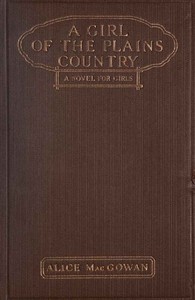
A Girl of the Plains Country
English432 downloads on Project GutenbergDownload EPUB
Public-domain ebook sourced from Project Gutenberg #63044.
Public-domain ebook
English432 downloads on Project GutenbergDownload EPUB
Public-domain ebook sourced from Project Gutenberg #63044.
The opening · free to read
The little girl on the back seat of the stage clung to one of the uprights of the vehicle as though she feared that when it stopped she would, in her enthusiasm, hurl herself bodily from it, and into this strange, interesting, dusty life of the plains country.
Hank Pearsall, manager of the Three Sorrows Ranch, who had driven the sixty miles in to Mesquite to meet the new owners coming all the way from New York, looked at her small face with its pointed chin, great black eyes under the thatch of dark curls, the repressed vitality with which she sat there giving more of an impression of urgency than most people could have given by running and jumping, and thought to himself that here was one who would all her life be a little happier, or a little more miserable, than the average.
The child returned his gaze with an eager, welcoming sort of look, and her eyes followed him as he stepped to the side of the stage. What she saw was a tall man of fifty, in the sort of clothes she was beginning to be familiar with—flannel shirt, trousers tucked into cowboy boots, and a sombrero, which he took off now, uncovering thick, crinkled hair of a wonderful black-and-silver sheen. His face was tanned and bearded; it had a look of calm about the brows and temples; but the very deep blue eyes looked as though there was always a twinkle in them. He smiled at the little girl, but spoke to the man in the front seat.
City people, the Van Brunts. Hank knew that the wife and mother had died suddenly on the way out. To the elegant gentleman, handsome, with the marks of dissipation in his face, and the sleeping baby looking so strangely out of place in his arms, Hank said a little doubtfully:
“Mr. Van Brunt? Pearsall’s my name. I’ve brought the ambulance for you folks. It’s right across there.”
The young man climbed out and shifted to get a hand free to offer, answering in a low tone, and with great courtesy:
“We’re very glad to get here, Mr. Pearsall. This is my aunt, Miss Valeria Van Brunt,” and Pearsall turned to help down a small, silver-haired, fine-featured lady with a high, delicate nose and brilliant black eyes behind gold-rimmed nose-glasses. From the tiny jet bonnet to the high-heeled slippers and silk stockings, her fashionable clothing was dim with plains dust, and as she looked about at Mesquite—just a stage station, a bunch of shanties huddled together on the bald plain—she cried accusingly:
“Dear me, Charles! Is this the place? Why, it isn’t a town at all!”
Her nephew answered something, in that low, courteous tone of his, Hank didn’t hear what.
Among them, they seemed to have forgotten that there was another passenger to disembark at Mesquite. Pearsall realized with sure, swift sympathy, that the child was used to being forgotten; he put up his arms and lifted down little Hilda Van Brunt. They were all on the ground then, their luggage dumped beside them, and the stage jingled away.
“Is there any hotel?” Miss Valeria demanded. “We ought to have some rest—and dinner.”
“It’ll be all right,” the ranch manager said quickly. “I’ve fixed for you. The ambulance is ready, and—”
“Ambulance!” Miss Valeria interrupted. “Is anybody hurt or—or sick—or anything like that? We certainly can’t—”
“An ambulance is the regular family vehicle on all the ranches around here, ma’am,” Pearsall explained. “You’ll find it mighty comfortable traveling. I aim to have you get in now and drive out a piece to a good camping place. We’ll have our supper there. There’s plenty good bedding. And we’ll get a soon start in the morning. No—well, nothing that you folks would call a hotel, here. You’ll find it better that way.”
The baby on Van Brunt’s shoulder roused without a whimper, opened big, serious blue eyes and gazed about him. This gaze lit upon the little girl, fastened there, and slowly grew into a smile. His sister pressed in close to her father’s side and reached up to pat the baby, then thrust her hand into Van Brunt’s free one, urging:
“Oh, yes, papa—please let’s go and have a picnic. It’ll be so beautiful!” And Van Brunt said:
“Certainly, Pearsall. We’re in your hands now.”
The ranch boss got his passengers into the ambulance, Miss Van Brunt and her nephew with the baby on the back seat, Hilda perched beside him on the front. As he gathered up his lines he smiled down at the tousled dark hair from which she had promptly pulled the much-trimmed small hat.
“Now for our picnic, sister,” he said. “We’re a-goin’ to have a good long one. Sixty miles long. And camp overnight on the plain. I’ve got grub a-plenty, and everything fixed.”
Hilda just gave him a smile and a little bubbling, inarticulate sound of delight in answer to this. Presently, when they went over a bump in the trail, her short legs made it necessary that she grasp his arm to keep from being shot forward over the dashboard.
“Why, here, this won’t never do!” said the old man as he stopped the ponies, tied the lines to the brake-handle, and fished out from among the supplies a box which he wedged securely beneath her feet. When they started on once more, he said in a confidential tone: “Ye see, I put you up here, because Auntie ain’t used to rough traveling; and your father, he’s got little brother to look out for. You and me can stand the jouncing, can’t we?”
With a sure instinct he had sounded the right note.
“Course we can!” the little girl echoed it with a sort of lyric jubilance. She took a long, pleased look at him, and began:
“Auntie finds it very hard to bear this kind of life. The nurse we had, she came as far as Amarillo; but she said she never in all her days saw such a flat country—and she despised it—and she just couldn’t put up with it—and there wasn’t any money ever made that would pay her to. So she went back. She went back to New York.”
“I expect this does look considerable different from New York,” Hank allowed mildly.
“Oh, it does!” Hilda glowed. “Beautifuller. I love the way it looks. Aunt Val, she’s been a great many places. But this—she wasn’t ever here before. She’s been to Europe, and to Egypt where the pyramids are, and the Sphinx that’s all getting covered up with sand. I—” Hilda sent a half-shy, questing look into the old man’s twinkling eyes—“I know a good deal about Phœnicians, and Cæsar, myself—Thor and his hammer, and Apollo, and the Holy Grail. My mother used to read to me about them.”
“Yes,” assented the ranch manager easily. “I guess them’s mostly New Yorkers and such. I haven’t the acquaintance of any of ’em.”
Hilda was silent for a few moments. This new friend was plainly somewhat given to humor. He might be jesting with her. Presently she spoke:
“But when—when my mother died in Denver, and there wasn’t anybody to take care of Burchie and me, papa telegraphed to Aunt Val and she came. It was very good of her. She doesn’t like the country—nor children, very much.” After a pause, she added, in a diminished voice, “Do you?”
“Do I what, honey?” asked Pearsall, starting a bit, for his mind had wandered from her prattle.
“Like children very much—and the country; this,” and her looks indicated the big world about them.
“Why, yes—yes, sure,” he protested. “I like this country, sister. And I certainly git a-plenty of it. But I’m a mighty lonesome person, sometimes—I’m a plumb lonesome old feller. You see there’s no child that belongs to me.”
“Haven’t you got any little girl?”
“No. No, not any little girl—” Quite a long pause, then,—“or boy either.”
Hilda moved uneasily, and her eyes went to his face and back again, plainly under the stress of acute compassion.
“Well,” she hesitated, “I’ll be your little girl, too, if—if you want me. You see, papa’s got two of us.”
The noises of the big vehicle had often made it necessary for the child to stretch up and put her rosy mouth close to her companion’s ear in speaking. Now these last words were forwarded very carefully, and with a swift, backward glance toward the rear seat. Miss Van Brunt was engaged with a smelling bottle; Van Brunt held his son on his knee and stared across the baby’s head toward a future which plainly daunted.
“That’s a bargain, sister,” said the driver. “From now on you’re my little girl, too. And I’m your Uncle Hank. There’s a few youngsters in the neighborhood, and that’s what they call me.”
That was a memorable drive, and it decided some important issues in the lives of those who made it. Sixty miles southward of Mesquite, in Lame Jones county, lay the ranch of the Three Sorrows which poor Katharine Van Brunt had bought with the remnant of her big fortune that Charley’s dissipation had left—the haven to which she had thought to bring her weak husband and her two children. Now she slept in her grave in beautiful, far-away Denver, and the husband and children were going alone toward the home she would have made possible for them, but which, without her, looked doubtful indeed. An hour—another hour—the team of cow ponies loped steadily across that high upland floor of brown plain.
“Like the sea,” whispered Hilda, enraptured. “Just like the sea, only the water’s all grass—and you can drive over it. It jounces; but you and I—we can stand the jouncing.”
The book keeps going
Reading is free forever. Sign up and watch scenes appear while you read.



Scenes Storieta drew for other classics.
New illustrated classics
Once or twice a month: the latest books to get full character casts, scene art, and free comic editions. No account needed.