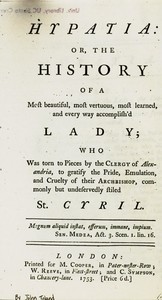
OR, THE HISTORY OF A Most beautiful, most vertuous, most learned, and every way accomplish’d LADY; WHO Was torn to Pieces by the Clergy of Alexandria, to gratify the Pride, Emulation, and Cruelty of their Archbishop, commonly but undeservedly stiled St. CYRIL.
Magnum aliquid instat, efferum, immane, impium. Sen. Medea, Act. 3. Scen. 1. lin. 16.
LONDON: Printed for M. Cooper, in Pater-noster-Row; W. Reeve, in Fleet-street; and C. Sympson, in Chancery-lane. 1753. [Price 6d.]
HYPATIA.
CHAP. I.
A general Character of the Lady; the Contrivers and Executioners of the Barbarities which she suffered; and the Authorities from whence this Story is extracted.
I am going to give a short Account, but as full as antient Books afford us Materials, of the Life and Death of Hypatia; who will ever continue the Glory of her own Sex, and the Disgrace of ours: For the Women have no less Reason to value themselves, that there existed a Lady of such rare Accomplishments, without the least Blemish, even as a Foil to her numberless Perfections; than the Men to be ashamed, that any could be found among them of so brutal and savage a Disposition, as, far from being struck with Admiration at so much Beauty, Innocence, and Knowledge, to stain their barbarous Hands with her Blood, and their impious Souls with the indelible Character of sacrilegious Murderers. A Bishop, a Patriarch, nay, a Saint, was the Contriver of so horrid a Deed, and his Clergy the Executioners of his implacable Fury. The Authors out of whom I collect my Account (and I omit none that has come to my Knowledge) were either her Contemporaries, or lived near that Age. One of them was her School-fellow, another her Scholar. But they who relate the most odious and flagitious Circumstances, are Ecclesiastical Historians; counted orthodox in their own Time, as well as eminently so by most in ours. Nor ought we to forget that several of them were Priests. To every one of them we shall do the Justice that their Sincerity or Prevarication deserves, though little remains to do in this respect; all being agreed about the principal Facts, and some differing only in Points of no great Importance. They are such Things, as, taken either Way, neither serve much to alleviate a very bad Cause, nor to aggravate what cannot be possibly made worse.
CHAP. II.
Alexandria, famous for Learning and Merchandize, but particularly for a School or Academy, of which Theon, the Father of Hypatia, was Master.
After Alexander the Great had founded Alexandria in Egypt, as the Center of Commerce in the Empire he was projecting, this City soon became a flourishing Mart for Learning as well as for Merchandize. The Fame of the Alexandrian School, and of the Alexandrian Library, reached much further than the Name of Alexander himself; or at least they carried it, whither it could never have reached without their Means. This was the most proper Tribute, that could in Gratitude be paid to the Memory of a Prince so ambitious of Glory: As indeed no private Persons, no more than Potentates, will ever do any thing praise-worthy without the Prospect of a long-lived Reputation, the most effectual Spur to laudable and arduous Undertakings. The Succession of the great Men that presided in this School, may be learnt out of the Works of those, who have purposely written on such Subjects. My Design however obliges me here to mention one of them, namely Theon, who governed that Academy with much Applause in the latter part of the fourth Century. He was particularly famous for his extensive Knowledge in Astronomy, as the Catalogues, made of such who excelled in this Science, abundantly shew. But what has contributed to render him more illustrious to all Posterity, is, that he was Father to the incomparable Hypatia; whom, according to the Custom of those Times, or rather prompted by the Encouragement he received from her own promising Genius, he educated not only in all the Qualifications belonging to her Sex; but caused her likewise to be instructed in the most abstruse Sciences, which are reputed the proper Occupation of Men, as requiring too much Labour and Application for the delicate Constitution of Women.
CHAP. III.
Philosophy not an improper Study for the Female Sex; many of them very eminent for their great Progress in the Sciences; particularly Hypatia, who excelled all the Philosophers of her Time.
That this Notion is a vulgar Prejudice, the vast Number of Ladies, who have in every Age distinguish’d themselves by their Professions or Performances in Learning, furnishes an unanswerable Argument. Whole Volumes have been written, containing nothing else but the Lives of such Women, as became eminent in all Kinds of Literature, especially in Philosophy; which, as it is the highest Perfection, so it demands the utmost Effort of human Nature. But leaving those Heroines to the Search of the Curious, I shall confine myself at present to one Object worthy all Admiration; in doing Justice to whom, I may be deemed to write the Panegyric of the whole Sex. We have the unanimous Consent of Synesius, Socrates, and Philostorgius, her Contemporaries; as likewise of Damascius, Nicephorus Gregoras, Nicephorus Callistus, Photius, Suidas, Hesychius Illustris, and others, touching the prodigious Learning and other excellent Accomplishments of Hypatia. What is still a greater Proof of the Fact, no one Person, or through Ignorance or through Envy, has ever as much as insinuated the contrary. Socrates, the Ecclesiastical Historian, an unsuspected Witness, says, That she arrived to such a Pitch of Learning, as very far to exceed all the Philosophers of her time; to which Nicephorus, also an Ecclesiastical Historian, adds, Those of other Times. Philostorgius affirms, That _she was much superior to her Father and Master Theon, in what regards Astronomy_. And Suidas, who mentions two Books of her Writing, one on the Astronomical Canon of Diophantus, and another on the Conics of Apollonius, avers, That she not only exceeded her Father in Astronomy: But further, that she understood all the other Parts of Philosophy; a Thing that will be easily credited by those, who shall peruse the Sequel of this Story, wherein nothing is advanced without competent Vouchers.
CHAP. IV.
Hypatia, succeeds in the Government of the Platonic School at Alexandria, for which she was judged Qualified, in Preference to all the Men of Learning at that Time.
And truly were not this Matter so well attested by those Writers we have just nam’d, and by others we shall presently have Occasion to alledge; yet no Body could any longer doubt of it, after being informed by the very same Persons, that Hypatia succeeded in the Government of the Platonic School at Alexandria, the Place of her Birth and Education. This was another-guess Thing, God knows, than taking the Degree of Doctor in any of the Faculties; which one or two Women have not long since done, for which they have been loaded with fulsome Elogies, tho’ producing no Effects suitable to the Titles they have so much ambitioned. But what greater Glory for a Woman, what greater Honour redounding to all Women, than to see a Lady teaching in that Chair, where Ammonius and Hierocles (to Name no more, for ’tis a Mistake in Socrates or his Transcriber to make Plotinus one of them) where so many Professors, I say, uttered the Oracles of Learning, rather as divine Intelligences than mortal Men? What infinite Merit must she have possessed, who could be preferr’d to that conspicuous Station, at a Time when Men of immense Learning abounded both at Alexandria, and in many other Parts of the Roman Empire? Wherefore, the Novelty of the Thing considered, and _Hypatia_’s Worth being universally acknowledged, ’tis no Wonder that she soon had a crouded Auditory. She explained to her Hearers, says Socrates, the several Sciences, that go under the general Name of Philosophy; for which Reason, continues he, there was a Confluence to her from all Parts, of those who made Philosophy their Delight or Study. To the same Purpose speak others; and Suidas adds, that she explained all the Philosophers, that is, all the several Sects, with the particular Tenets of their Founders, which shews an inexpressible Elevation and Capacity, each of these separately being thought a sufficient Province, to exercise the Diligence of any one Man, consummate in Letters.
CHAP. V.
Hypatia’s School crouded with Scholars of the best Fashion. She is admired for her incomparable Beauty, and the vast Extent of her Learning.
Now, I cannot but here represent to myself with Pleasure, let who will censure me for it, the Flower of all the Youth in Europe, Asia, and Africa, sitting at the Feet of a most beautiful Lady (for such we are assur’d Hypatia was) all greedily swallowing Instruction from her Mouth, and many of ’em Love from her Eyes. How she serv’d one of this last Sort, shall be told in its due Place. It was doubtless a Thing impossible, not to improve under such a Teacher; as one must be equally stupid and insensible, that could not be powerfully affected by a charming Mind in a charming Body. I am sure this Reflection is very agreeable to that Philosophy she peculiarly professed; and accordingly the Alexandrian School never flourish’d more. Her Disciples entered into a strict Tye of Intimacy with one another, stiling themselves Companions, or, as in our Colleges Fellows; which was likewise the Custom at Athens, and in other famous Seminaries of Learning. This commonly begot Effects of Benevolence thro’ the whole Course of their Lives, and sometimes Acts of Friendship very extraordinary. Hypatia was by way of Excellence named The Philosopher, altogether as much on Account of her profound Knowledge, as for her public Profession of Teaching. Nor was any Professor ever more admired by the World, or more dear to his own Scholars. Hers were as remarkable as numerous.
CHAP. VI.
An Encomium on Synesius, one of _Hypatia_’s Scholars; who, tho’ a Heathen, was consecrated a Christian Bishop.
One of these, who has preserved to us the Names of several others, is the celebrated Synesius. He was a Native of Cyrene in Africa, on the Borders of Egypt, a very ancient Greek Colony, the Birth-place of Aristippus and Carneades, which Synesius forgets not to mention in his Writings. He travelled for Improvement to his neighbouring Country of Egypt, the undoubted Mother of the Sciences, where he happily succeeded in his Studies at Alexandria under Hypatia. This Personage alone may suffice for a Specimen, of the extraordinary Spirits that she formed. If we may rely on the Judgement of no less a Man than Nicephorus Gregoras, Patriarch of Constantinople (who wrote elaborate Annotations on his Treatise of Dreams, a Piece fraught with uncommon Learning) he says, There was nothing he did not know, no Science wherein he did not excel, no Mistery in which he was not initiated or skilled, with a great deal more to this Purpose. And it must be owned, that to all the Vivacity natural to his Country, there was joined the most profound Knowledge and solid Judgement. His Works are every one highly commended, but his Epistles are admirable, as Suidas very truly remarks, and in the Opinion of Protius, as well as of Evagrius, they are elegant, agreeable, sententious, and learned. He was a Man of noble Birth, which added no less Weight to his Learning then this relieved Lustre on his Quality; as both together procured him Credit with his Superiors, Authority over his Inferiors, and Admiration from his Equals. He went upon an Embassy, which lasted three Years, to the Emperor Arcadius at Constantinople, on the Behalf of his Country; which was miserably harrassed by the auxiliary Goths and other Barbarians, but which received considerable Relief from his Solicitations. It was then that with greater Boldness than any of the Grecians (as he tells us himself) he pronounced before the Emperor, that extremely fine Oration concerning Government; which, in a Country so justly fond of Liberty as ours, I wonder has never been translated. This defect I have supplied, and will impart it to the Public on a proper Occasion. As for _Synesius_’s being consecrated Bishop of Ptolemais, notwithstanding his Protestation, that he disbelieved some of the most essential Articles of the Christian Religion, we spoke enough to that Point at the latter end of Clidophorus; only we shall observe in this Place, how Petavius, the Editor of his Works, affirms, that, in some of the Books written after his Profession of Christianity, he appears as very a Heathen as ever. But this being no Prejudice to his Parts, however it may affect his Salvation, is none of our present Business to examine; much less to adopt the pitiful Excuses, or rather Prevarications, invented by some learned Men to defend him from this Imputation. The principal is Baromius.