Public-domain ebook
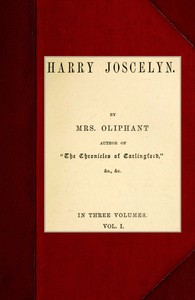
Harry Joscelyn; Vol. 1 of 3
Language: en397 downloads on Project Gutenberg
Subjects
Public-domain ebook sourced from Project Gutenberg #63142.
Public-domain ebook
Language: en397 downloads on Project Gutenberg
Subjects
Public-domain ebook sourced from Project Gutenberg #63142.
The opening · free to read
THE WHITE HOUSE.
“Mother, I wish you would not make such a fuss. It is only Harry quarrelling with father; I am sure you ought to be used to that by this time. It is just as sure to happen when they get together as that night will come after day.”
“I never can be used to it if I should live a hundred years,” said the mother thus addressed. She was walking up and down a long low room, wringing her hands as she walked, her brow contracted with anxiety and alarm. Her daughter sat tranquilly knitting, following her with eyes full of calm disapproval as her figure crossed the glow of the firelight, and went and came into the gloom on either side. The occasional sound of their low voices, the faint rustle of the elder woman’s movements, the crackle of the fire burning brightly, with now and then a small explosion and sudden blaze, were all the sounds that broke the quiet here; and this made all the more apparent a growl of deep-voiced talk in an adjoining room, with now and then a high word, almost audible, quite comprehensible in its excited tone. Father and son were in the dining-room, mother and daughter were in the parlour, a pleasant division one might have thought. Outside the wind was blowing down the valley with a force which might have suggested storm in other localities, but was natural and ordinary here. It was April, but scarcely spring as yet in the north country. “As the day lengthens the cold strengthens,” is the rule under the Shap Fells. Joan Joscelyn, the elder daughter of the house, was seated near the fire with her knitting. She was quite still save for the twinkle of her knitting needles, which caught the firelight, and her eyes, with which she watched her mother without turning her head. Her shadow upon the drawn curtains behind her was as still as though cut out of paper. She was not very young nor had she any traces of beauty in the somewhat worn and very fixed and steady lines of her face. Her dark hair was very smooth, her dress very neat, everything about her orderly and calm. A slight look of restrained impatience in her eyes, impatience mingled with disapproval, and that sort of faint contempt which children so often feel for their parents, was the only sign which the calm daughter of a nervous mother gave of her feelings. “I wish you would not make such a fuss, you ought to be used to it by this time,” was written all over her, and perhaps there was in her aspect something of that conscientious superiority felt by Mrs. Hardcastle in the play when she said, “See me, how calm I am;” but all subdued by the natural spectatorship of her position. What could she do one way or another? Then why should she excite herself for nothing? This was Joan’s sensible conclusion--and why her mother could not adopt it too was a thing she could not understand.
Mrs. Joscelyn was a pale woman of a very different aspect. She was, people thought at the first glance, not so old as her daughter, notwithstanding the advantage which a calm temperament is supposed to have over an excitable one. But it is not always true that the sensitive and self-tormenting grow old sooner than their more tranquil companions. Joan had never been young at all, so to speak. Her mother was young still in the freshness of a mind which would not be controlled by experience, which trusted every new promise and embraced every new hope, and was as bitterly disappointed by every failure of her hopes as if she had never known a disappointment before. How many pangs this temperament brought to her it would be impossible to reckon; but it kept a sentiment of youth about her, a sense of living such as her daughter in her best days never knew. Both of them however agreed in believing that this temperament was a curse and not a blessing; the daughter with heartfelt astonishment at the power which her mother possessed of tormenting herself--if indeed it were not a fictitious torture which she rather liked than otherwise, as Joan sometimes imagined with instinctive contempt; while the mother as often sighed, Oh, that she could take things as quietly, give up making a fuss, bear her troubles with the same calm as Joan. But neither could the one bring herself to the level of the other, nor either understand the different conditions which made similar action impossible. Joan for her part followed Mrs. Joscelyn’s restless movements with a wonder which she could never get over. What good could it do? Why couldn’t she sit down and get her work, and occupy herself? Even, Joan thought, it would be better to get a book and read (though that was a waste of time) and “take her mind off,” the thing that so troubled her. “Of course it was a pity that father and Harry should quarrel; but then, bless me,” Joan said to herself, “boys so often quarrel with their fathers. Why should there be more fuss made about it here than anywhere else?” She was knitting a long worsted stocking which hung down from her hands like a big grey bag; now and then she gave it a momentary look, to see that the ribs were right and the “seam” kept straight; but for the most part did not look at it at all, but watched her mother while the needles twinkled in the firelight and the big stocking leg turned round in her hands with an occasional jerk.
Meanwhile Mrs. Joscelyn walked up and down wringing her hands. The room was not very light. There were two candles on the table; but it was the brilliant glow of the fire which lit up the space in front, throwing a ruddy reflection even into the darkness of the corners. She paced all the length of the room, crossing periodically the bar of brighter light. She was rather tall, but stooped, her shoulders coming together with the ceaseless movement of her hands. Harry had put his hand into hers and vowed to her that he would avoid all subjects of quarrel, that he would give to his father the soft answer that turns away wrath. But, alas! he must have broken his word. It was not the first time nor the thirtieth time; but she felt astonished and disappointed as if up to that moment all promises had been kept to her. She was one who could not get used to suffering. It was as intolerable to her after so many years of it, so many pangs, as if she had lived the life of a spoilt child up to that moment and never known what contradiction was. The sound of the voices in the next room seemed to pierce into her heart. When they rose louder than usual she would give a low cry. Sometimes she stood still for a moment to hear the better, sometimes she spoke half to Joan, half to herself.
“I think I must go in--I must go in, I can’t let them go on like this. What if they were to lift their hands to each other, father and son, oh! father and son,” and then she made a sudden impulsive step towards the door; but paused again with a convulsive pressure together of her worn hands.
“Let them alone mother,” said Joan, “what good could you do? Only turn both of them upon yourself.”
“I know, I know,” moaned the poor lady. Then she stopped in the middle of the light. “Oh!” she said, raising her arms with a gesture which would have been theatrical had it not been so real, “oh! what have I done, what have I done that I can never have peace in my house?”
Joan never took her eyes from this moving figure, but the long grey stocking jerked and turned round in her hands, and the needles twinkled without intermission.
“You expect too much,” she said; “bless me! there’s quarrels in all houses, and lads go wrong, and all sorts of things happen. Girls too, which is worse. We should be thankful nothing of that kind has happened to us. If Will and Tom have been a little wild in their time they’ve settled down; and I’ve always behaved myself. You have a deal to be thankful for, mother. As for sons at home when the father is a hale man like father, they’re always quarrelling. What young fellows want is their own way. Father’s too young to manage Harry, he’s too strong and likely, just as good a man as any of them. That’s my opinion; so are you a deal too young. Bless me, you’re not a bit older than I am. If I wasn’t so steady I shouldn’t like it, I’d rather have an old wife that would give in to me and admire me, whatever I did--”
Joan continued the monologue with a little curve at one corner of her mouth which did duty for a smile. It was not much more than a soliloquy, if truth were told. She knew very well her mother was not listening and did not hear her. Mrs. Joscelyn had re-commenced the walk with which she was trying to subdue her restlessness. And now the voices grew louder than ever. There was a long volley of sounds, in the deepest tone, a sort of discharge of musketry, vituperation rounded off with a large mouth-filling oath or two; then a louder noise like the pushing back of chairs, one of which was thrown down with a heavy crash on the floor. Even Joan started at this noise, and her mother rushed trembling to the door. But before she could open it the door of the next room was thrown violently against the wall, and some one plunged out, rushing across the hall and flinging forth at the outer door. Another volley from the deep voice accompanied this hasty retreat. The mother turned, and hurrying across the room to the window, disappeared behind the drawn curtain that covered it. She opened the shutter as softly and quickly as her trembling would permit, and looking out watched the owner of the hasty steps disappearing, with a clang of the garden gate, in the faint wintry moonlight, which made the landscape beyond look like a white mist. She stood and watched him, shaking her head with a low moan.
“Now he is away to the village,” she said piteously, “oh, my poor lad! the ‘Red Lion,’ that’s all the fireside my Harry will get. Oh, good Lord, good Lord! and me here breaking my heart; and neither sleep nor rest will I get this night till I hear my boy come home. But it is not his fault, it’s not his fault; and what is to be the end of it?” the poor lady cried.
Joan, though she was so tranquil, was not unsympathetic. She made a little remonstrative sound with her tongue in unison with the clicking of her needles.
“Bless me! dear me! but he’ll take no harm at the ‘Red Lion;’ don’t always be thinking the worst, and making things out more dreadful than they are,” she said.
Mrs. Joscelyn emerged from the heavy dark-hued curtains with a sigh, but yet there was a certain softening in her face. Her anxiety was changed, at least, if not relieved. She came and stood in front of the fire, holding up a thin shapely foot to the red glow.
“I am so cold,” she said, with a nervous shiver.
“That’s because you will fret so, mother, and make such a deal of everything,” Joan said.
Mrs. Joscelyn made no answer to this reproach.
“My feet are like lumps of lead,” she said. “It’s more like December than April. I think I will never be warm again.”
A little sympathetic moisture softened Joan’s steady eyes. She felt towards her mother as she might have felt to a tiresome but amiable child, impatient of her vagaries, yet sorry for the useless trouble and pain the poor thing gave herself.
The book keeps going
Reading is free forever. Sign up and watch scenes appear while you read.



Scenes Storieta drew for other classics.
New illustrated classics
Once or twice a month: the latest books to get full character casts, scene art, and free comic editions. No account needed.