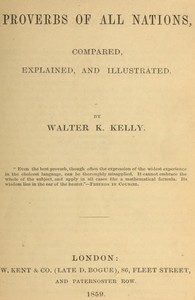
EXPLAINED, AND ILLUSTRATED.
BY WALTER K. KELLY.
"Even the best proverb, though often the expression of the widest experience in the choicest language, can be thoroughly misapplied. It cannot embrace the whole of the subject, and apply in all cases like a mathematical formula. Its wisdom lies in the ear of the hearer."--FRIENDS IN COUNCIL.
LONDON: W. KENT & CO. (LATE D. BOGUE), 86, FLEET STREET, AND PATERNOSTER ROW. 1859.
WINCHESTER: PRINTED BY HUGH BARCLAY, HIGH STREET.
PREFACE.
ENGLISH LITERATURE, in most departments the richest in Europe, is yet the only one in which there has hitherto existed no comprehensive collection of proverbs adapted to general use. To supply this deficiency is the object of the present attempt.
Dean Trench, in the preface to his "Proverbs and their Lessons," adverts to "the immense number and variety of books bearing on the subject;" but adds, that among them all he knows not one which appears to him quite suitable for all readers. "Either," he says, "they include matter which cannot fitly be placed before all--or they address themselves to the scholar alone; or, if not so, are at any rate inaccessible to the mere English reader--or they contain bare lists of proverbs, with no endeavour to compare, illustrate, or explain them--or, if they do seek to explain, they yet do it without attempting to sound the depths or measure the real significance of that which they attempt to unfold."
My own experience in this department of literature is entirely in accordance with these views. I have, therefore, during the preparation of the following pages, kept constantly before my mind the Dean of Westminster's precise statement of things to be done, and things to be avoided.
British proverbs for the most part form the basis of this collection. They are arranged according to their import and affinity, and under each of them are grouped translations of their principal equivalents in other languages, the originals being generally appended in footnotes. By this means are formed natural families of proverbs, the several members of which acquire increased significance from the light they reflect on each other. At the same time, a source of lively interest is opened for the reader, who is thus enabled to observe the manifold diversities of form which the same thought assumes, as expressed in different times and by many distinct races of men; to trace the unity in variety which pervades the oldest and most universal monuments of opinion and sentiment among mankind; and to verify for himself the truth of Lord Bacon's well-known remark, that "the genius, wit, and spirit of a nation are discovered in its proverbs."
Touching as they do upon so wide a range of human concerns, proverbs are necessarily associated with written literature. Sometimes they are created by it; much oftener they are woven into its texture. Personal anecdotes turn upon them in many instances; and not unfrequently they have figured in national history, or have helped to preserve the memory of events, manners, usages, and ideas, some of which have left little other record of their existence. From the wealth of illustration thus inviting my hand, I have sought to gather whatever might elucidate and enliven my subject without overlaying it. In this way I hope to have overcome the general objection alleged by Isaac Disraeli against collections of proverbs, on the ground of their "unreadableness." It is true, as he says, that "taking in succession a multitude of insulated proverbs, their slippery nature resists all hope of retaining one in a hundred;" but this remark, I venture to believe, does not apply to the present collection, in which proverbs are not insulated, but presented in orderly, coherent groups, and accompanied with appropriate accessories, so as to fit them for being considered with some continuity of thought.
CONTENTS.
=What's sauce for the goose is sauce for the gander.=
This is an Englishwoman's proverb. The Italian sisterhood complain that "In men every mortal sin is venial; in women every venial sin is mortal."[1] These are almost the only proverbs relating to women in which justice is done to them, all the rest being manifestly the work of the unfair sex.
=If a woman were as little as she is good, A peascod would make her a gown and a hood.=
This is Ray's version of an Italian slander.[2] The Germans say, "Every woman would rather be handsome than good;"[3] and that, indeed, "There are only two good women in the world: one of them is dead, and the other is not to be found."[4] The French, in spite of their pretended gallantry, have the coarseness to declare that "A man of straw is worth a woman of gold;"[5] and even the Spaniard, who sometimes speaks words of stately courtesy towards the female sex, advises you to "Beware of a bad woman, and put no trust in a good one."[6]
"The crab of the wood is sauce very good For the crab of the sea; But the wood of the crab is sauce for a drab, That will not her husband obey."
=A spaniel, a woman, and a walnut tree,= =The more they're beaten the better they be.=
There is Latin authority for this barbarous distich.[7] The Italians say, "Women, asses, and nuts require rough hands."[8] Much wiser is the Scotch adage,--
=Ye may ding the deil into a wife, but ye'll ne'er ding him out o' her.=
The French make the rule more general--"Take a woman's first advice, &c."[9] There is good reason for this if the Italian proverb is true, "Women are wise offhand, and fools on reflection."[10] They have less logical minds than men, but surpass them in quickness of intuition, having, says Dean Trench, "what Montaigne ascribes to them in a remarkable word, _l'esprit prime-sautier_--the leopard's spring, which takes its prey, if it be to take it at all, at the first bound." "Summer-sown corn and women's advice turn out well once in seven years,"[11] say the Germans; and the Spaniards hold that "A woman's counsel is no great thing, but he who does not take it is a fool."[12] In Servia they say, "It is sometimes right even to obey a sensible wife;" and they tell this story in elucidation of the proverb. A Herzegovinian once asked a Kadi whether a man ought to obey his wife, whereupon the Kadi answered that he needed not to do so. The Herzegovinian then continued, "My wife pressed me this morning to bring thee a pot of beef suet, so I have done well in not obeying her." Then said the Kadi, "Verily, it is sometimes right even to obey a sensible wife."
=It's nae mair ferlie to see a woman greet than to see a guse gang barefit.=--_Scotch._
That is, it is no more wonder to see a woman cry than to see a goose go barefoot. "Women laugh when they can, and weep when they will."[13] This is a French proverb, translated by Ray. Its want of rhyme makes it probable that it was never naturalised in England. The Italians say, "A woman complains, a woman's in woe, a woman is sick, when she likes to be so,"[14] and that "A woman's tears are a fountain of craft."[15]
=A woman's mind and winter wind change oft.=
"Women are variable as April weather" (German).[16] "Women, wind, and fortune soon change" (Spanish).[17] Francis I. of France wrote one day with a diamond on a window of the château of Chambord,--
"Souvent femme varie: Bien fou qui s'y fie."
"A woman changes oft: Who trusts her is right soft."
His sister, Queen Margaret of Navarre, entered the room as he was writing the ungallant couplet, and, protesting against such a slander on her sex, she declared that she could quote twenty instances of man's fickleness. Francis retorted that her reply was not to the point, and that he would rather hear one instance of woman's constancy. "Can you mention a single instance of her inconstancy?" asked the Queen of Navarre. It happened that a few weeks before this conversation a gentleman of the court had been thrown into prison upon a serious charge; and his wife, who was one of the queen's ladies in waiting, was reported to have eloped with his page. Certain it was that the page and the lady had fled, no one could tell whither. Francis triumphantly cited this case; but Margaret warmly defended the lady, and said that time would prove her innocence. The king shook his head, but promised that if, within a month, her character should be re-established, he would break the pane on which the couplet was written, and grant his sister whatever boon she might ask. Many days had not elapsed after this, when it was discovered that it was not the lady who had fled with the page, but her husband. During one of her visits to him in prison they had exchanged clothes, and he was thus enabled to deceive the jailer, and effect his escape, while the devoted wife remained in his place. Margaret claimed his pardon at the king's hand, who not only granted it, but gave a grand fête and tournament to celebrate this instance of conjugal affection. He also destroyed the pane of glass, but the calumnious saying inscribed on it has unfortunately survived.
=A woman's tongue wags like a lamb's tail.=
=A woman's strength is in her tongue.=--_Welsh._
=Arthur could not tame a woman's tongue.=--_Welsh._
"Three women and three geese make a market,"[18] according to the Italians. "Foxes are all tail, and women are all tongue;" at least, it is so in Auvergne.[19] "All women are good Lutherans," say the Danes; "they would rather preach than hear mass."[20] "A woman's tongue is her sword, and she does not let it rust," is a saying of the Chinese.
=Swine, women, and bees are not to be turned.=
"The man's a fool who thinks by force or skill To stem the torrent of a woman's will; For if she will, she will, you may depend on't, And if she won't, she won't, and there's an end on't."
The cunning of the sex is equal to their obstinacy. "Women know a point more than the devil" (Italian).[23] What wonder, then, if "A bag of fleas is easier to keep guard over than a woman?" (German).[24] The wilfulness of woman is pleasantly hinted at in the Scotch proverb, "'Gie her her will, or she'll burst,' quoth the gudeman when his wife was dinging him."
=A woman conceals what she does not know.=
=Women and bairns lein [conceal] what they kenna.=--_Scotch._
"To a woman and a magpie tell what you would speak in the market-place" (Spanish).[25] Hotspur says to his wife,--
"Constant you are, But yet a woman, and for secrecy No lady closer; for I well believe Thou wilt not utter what thou dost not know, And so far I will trust thee, gentle Kate."
But, if there is truth in proverbs, men have no right to reproach women for blabbing. A woman can at least keep her own secret. Try her on the subject of her age.