Public-domain ebook
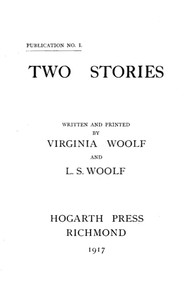
Two Stories
by Woolf, Virginia; Woolf, Leonard
Language: en1,002 downloads on Project Gutenberg
Subjects
In: Short Stories·British Literature
Public-domain ebook sourced from Project Gutenberg #63230.
Public-domain ebook
by Woolf, Virginia; Woolf, Leonard
Language: en1,002 downloads on Project Gutenberg
Subjects
In: Short Stories·British Literature
Public-domain ebook sourced from Project Gutenberg #63230.
The volume brings together two short stories by Virginia Woolf and Leonard Woolf, both noted for their explorations of early‑twentieth‑century English life. The first tale opens on a bright Sunday in early spring, when the narrator, restless and alone, steps out of his London flat to chase the promise of “the horizon” beyond the soot‑stained city. He travels to Kew, where the garden’s apple‑blossoms, the pastel sky, and a bustling tea party provide a backdrop for a chance encounter with a striking, dark‑featured stranger. Their conversation drifts from the simple pleasure of a fine day to deeper musings on belonging, faith, and memory, while the narrative weaves in vivid descriptions of the park’s flora, the genteel crowd, and the lingering melancholy of a recent loss.
The prose is unmistakably Woolish, marked by long, flowing sentences that blend interior reflection with detailed observation, capturing the rhythm of London’s seasonal moods. The voice is both lyrical and conversational, moving fluidly between the narrator’s personal yearning and the stranger’s philosophical banter. Readers who appreciate nuanced character studies, subtle social commentary, and the atmospheric quality of interwar English fiction will find these stories rewarding, especially those drawn to the interplay of place, memory, and the quiet complexities of everyday encounters.
The opening · free to read
LEONARD WOOLF.
It was a Sunday and the first day of spring, the first day on which one felt at any rate spring in the air. It blew in at my window with its warm breath, with its inevitable little touch of sadness. I felt restless, and I had nowhere to go to; everyone I knew was out of town. I looked out of my window at the black trees breaking into bud, the tulips and the hyacinths that even London could not rob of their reds and blues and yellows, the delicate spring sunshine on the asphalt, and the pale blue sky that the chimney pots broke into. I found myself muttering "damn it" for no very obvious reason. It was spring, I suppose, the first stirring of the blood.
I wanted to see clean trees, and the sun shine upon grass; I wanted flowers and leaves unsoiled by soot; I wanted to see and smell the earth; above all I wanted the horizon. I felt that something was waiting for me beyond the houses and the chimney-pots: I should find it where earth and sky meet. I didn't of course but I took the train to Kew.
If I did not find in Kew the place where earth and sky meet or even the smell of the earth, I saw at any rate the sun upon the brown bark of trees and the delicate green of grass. It was spring there, English spring with its fresh warm breath, and its pale blue sky above the trees. Yes, the quiet orderly English spring that embraced and sobered even the florid luxuriance of great flowers bursting in white cascades over strange tropical trees.
And the spring had brought the people out into the gardens, the quiet orderly English people. It was the first stirring of the blood. It had stirred them to come out in couples, in family parties, in tight matronly black dresses, in drab coats and trousers in dowdy skirts and hats. It had stirred some to come in elegant costumes and morning suits and spats. They looked at the flaunting tropical trees, and made jokes, and chaffed one another, and laughed not very loud. They were happy in their quiet orderly English way, happy in the warmth of the sunshine, happy to be among quiet trees, and to feel the soft grass under their feet. They did not run about or shout, they walked slowly, quietly, taking care to keep off the edges of the grass because the notices told them to do so.
It was very warm, very pleasant, and very tiring. I wandered cut at last through the big gates, and was waved by a man with a napkin--he stood on the pavement--through a Georgian house into a garden studded with white topped tables and dirty ricketty chairs. It was crowded with people, and I sat down at the only vacant table, and watched them eating plum-cake and drinking tea quietly, soberly, under the gentle apple-blossom.
A man came up the garden looking quickly from side to side for an empty place. I watched him in a tired lazy way. There was a bustle and roll and energy in his walk. I noticed the thickness of his legs above the knee, the arms that hung so loosely and limply by his sides as they do with people who wear loose hanging clothes without sleeves, his dark fat face and the sensual mouth, the great curve of the upper lip and the hanging lower one. A clever face, dark and inscrutable, with its large mysterious eyes and the heavy lids which went into deep folds at the corners.
He stopped near my table, looked at the empty chair and then at me, and said:
"Excuse me, Sir, but d'you mind my sitting at your table?"
I noticed the slight thickness of the voice, the overemphasis, and the little note of assertiveness in it. I said I didn't mind at all.
He sat down, leaned back in his chair, and took his hat off. He had a high forehead, black hair, and well-shaped fat hands.
"Fine day," he said, "wonderfully fine day, the finest day I ever remember. Nothing to beat a fine English spring day."
I saw the delicate apple-blossom and the pale blue sky behind his large dark head. I smiled. He saw the smile, flushed, and then smiled himself.
"You are amused," he said, still smiling, "I believe I know why."
"Yes," I said, "You knew me at once and I knew you. We show up, don't we, under the apple-blossom and this sky. It doesn't belong to us, do you wish it did?"
"Ah," he said seriously, "that's the question. Or rather we don't belong to it. We belong to Palestine still, but I'm not sure that it doesn't belong to us for all that."
"Well, perhaps your version is truer than mine. I'll take it, but there's still the question, do you wish you belonged to it?"
He wasn't a bit offended. He tilted back his chair, put one thumb in the arm-hole of his waistcoat, and looked round the garden. He showed abominably concentrated, floridly intelligent, in the thin spring air and among the inconspicuous tea-drinkers. He didn't answer my question; he was thinking, and when he spoke, he asked another:
"Do you ever go to Synagogue?"
"No."
"Nor do I, except on Yom Kippur. I still go then every year--pure habit. I don't believe in it, of course; I believe in nothing--you believe in nothing--we're all sceptics. And yet we belong to Palestine still. Funny, ain't it? How it comes out! Under the apple-blossom and blue sky, as you say, as well as--as--among the tombs."
"Among the tombs?"
"Ah, I was thinking of another man I met. He belongs to Palestine too. Shall I tell you about him?"
I said I wished he would. He put his hand's in his pockets and began at once.
The first time I saw him, I remember the day well, as well as yesterday. There was no apple-blossom then, a November day, cold, bitter cold, the coldest day I remember. It was the anniversary of my poor wife's death. She was my first wife, Rebecca. She made me a good wife, I tell you--we were very happy. (He took out a white silk pocket handkerchief, opened it with something of a flourish, and blew his nose long and loudly. Then he continued.)
I buried her at the cemetery in K--Road. You know it? What? No? You must know it, the big cemetery near the hospital. You know the hospital at any rate? Well, you turn down by it coming from the station, take the first turning to the right and the second to the left, and there you are. It's a big cemetery, very big, almost as big as Golders Green, and they keep the gardens very nicely. Well, my poor wife lies there--my first wife, I've married again, you see, and she's living and well, thank God--and I went on the first anniversary to visit the grave and put flowers on it.
There you are now, there's another curious thing. I often wonder why we do it. It's not as if it did anyone any good. I don't believe in immortality, nor do you, nor do any of us. But I go and put flowers on her grave though it won't do her any good, poor soul. It's sentiment, I suppose. No one can say we Jews haven't got that, and family affection. They're among our very strongest characteristics.
Yes, they don't like us. (He looked round at the quiet tea-drinkers.) We're too clever perhaps, too sharp, too go-ahead. Nous, that's what we've got, Nous, and they don't like it, eh? But they can't deny us our other virtues--sentiment and family affection. Now look at the Titanic disaster: who was it refused to get into the boats, unless her husband went too? Who met death hand in hand with him? Eh? A Jewess! There you are! Her children rise up and call her blessed: her husband also and he praiseth her!
I put that verse from Proverbs on my poor wife's tombstone. I remember standing in front of it, and reading it over and over again that day, the day I'm talking about. My dear Sir, I felt utterly wretched, standing there in that cold wet cemetery, with all those white tombstones round me and a damp yellow November fog. I put some beautiful white flowers on her grave.
The cemetery-keeper had given me some glass gallipots to stand the flowers in, and, as I left, I thought I would give him a shilling. He was standing near the gates. By Jove! You couldn't mistake him for anything but a Jew. His arms hung down from his shoulders in that curious, loose, limp way--you know it?--it makes the clothes look as if they didn't belong to the man who is wearing them. Clever cunning grey eyes, gold pince-nez, and a nose, by Jove, Sir, one of the best, one of those noses, white and shiny, which, when you look at it full face, seems almost flat on the face, but immensely broad, curving down, like a broad highroad from between the bushy eye-brows down over the lips. And side face, it was colossal; it stood out like an elephant's trunk with its florid curves and scrolls.
I was, as I say, utterly wretched. I wanted someone to talk to, and though I didn't expect to get much comfort out of a cemetery-keeper, I said by way of conversation, as I gave him a shilling:
"You keep these gardens very nicely."
He looked at me over the gold rims of his glasses:
"We do our best. I haven't been here long, you know, but I do my best. And a man can't do more, now can he?"
"No" I said, "he can't."
He put his head on one side, and looked at a tombstone near by: it was tilted over to one side, blackened by the soot to a dirty yellow colour, the plaster peeling off. There was one dirty scraggy evergreen growing on the grave. There was a text on the stone, I remember, something about the righteous nourishing like the bay-tree.
"Of course one can't do everything. Look at that now. Some people don't do anything, never come near the place, don't spend a penny on their graves. Then of course they go like that. It will get worse and worse, for we only bury reserves here now. Sometimes it ain't anyone's fault: families die out, the graves are forgotten. It don't look nice, but well, I say, what does it matter after all? When I'm dead, they may chuck me on the dung-hill, for all I care."
He looked down his nose at the rows and rows of dirty white grave-stones, which were under his charge, critically, with an air of hostility, as if they had done him some wrong.
"You don't perhaps believe in a life after death?" I said.
He pushed his hands well down into the pockets of his long overcoat, hugged himself together, and looked up at the yellow sky and dirty yellow houses, looming over the cemetery.
The book keeps going
Reading is free forever. Sign up and watch scenes appear while you read.



Scenes Storieta drew for other classics.
New illustrated classics
Once or twice a month: the latest books to get full character casts, scene art, and free comic editions. No account needed.