Public-domain ebook
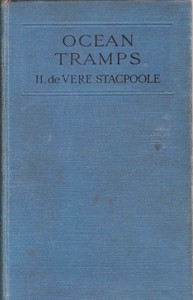
Ocean Tramps
Language: en476 downloads on Project Gutenberg
Subjects
Public-domain ebook sourced from Project Gutenberg #63269.
Public-domain ebook
Language: en476 downloads on Project Gutenberg
Subjects
Public-domain ebook sourced from Project Gutenberg #63269.
The opening · free to read
The moon was rising over Papaleete, over the Pacific Ocean and the bay where the anchor lights were spilling their amber on the water, over the palm trees and flame trees and the fragrant town from which, now clear, now sheltered by the sea wind, came the voices of girls singing to the tune of Hawaiian guitars.
Mixed with the breathing of the tepid wind in the trees, the voices of the girls and the tune of the guitars, came the murmur and sigh of the beach, the last note wanted, the last touch, to a scene of absolutely absurd and impossible loveliness, amidst which, by the water’s edge, casting a thirty-foot shadow on the hard white sand, Mr. Harman was walking, blind to the Eden around him.
Billy was on the beach in more senses than one. He was down and out, without friends, without food, without drinks, and almost without tobacco, starving in the midst of plenty, for in Papaleete, if you are a cadger, you may live for ever on the fat of the land, and not only live, but love, drink, smoke, dream under tree shadows and bathe in a sea warm with perpetual summer.
But that was not Billy’s way. This gig, four-square, blue-eyed man out of San Francisco could do anything but cadge. It wasn’t a question of morals, it was more a question of simplicity.
Billy’s morals had mostly been forgotten by Nature, or maybe they had been extracted by San Franciscans and shore-along toughs from Valparaiso up, anyhow and however that may be, the resulting vacuum seemed to have filled itself up with simplicity, not stupidity, just simplicity. The simplicity of a child that allowed him to go into the most desperate and questionable deals in ward politics and doubtful sea practice, wide-eyed, blue-eyed, and reproaching others for their moral lapses with the unchanging formula: “It don’t pay.”
“Crooked dealing don’t pay,” said Mr. Harman after some crooked deal had failed—never before.
Yet somehow, in some extraordinary way, Billy was lovable, there was nothing mean about him, and that was maybe why he couldn’t cadge, and he had behind those blue eyes and that honest-dog looking, tanned face, a power of cool, uncalculating daring that might have landed him anywhere if he had come on a decent jumping-off place.
As he turned back along the beach, the moonlight struck a figure coming towards him. It was Davis. Fate or some strange chance had thrown Davis and Harman together on the same beach at the same time, and though there was a world of difference between their faces, forms, characters and dispositions, they were alike in this—they couldn’t cadge.
Davis was a lean slip of a man with a chin tuft and a terrific past about which he was quite open. Never satisfied or driven by the craze of adventure, he had overrun two or three fortunes and had beached at Papaleete from a B.P. boat which had picked him up from a trading station down somewhere in the Paumotus, and was glad to get rid of him on the terms of a twenty-dollar loan. The captain laughed when Davis had entered the loan in a pocket-book, but it would be returned with interest some time or another if the borrower lived. That was Davis.
The one remarkable thing about this plain-looking man with the chin tuft and the flat cheek-bones was his quietude, nothing hurried or flurried him. That was perhaps the secret behind his shooting. He was more than a good shot with a revolver. He was inevitable.
“That’s done,” said Davis, coming up with the other. “Penhill and Jarvis are highballing it at the club, and their Kanakas are playing hopscotch with the hula-hula girls. What’s the matter with you? Don’t go saying you’ve got cold feet.”
“It’s not my feet,” said Mr. Harman, “but I’ve never run off with a ship before and that’s the fact, it’s not like sinkin’ her or pilin’ her. I’ve done most things, but I’ve never run off with a ship before, that’s a fact. I’ve never——”
“Oh, close up!” said Davis. “Didn’t I tell you that Penhill can’t move against us, once I get his ship out, his feet are cut off. I’m the one man living that he’s afraid of, because I’m the one man living that can put him in quod without hurting myself. This thing isn’t running off with a ship. It’s Providence.”
“How do you get at that?” asked Billy doubtfully.
“Well, look at it,” said Davis. “In he comes with the Araya, sees me, remembers the trick he played me, tries to pal up, gets a snub on the nose, puts it in his pocket, and then goes on the jag, him and Jarvis, leaving his schooner with a parcel of damn fool Kanakas in charge and me layin’ about dangerous. Kanakas, why they’re worse than that! Island boys that’ll take any white man’s bidding s’long as he feeds them with fried bananas. It’s lovely, that’s what it is, lovely——” Linking his arm in that of Harman, he was walking him along the sand towards a boat beached and left almost high and dry by the ebbing tide. To the right lay the lights of the town, and almost on the beach sand the long amber glow of the lit club. Harman, walking between the beauty of Papaleete by night and the glory of the moon upon the sea, showed no sign of haste to reach the boat.
What bothered him was, not so much the turpitude of the business, as the seeming futility and madness of it, for even in those days before wireless talked it was next to impossible to steal a ship and make good. Every port in the world is a compound eye for scrutiny, the character of a ship is inquired into as carefully as her health. Harman knew the whole business. There is a cable from Papaleete to Suva, and from Suva to ’Frisco and beyond, and to-morrow morning Penhill had only to speak and the description of the Araya and the two vanished beachcombers would be in the hands of the San Francisco authorities before noon; before night all American seaboard ports would be closed to the Araya, and by next day at noon, the British Board of Trade would seal Australia and Hong Kong. Chinese ports would be notified in “due course.”
With every bolthole blocked, the Araya might still live free for years pottering among the less-known islands, they might even pile her on some rock and make their escape in the boats, but what would be the use of all that? No, the whole thing would have been futile and ridiculous but for the one thing that made it possible—Penhill. Penhill daren’t prosecute. The schooner was his, and he was the only man who could move, and he was tied. Davis said so. Davis had given details which made the matter clear to Harman, yet still he hesitated.
They had reached the boat. It was the Araya’s, left confidingly on a beach where no man ever stole boats; there were canoes to be had in plenty, but Davis preferred the boat, he had reasons.
Harman, resting his hand on the gunnel, looked about him for a moment at the deserted beach, still undecided.
His dunnage left at the house of a native woman where he had lodged was unprocurable, he owed a bill. As he stood considering this and other matters, from the groves by the beach diffusing itself through the night, came the voice of a native singing a love song, tender, plaintive, old as Papaleete and focussing in itself all the softness and beauty that the active soul of Billy Harman had learnt to hate.
He seized the gunnel of the boat and assisted by Davis, shoved her off.
Out on the moonlit water, the town showed up fairylike, its lights twinkling amidst the moving foliage. Away on Huahine, rising steeply like a wall of velvety blackness to the stars, the lights of tiny villages showed like fireflies come to rest; fronting and beneath all this mystery and loveliness showed the definite amber glow of the club where Penhill and Jarvis were drinking themselves blind. That was Papaleete.
No port authorities, no harbour police, no sign of life but the anchor lights of a brigantine and a bêche-de-mer boat—that also was Papaleete. On board the Araya the anchor watch was snoring; kicked awake and rubbing its eyes, it jumped to the voice of white authority. The returned boat was a certificate that the new white fellow mas’rs were representatives of white fellow mas’r Penhill and Penhill’s character was an antidote to loving inquiries.
“They’re a sprightly lot,” said Harman as the main boom swung to starboard and the great sail filled, tugging at the sheet. “Monkeys to jump an’ no tongues to ask questions.”
“That’s Penhill,” said Davis, “he’s milled them into brute beasts, not that they wanted much milling, but there you are, he done his best and I reckon we’re profiting by it.”
Four days later they had cut Capricorn, discovered the sailing qualities of the Araya, and taken stock of ship and cargo. There was also Penhill’s gold watch and eighteen hundred dollars of ship’s money. Davis calculated it all up and said he reckoned that the account between him and Penhill was clear.
He said he reckoned that Penhill had deserved what he got and Harman concurred.
They sat in judgment on Penhill and brought him in guilty. Harman almost felt virtuous.
“I reckon he’ll learn it don’t pay to run crooked,” said he. “I’ve took notice that them sort of chaps always gets scragged in the end. What’s this you said he did you out of?”
“Seventy dollars, and left me on the beach,” replied Davis.
“Same as we’ve done him,” said Harman. “No, it don’t pay. It don’t pay no-how.”
South at first, then due west they made past St. Felix and heading for Caldera on the Chili coast. But Caldera was not Davis’ objective. Buenodiaz, with its land-locked harbour, its lazy ways, its pretty women and negligent Port authorities, was his idea, and smoking Penhill’s cigars under a blazing sun whilst the Araya snored along through a Reckitts’-blue sea, he expounded matters to Billy Harman.
“Sell her on the hoof,” said Davis, “innards, outwards, hump, tail and all, that’s my idea. There are ten cent mail boats that’ll take us anywhere up or down the coast, Valparaiso for choice, once we’ve got the dollars in our pockets; there’s big things to be done in Chili with a few dollars by fellows that know the ropes.”
Mr. Harman concurred.
“I’ve been done there myself,” said he, “by chaps that hadn’t cents in their pockets, let alone dollars. Skinned alive I was of every buck to my name in a faro joint at Cubra, and me winning all the time. Hadn’t got half-way down the street to my ship with a pocket full of silver dollars when I put my hand in my pocket and found nothing but stones, filled me up they had with pebbles off the beach, playin’ guitars all the time and smokin’ cigarettes and pretendin’ to hasty-manyana.
“Well, I’m not against landin’ this hooker on them, but I tell you, Bud, it’s my experience, before we comes to close grips with them we’ll be wantin’ to fix our skins on with seccotine.”
“You leave them to me,” said Bud Davis.
“I’ve known the insides and outsides of Chinks,” went on the other, “and I’ve had dealin’s with Greeks up Susun way, oyster boat Levantines will take your back teeth whiles you’re tellin’ them you don’t want buyin’ their dud pearls, but these chaps are in their own class. Jim Satan, that’s what they are, and there’s not a ’Frisco Jew sellin’ dollar watches can walk round the brim of their sombreros.”
The book keeps going
Reading is free forever. Sign up and watch scenes appear while you read.



Scenes Storieta drew for other classics.
New illustrated classics
Once or twice a month: the latest books to get full character casts, scene art, and free comic editions. No account needed.