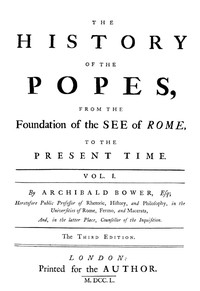
It is not only as having the Happiness to be Your subject, that I beg Your permission to lay this Book at Your feet. In whatever part of the world I had been born, or had resided, I should have desired to present it to Your Majesty, as the Great Protector of the Reformed Religion, and worthily filling that Throne, which, above any in Europe, is the chief Bulwark against the Papal Power, and all its pernicious attendants. The wonderful rise, and monstrous growth of that Power, almost to the ruin of all true Religion, and all the Civil rights of mankind, will be delineated in the course of this Work, which I flatter myself may be of some Use to the Protestant Cause. For, next to the light of the Gospel, there is nothing that Popery has more to fear, than that of historical Truth: It is a test which the pretensions and doctrines of Rome can never abide; and therefore she has used her utmost endeavours, not only to lock up the Gospel from the eyes of the Laity, and prefer her own Comments, Decrees, and Traditions, to the authority of the Scriptures, but to corrupt, disguise, and falsify History, in which necessary business her ablest pens have been employed. To take off those disguises, and discover those falsehoods, is consequently a task becoming the zeal of a good Protestant; and my intention at least, though not my performance encourages me to hope for Your Majesty’s Gracious Protection.
In the latter part of this History I shall have often the pleasure to shew, how great an Instrument under GOD the Power and Strength of this kingdom has been, to maintain and support the Reformation all over Europe. But I must also shew with concern, that from the death of our wise Queen Elizabeth, the Princes of the House of Stuart, instead of pursuing that glorious Plan, which she had traced out, were either remiss in the cause, or wholly forsook it; so that had not the Revolution providentially happened, and in consequence of it, the House of Brunswick been called to the Throne of these kingdoms, the Reformed Religion would, in all probability, have not only been lost in Great Britain, or at least under a fate of severe persecution, but would have been in great danger every-where else, from such a change in the Balance of Power as that event must have produced. The support of Your Royal Family is therefore most necessary, even upon motives of self-preservation, to every Protestant both here and abroad. May a due sense of that important connection between Your safety and Theirs, be always kept alive in their minds. May our Holy Religion continue to flourish under Your Majesty’s Care, and that of Your Royal Posterity, to the latest times. May neither the open attacks, nor secret machinations of Rome prevail against it. And may it produce all the Fruits that ought to spring from it, the truly-christian spirit of Toleration, universal charity, good morals, good learning, freedom of thought, and candour of mind. I need add no other wishes or prayers to these: They comprehend all happiness to Your Majesty, to Your Royal Family, and to my Country; and they come from the heart of,
Sir, Your Majesty’s Most Loyal, Most Faithful, And most devoted Subject,
ARCHIBALD BOWER.
------------------------------------------------------------------------ ------------------------------------------------------------------------
The Preface
The Work, which I now offer to the Public, I undertook some years since at Rome, and brought it down to the Pontificate of Victor, that is, to the close of the Second Century. As I was then a most zealous champion for the Pope’s Supremacy, which was held as an article of Faith by the body I belonged to, my chief design, when I engaged in such a work, was, to ascertain that Supremacy, by shewing, century by century, that, from the Apostles times to the present, it had ever been acknowleged by the Catholic Church. But alas! I soon perceived, that I had undertaken more than it was in my power to perform. Nay, while, in order to support and maintain this cause, I examined, with particular attention, the writings of the Apostles, and of the many pious and learned men who had flourished in the three first centuries of the church, I was so far from finding any thing that seemed the least to countenance such a doctrine, that, on the contrary, it appeared evident, beyond all dispute, that, during the above-mentioned period of time, it had been utterly unknown to the Christian world. In spite then of my endeavours to the contrary, Reason getting the better of the strongest prejudices, I began to look upon the Pope’s Supremacy, not only as a prerogative quite chimerical, but as the most impudent attempt that had ever been made: I say, in spite of my endeavours to the contrary; for I was very unwilling to give up a point, upon which I had been taught by Bellarmine, that _the whole of Christianity depended_[1]; especially in a country, where a man cannot help being afraid even of his own thoughts, since, upon the least suspicion of his only calling in question any of the received opinions, he may depend upon his being soon convinced by more cogent arguments, than any in Mood and Figure. But great is the power of truth; and at last it prevailed: I became a proselyte to the opinion which I had proposed to confute; and sincerely abjured, in my mind, that which I had ignorantly undertaken to defend.
Being thus fully convinced, that the Pope’s so much boasted Supremacy was a bold and ungodly usurpation, I could not help censuring with myself the men of learning, who had countenanced such a pretension, especially the two great champions of the Papal power Bellarmine and Baronius. Did they not see what every man, who but dips into the primitive writers, must see; what is obvious to common sense? The poor shifts they are often put to, their ridiculous evasions and cavils, their unmeaning distinctions, their wresting several passages, contrary to the plain and natural meaning of the authors they quote, and, above all, their unsatisfactory answers to the objections of the adverse party, shew but too plainly, that they wrote not from conviction, nor aimed at truth, but, perhaps, at the red Hat, which was afterwards bestowed upon them, as a reward for betraying the truth. Few have written in defence of the Pope’s Supremacy, that have not been preferred; and none perhaps who had not preferment in view. Æneas Sylvius, afterwards Pius II. being asked, before he was raised to the Papal Chair, How it happened, that, in all disputes between the Popes and the Councils, many Divines sided with the former, and very few with the latter? Because the Popes, answered he, have benefices to give, and the Councils have none. Had he been asked the same question after he was Pope, he would not perhaps have returned the same answer; but said, upon his being put in mind of it, as Gregory XIII. did afterwards on a like occasion, that, being raised higher, he saw better and farther. Those therefore who have stood up in defence of the liberty of the Church against Papal Usurpation, cannot be supposed to have had any other inducement to espouse the cause of truth, but truth itself. And this some have had the Christian courage to do even in Italy, and almost in the Pope’s hearing, at the peril of their liberty, of their lives, of all that was dear to them; as I shall have occasion to shew hereafter. But to return, in the mean time, to the present History: I no sooner found myself in a Country where truth might be uttered without danger, than I resolved to resume and pursue, in my native tongue, as soon as I recovered the use of it, the work I had begun in a foreign language. On the one side I saw the only obstruction to an undertaking, which had already cost me no small pains and labour, happily removed; while I flattered myself on the other, that as a complete History of the Popes was still wanting, such a performance might meet with a favourable reception from the public. I am well apprised, that others have, at different times, and in different languages, treated the same subject: but whether any of their several works may deserve the name of a complete, or even of a tolerable History, I leave those to judge who have perused them; and shall only say in respect to myself; that, instead of diverting me from undertaking the same province, they have more than any thing else encouraged me to it. Anastasius and Platina, the two Classics, as they are deemed, in this branch of History, have indeed given us the Lives of the Popes, from the foundation of the See of Rome to their times, but in so broken, imperfect, and unsatisfactory a manner, that from them we learn but very little, even concerning those of whom they have said most. It was not their design to write a History, but only to draw, as it were in miniature, the portraits of the Roman Bishops, by relating, in a summary way, such of their actions, as appeared to them most worthy of being recorded; and, to say the truth, they have both betrayed no less want of discernment in chusing what they should relate, than of exactness in relating what they had chosen.
Anastasius the Monk, surnamed Bibliothecarius, that is, Library-keeper, Secretary, and Chancellor of the Church of Rome (for all these employments antiently centred in one person, and were comprised under the common name of Bibliothecarius) flourished in the ninth century, under Nicolas I. Adrian II. and John VIII. He wrote a succinct account of the Bishops, who governed the Church of Rome, from St. Peter to Nicolas I. who died in 867. But the memoirs he made use of were none of the best. In his time the world was over-run with forged or corrupted Pontificals, Martyrologies, Legends, &c. which were then no less universally received, than they have been since rejected by the learned of all persuasions. However, that from these the Bibliothecarian borrowed the greater part of his materials, at least for the six first centuries, is but too apparent from his overlooking, nay, and often contradicting, the unexceptionable testimonies of contemporary writers; as will be seen in the sequel of the present History. As therefore the records, which he copied, are so justly suspected, and his own authority can be of no weight with respect to those distant times, the reader must not be surprised to find, that, in this History, I have paid no manner of regard to an author, who has been hitherto blindly followed by those, who have written on the same subject. There may indeed be some truth in what he relates; but his frequent mistakes render that truth too precarious to be relied on, unless confirmed by the concurring testimonies of other more credible and less credulous authors. However, in the times less remote from his own, I shall readily allow his authority its due weight; the rather, as he seems not to have written with a design of imposing upon others, but to have been imposed upon himself by frauds and forgeries; for he wrote in an age, when the world lay involved in the thickest mist of ignorance, when superstition and credulity triumphed without controul, and spurious pieces, filled with idle and improbable stories, had thrust every grave writer, nay, and the Gospels themselves, out of doors.