Public-domain ebook
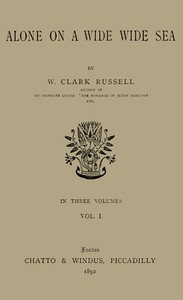
Alone on a Wide Wide Sea, Vol. 1 (of 3)
Language: en436 downloads on Project Gutenberg
Subjects
In: Adventure·Novels·British Literature
Public-domain ebook sourced from Project Gutenberg #63385.
Public-domain ebook
Language: en436 downloads on Project Gutenberg
Subjects
In: Adventure·Novels·British Literature
Public-domain ebook sourced from Project Gutenberg #63385.
The opening · free to read
In the West of England stands a city surrounded by hills. Its streets are wide, its shops fine and plentiful, and there are many handsome and some stately terraces of houses in it. In the heart of the city a gem of ecclesiastical architecture rears its admirable tower, and this fine old structure is known everywhere as the Abbey Church.
How am I to convey to one who has never beheld them the beauties of the scene when viewed from some commanding eminence--say on a rich autumn afternoon whilst the sun paints every object a tender red, and before the shadows have grown long in the valley? Orchards colour the landscape with the dyes of their fruit and leaves. White houses gleam amidst trees and tracts of vegetation. The violet shadow of a cloud floats slowly down some dark green distant slope. In the pastures cattle are feeding, and the noise of the barking of dogs ascends from the river-side. Rows and crescents of buildings hang in clusters upon the hills, blending with the various hues of the country and lending a grace as of nature’s own to the scene. The river flows with a red glitter in its breast past meadows and gardens and nestling cottages.
Many roads more or less steep conduct to the several eminences, in the valley of which peacefully stands this western city. One of them in a somewhat gentle acclivity winds eastwards, and as the wayfarer proceeds along this road he passes through a long avenue of chestnuts, which in the heat of the summer cast a delicious shade upon the dust, and here the air is so pure that it acts upon the spirits like a cordial. The ocean is not very many miles distant, and you taste the saltness of its breath in the summer breeze as it blows down the hill-sides, bringing with it a hundred perfumes, and a hundred musical sounds from the orchards and the gardens.
About a mile beyond this avenue of chestnuts there stood--I say there stood, but I do not doubt there still stands--a pretty house of a modern character, such as would be offered for letting or for selling as a ‘villa residence.’ I will speak of it as of a thing that is past. It was situated on the edge of the hill; on one side the white road wound by it; on the other side its land of about one acre and a half sloped into meadows and pastures, and this wide space of fields sank treeless, defined by hedges, well stocked in the seasons with sheep and cows and other cattle, to the silver line of the river.
Now have I brought you to my home, to the home in which I was living a little while before the strange and terrible experience that, with the help of another pen, I am about to relate befel me. And that you may thoroughly understand the story which I shall almost immediately enter upon, it is necessary that I should submit a little home picture to you.
It was a Sunday afternoon early in the month of October in a year that is all too recent for the endurance of memory. A party of four, of which one was a little boy aged two, were seated at table drinking tea in the dining-room of the house, which stood a mile beyond the chestnut avenue. Upon the hearth-rug, where was stretched a soft white blanket, lay a baby of eight months old, tossing its fat pink legs and dragging at the tube of a feeding-bottle. A lady sat at the head of the table.
This lady was in her twenty-sixth year--no one better knew the date of her birth than I. She was a handsome woman, and presently you will understand why I exhibit no reluctance in speaking of her beauty. I will be brief in my description of her, but I will invite your attention to a sketch that, in its relations to this tale, carries, as you will discover, a deeper significance than ordinarily accompanies the portraits of the heroes or heroines of romance.
She was in her twenty-sixth year, I say. Her hair was dark, not black. I am unable to find a name for its peculiar shade. It was so abundant as to be inconvenient to its owner, whose character was somewhat impatient, so that every morning’s wrestle with the long thick tresses was felt as a trouble and often as a cause of vexatious delay. Her eyebrows were thick and arched, and, as she wore her hair low, but a very little of her white well-shaped brow was to be seen. Her nose was after the Roman type, but not too large nor prominent, yet it gave her an air as though she held her head high, and it also communicated an expression of eagerness to the whole countenance. Her complexion was a delicate bloom, her mouth was small, the teeth very white and regular. She had a good figure, a little above the medium height of women, with a promise in her shape of stoutness when her years should have increased. She was simply dressed, and wore but little jewellery, no more than a thin watch-chain round her neck and a wedding-ring and two other rings on the same finger.
Such was the lady in her twenty-sixth year who sat at the head of the tea-table on that October Sunday afternoon.
At her side was her little boy, two years old. He was a beautiful child with golden hair and dark blue eyes. He sat in a high child’s chair on his mother’s left, and whilst he waited for her to feed him he beat the table with a spoon.
At the table on the right sat the husband of this lady, a man entering upon his thirty-first year. He was tall, thin, and fair, and wore small whiskers, and his eyes were a dark grey. Handsome he was not, but he had a well-bred air, and his face expressed a gentle and amiable nature.
Confronting the lady at the head of the table was her twin sister. Nearly always between twins there is a strong family likeness. I have heard of twins who resembled each other so closely as to be mistaken one for the other unless they were together, when, to be sure, there must be some subtle difference to distinguish them. There was undoubtedly a family likeness between these two sisters, but it appeared rather in their smile and in certain small tricks of posture and of gesture, and in their walk and in the attitudes which they insensibly fell into when seated; in these things lay a family likeness rather than in their faces. Their voices did not in the least resemble each other’s. That of the lady who sat at the head of the table was somewhat high-pitched; her accents were delivered with impulse and energy, no matter how trivial might be the subject on which she discoursed. Her sister, on the other hand, had a sweet, low, musical voice; she pronounced her words with a charming note of plaintiveness, and she never spoke much at a time nor often. Her hair was not so plentiful as her sister’s; it was a light bright brown, with a gloss upon it like that of the shell of a horse-chestnut, but it had not the rich deep dye of that nut. She wore it with a simplicity that was infinitely becoming to her beauty. Beautiful she was, far more so than her sister; hers was a beauty far more tender and womanly than her sister’s; you thought of the meekness and the sweetness of the dove in looking at her, and the expression of her dark-brown eyes was dove-like. She was shorter than her sister, but equally well shaped, and she was the younger.
These four sitting at table, and the little baby of eight months tossing its tiny toes shod with knitted shoes upon a blanket on the hearth-rug, formed the occupants of that parlour, and were the living details of the domestic picture that the curtain of the terrible drama of my life rises upon. The rays of the westering sun streamed upon the windows of the room, and the atmosphere was warm with crimson light. One window stood open, but the church bells had not yet begun to ring for evening service, and the peace of the English Sabbath lay upon the land outside: a peace scarcely disturbed by the distant barking of dogs, by the occasional moaning lowing of near cattle, and by the drowsy murmuring hum of bees and flies amongst the flowers under the windows.
Who were these people, and what was their name? The name of the gentleman was John Campbell, and the lady seated at the head of the table was his wife, Agnes--Agnes Campbell, whose story she herself now relates, and the sweet sister at the foot of the table was Mary Hutchinson.
I had been married at the time when my story opens a little above three years. My father was Colonel Hutchinson, of the Honourable East India Company’s service. He had distinguished himself in India in a period of terrible peril, but he had died before he could reap the reward of his valour and his judgment. He died a poor man, his whole fortune amounting to no more than five thousand pounds; but the pension my mother drew, conjointly with the interest of my father’s little fortune, enabled her to live in tolerable comfort, and after my father’s death we took up our abode in the noble old city of Bath, where we dwelt happily, making many friends and enjoying a round of simple pleasures.
Society in Bath is largely, almost wholly, composed of ladies; young men are scarce, and marriage at the best is but vaguely dreamed of, though hope is sufficiently constant to support the spirits.
It chanced that Mary and I were invited one evening to play a round game of cards at the house of a friend. We went, expecting to find the company formed entirely of girls like ourselves, with perhaps one or two old fogeys. But soon after our arrival a gentleman was shown into the room, and introduced to us as Mr. John Campbell. He was the only young man present; the other gentlemen were composed of a general, a colonel, and an admiral, whose united ages I afterwards calculated would have exactly amounted to two hundred years. I did not notice that Mr. Campbell paid me much attention that evening. Mary afterwards said he seldom had his eyes off me, but that I did not observe. On the contrary, I thought he looked very often and very admiringly at her.
Well, he saw us to the door of our house, to use the homely phrase, and on the following afternoon he called upon us; but if it was love at first sight on his part, I cannot say that he illustrated his fervour by his behaviour. He was very polite, very kind, very attentive; seemed happy in my society, was a frequent visitor at our house, would steal an hour from business to find himself an excuse to meet us in the gardens or park where we walked; but that was all.
If I had been led by the reading of novels to suppose that a man looks love when he means love, I might have searched Mr. Campbell’s face in vain for any expression of deep-seated sentiment. Indeed, after three months, I could not have said that he was more in love with me than with my sister. But by the end of that time I must own that I was very much in love with him. And though so tenderly did I love my sister that I would gladly have relinquished him to her, had her love for him been as mine, yet to no other woman could I have parted with him without the belief--which to be sure I used to laugh at after I was married--that my heart would break if he did not make me his. But my heart was not to be broken because of his not loving me and making me his, for within six months from the date of our meeting we were married, and I was the happiest girl in all England, and my sister as happy as I in my happiness.
The book keeps going
Reading is free forever. Sign up and watch scenes appear while you read.



Scenes Storieta drew for other classics.
New illustrated classics
Once or twice a month: the latest books to get full character casts, scene art, and free comic editions. No account needed.