Public-domain ebook
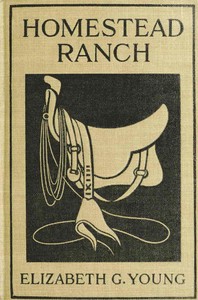
Homestead Ranch
English462 downloads on Project GutenbergDownload EPUB
Public-domain ebook sourced from Project Gutenberg #63389.
Public-domain ebook
English462 downloads on Project GutenbergDownload EPUB
Public-domain ebook sourced from Project Gutenberg #63389.
The opening · free to read
Now that the train had crossed the Rocky Mountains, most of the passengers in the tourist car were becoming bored and restless. The scenery was less absorbing; there was so much of it that even its magnificence had begun to pall! Yet Harriet Holliday was still deeply interested in everything. There were now only a few hours between her and her destination, and she had begun to look at the solitary ranches, wondering whether her brother's would look like them.
The train was passing across a seemingly endless desert, through ranges of hills without a sign of life, without water, grass or trees to break the monotony of sand and sagebrush. Once in a great while there appeared a row of buildings that, Harriet decided, must be a town--a few boxlike stores, a hotel with an imposing cement block front, a straggling line of cabins, some turf-roofed huts, some tents--then abruptly the gray solitude of the desert came into view once more.
Harriet thought of the clustering villages along the Connecticut shore--the white-and-green houses sheltered by elms, the church spire on the hill. Home seemed suddenly unutterably far away. A queer ache surged up in her throat. She felt not only endlessly far in miles from home, but in time, too--as if she had left the year 1912 behind her and come somehow into the vanished days of the first pioneers. To keep back the tears she glanced hastily up and down the car at the people who for several days had been her companions and nearly all of whom had given her glowing accounts of "the West."
A different promise had lured each, and each promise seemed golden. One family had sold the railroad shares from which they had drawn an income and had bought an apple orchard in Oregon. An old couple were on their way to California to invest in an orange grove. A newly married pair were on their way to a timber claim in Washington. A young public school teacher had given up a good position in Chicago to take a district school in Montana where she could homestead. Oddly enough, not one of those to whom Harriet had spoken so far was expecting to settle in Idaho.
Her roving glance came back along the seats. Just in front of her sat a broad-shouldered young fellow, staring out of the window. Harriet could see the boyish curve of his tanned cheek, his freckled nose and his light brown hair. Until this moment she had not set eyes on this young man. He must have got on at Ogden. While she was looking at him he turned and met her inquiring brown eyes with a pair of steady blue ones.
"This is Idaho," he said.
Then he blushed all over his tanned face. He had spoken as if the barren ranges had been mountains of gold, the gray sagebrush desert a vista of lakes and forests and gardens.
Harriet smiled. "Thank you," she said. "I'm glad to know." She was silent a moment; then, curiosity overcoming her reserve, she asked, "Have you any idea how much farther it is to Shoshone?"
"Say! You getting off there? It's the next stop." His blue eyes flashed when Harriet said she was, and he went on: "Homesteaders are coming in like rabbits round a haystack. If you're going to take up land you're wise to come now, before the best of it is all filed on."
"Oh, I'm not going to settle," Harriet protested. "I've been teaching but I have to rest my eyes so I've come out to visit my brother. He has a ranch."
"You'll stay though! I'm just back from Chicago. Took a bunch of cattle. I stayed East two months. Thought I'd like it. Not much! I'm glad I've hit the brush once more." His glance went to the window and seemed to feast hungrily on the gray plains.
Harriet looked out too, trying to see what he could find that lured him.
"You don't know where your brother's homestead is, do you?" he asked. "There are two districts that fellows are coming into; one south of those foothills yonder, the other on Camas Prairie."
"Yes. That's it, Camas Prairie. He sent me pictures of it. Here's one." She had been looking at the photographs a few moments before and drew it from her handbag.
"Well, what do you know about that!" the young fellow exclaimed as he glanced at the three pictures. "That's Sage Hen Springs, all right. There's the big quakin' asp that marks the section line. It's a landmark for all cattle men coming across the prairie."
He laughed to himself as he handed back the pictures. "I was just wondering what Joyce'll say when he finds some one has filed there. He's a sheepman and he's used that glen there for a lambing place for years. He's been meaning to put a man on there for two years anyhow. Yes, sir, I'll bet he's mad when he finds he's lost it."
"Isn't there some other place near by?"
"No, ma'am. That's just it. Water is mighty scarce in these hills anyhow, and Joyce knows the sheep have to have it."
"It's funny that he never took a homestead, living out here so long."
"Oh...." The young fellow hesitated. "He's got one," he said slowly, "but he needs a whole lot more than that."
"But I thought a man could only homestead once," Harriet said in surprise.
"That's right. But there's ways of crawling through the fence when the gate's shut. I shouldn't wonder but he'll try to buy your brother out."
"Oh, Rob would never sell! He's going to raise cattle!"
"That's good money, all right; but if Joyce wants that water hole as bad as I reckon he does, he'll put up a bunch of money for it. Well," he added, glancing out, "we're pretty near there."
Harriet began to collect her luggage and the young man rose. "My name's Garnett," he said hesitatingly. "Maybe we'll meet up on the prairie."
"Oh, I hope so," Harriet said smiling, and held out her hand.
As the train pulled into the station she looked eagerly among the crowd waiting on the platform, but did not see her brother. She had stepped down upon the cindery track and was wondering what she had better do when a voice exclaimed, "Hello, sis! Got here safely, did you?"
"Bobs!" Harriet turned quickly and then faltered. She had expected to find a slim, pale boy, wearing glasses and very fastidious about his collars and neckties. She was facing a big, sunbrowned man without glasses, who wore overalls, a gray flannel shirt, a sheepskin vest and huge laced boots; but he was smiling and he gripped her arm and kissed her.
"Bobs!" she cried. "I didn't know you."
"Don't worry," Rob told her. "You won't know yourself either in six weeks. Let's see. Got your traps? We'll go right over to Kenny's. Supper'll be ready as soon as you've washed the cinders out of your eyes. I've been so busy loading up for the ranch that I almost forgot to meet the train."
"Kenny's," the old hotel of the cattle days before there had been a town, stood just across the street, and every one who had left the train appeared to be going there for supper. When Harriet and Rob went in, a circle of miners, ranchers, sheep herders and cattle men had already gathered around the big office stove. They were gossiping in a cloud of tobacco smoke; another group hung over the clerk's desk.
Among them moved a big, red-cheeked woman, the hotel-keeper's wife. She nodded to Rob. "How do, Mr. Holliday? Your sister's come, I see."
As Rob introduced Harriet to Mrs. Kenny, the good-hearted Irishwoman held out her hand with words of welcome.
The big dining room was rigorously clean; the oilclothed floor almost reflected the electric lights; plates and glasses shone; two trim young women waited on the guests. But the guests themselves! They were all men, dressed in what Harriet mentally called "workmen's clothes"--overalls, flannel shirts, corduroy trousers, vests, but no coats. Unshaved, weatherbeaten, scarred and lined by hard experience, these men seemed as rough and repellent to the dainty, carefully reared girl as the mountains of this stranger land. As she was eating her supper, taking furtive glances down the long table, she heard a voice at her shoulder and saw Rob turn to speak to an old man.
"Axcuse me, Holliday, but it's just a worrud I'm wantin' wit' yourself."
Harriet saw beside her a little, bent old man; his legs were bowed from a life in the saddle and his neck was tanned and wrinkled from years of weathering. He wore a much mended flannel shirt, a drooping vest, and short overalls that revealed gray socks and congress gaiters much run down at heel. Harriet thought that, except for his merry, honest face, he looked very much like a tramp.
She was rather surprised when her brother introduced the old man to her. After greeting her cordially he went on to explain to Rob that he had not, after all, a fresh cow in the herd good enough to sell for a milk cow, but that he would send out the heifers he had promised and a cow that would be fresh in the fall. Then he turned to Harriet, wished her "good luck" and moved away.
"Rob, do all the cowboys dress in that--well, shabby sort of way?" Harriet asked as she and her brother left the dining room together.
"So that's what you didn't like!" said Rob. "Dan Brannan isn't a cowboy though. He's one of the richest cattle men around here. Worth over a hundred thousand, I've heard. That's why he can afford to wear old clothes."
"He might at least be neat."
The book keeps going
Reading is free forever. Sign up and watch scenes appear while you read.



Scenes Storieta drew for other classics.
New illustrated classics
Once or twice a month: the latest books to get full character casts, scene art, and free comic editions. No account needed.