Public-domain ebook
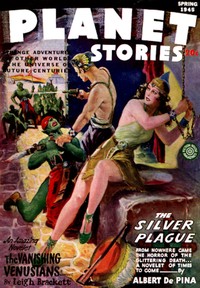
The Silver Plague
English423 downloads on Project GutenbergDownload EPUB
Public-domain ebook sourced from Project Gutenberg #63524.
Public-domain ebook
English423 downloads on Project GutenbergDownload EPUB
Public-domain ebook sourced from Project Gutenberg #63524.
The opening · free to read
Like a tide, the horror of the silver death was sweeping to inundate the inhabited worlds--with only Varon to halt its flood--and he was already marked by the plague he fought.
[Transcriber's Note: This etext was produced from Planet Stories Spring 1945. Extensive research did not uncover any evidence that the U.S. copyright on this publication was renewed.]
Fermin, the Arch-Mutant, had risen before dawn and in the garnet-colored light that passed for morning on Ganymede, repaired to the magnificent austerity of his cloister where he received an endless series of reports.
He had been reading Seville-Lorca the previous evening, delighting in the incredible pages which had been the great historians' dying contribution to their worlds, and to which he had every intention of adding an ironic anti-climax of his own. He sat in an austere Jadite chair basking in the archaic warmth of an open hearth, and watched whimsically for a moment how the darting flames reflected a bright patina on the fur of the somnolent Felirene at his feet. There was a chapter on the Jovian Societies he wanted to re-read. Not for the brilliant, facile style in which Seville-Lorca presented the distilled chronicles of the Jovian Moons, but for that deeper purport which is the notation of the heart.
Slowly, Fermin became absorbed in the photo-plastic record on the stand before him, unrolling in synchronized timing with his own reading speed.
"... It seems natural, I suppose, human nature being as it is--that the Mother Planet should maintain an attitude of supercilious aloofness. But then, it is axiomatic we can never quite love those we have wronged. And the history of the colonization of the major Jovian Moons is anything but exalting.
"When at the close of the 'Great Unrest,' as the twenty-third century is popularly known, it was definitely established that the ratio of Mutants to the grand total of normal populations was becoming an increasingly dangerous potential, they were given their choice of a charter to the newly explored Jovian Moons--a magnanimous gesture which ignored with olympic indifference the fact that at least one--Ganymede--had already a civilization of its own.
"The fact that 'Mutants' were the direct result of malignant rays and fiendish gases to which their ancestors had been exposed during the endless wars that ravaged Terra until the twenty-second century, thus damaging and modifying their chromosomes until Mutants began to appear in increasing numbers, was beside the point.
"Terra was not interested in 'origins' it was only interested in 'conclusions'--and that the sooner the better! For these silver-haired Mutants the color of old ivory, with the piercing silver-grey eyes, were a constant reminder of a recent barbarism, of fratricidal wars so damning that the new apostles of the 'Great Peace' would rather avert their minds. Besides, and this was the deciding factor, the Mutants' infinite capacity for intrigue bid fair to upset Terra's idyllic applecart!
"For in a world devoid of want, where strife had ceased under scientific control, where obedience was taken for granted, and robot-labor performed an endless variety of tasks, the blessed Mutants found ways and means of fomenting discontent with admirable logic. Had it been confined to their own ranks, it would have been no problem at all, for as yet their number were negligible--scarcely a million. But the perversity of human nature is sometimes appalling to behold; thus, under the persuasive eloquence of the Mutants, great numbers of the population of the World State began audibly to long for freedom!
"What manner of freedom they longed for, was a little difficult for the World-Council to establish. For surely, in the face of universal plenty, freedom from want had been accomplished. Since the Government was a benevolent bureaucracy staffed by scientists, oppression was unknown. And, in the absence of need for labor, thanks to robots, anyone could and did pursue such bents and careers as best suited them, within certain limits. Even pleasure palaces; rejuvenation centers--and pleasures had been socialized. The Government furnished Cinemils, mild stimulants; even the more esoteric delights to all who performed a minimum of work per day.
"Of course, we now know (thanks to three hundred years of perspective), what the World-State failed to perceive: That human beings need not so much 'Freedom' per se, as the 'conditions of freedom.' For in a Social Order where everything is provided without effort, effort itself is hopelessly circumscribed. Where the 'Will to Achievement' is subtly neutralized by an established way of life, that precludes 'friction,' such a 'Will' becomes atrophied and progress stagnant. Just as 'resignation' is an inadequate word to describe the psychic exhaustion of a wounded soldier who contemplates with indifference the immediacy of death, so is 'exaltation' insufficient to describe the spiritual change that came over large segments of the World-State under the fine ivory hands of the Mutants.
"Fortunately, the Terran Government had the wit to sense an impending explosion that would have scattered their precious 'Peace' to Kingdom Come. Thus began the hurried exodus of both Mutants and malcontents to the Jovian system of Moons. The Mutants went first by unanimous decision of the Council. They demanded to be taken to Ganymede, where with a sigh of infinite relief (on the part of the World-State), they were deposited bag and baggage. Then the malcontents were taken to Callisto, to Io, to Europa, and some even to one or two of those smaller Moons hardly bigger than asteroids. Even in exile, however, the parental hand of Terra followed its strange and wayward children.
"For we can suppose without fear of error, that the stately World-State Government felt much as an old and weary hen that has hatched a particularly bewildering brood of ducks. Deep in its heart, Terra felt a guilty sense of blame, and had anyone been able to reach that cold and battered throne, he would have discovered the angry pity and vast misgivings with which it undertook the colonization of the Moons.
"But as usual, they failed to take into consideration the 'Unpredictable,' that cosmic accident that recurs always in the lives of men--thus the World-State never even dreamed of what were later on to be called 'The Societies.'"
Fermin the Arch-Mutant paused meditatively in his reading, and wondered with faint amusement if Seville-Lorca peering from the summit of some remote Nirvana could see the stupendous drama that was being enacted in the Moons, and write on the spectral pages of a book, a new addition to his "_Annals_." But his sardonic reverie was suddenly arrested in mid-flight, for at his feet the great, golden Felirene had stirred with the preternatural awareness of the feline, its immense green eyes feral as it sensed....
In the semi-darkness, the vast crysto-plast observatory was deserted. For the fifteen Tiers devoted to the feast, overflowed with celebrants who observed the three hundredth anniversary of their landing.
All Io seemed devoted to the chief preoccupation in their lives, and, had managed to make of an historic fact, the excuse for a planet-wide bacchanale. Julian Varon removed his black silk mask and stepped to the wide balcony overhanging the plains. The frosty air was like a benison on his narrow, high-cheek-boned face, and the silence was a greater blessing still. Vaguely, he remembered the lines of an ancient poem of the twentieth century, which, by one of those ironies of Fate, had been preserved when far greater masterpieces had faded into oblivion:
"_The brandy's very good-- Blue space before me and no sign of man._"
Meditatively, he raised the fragile Bacca-glass to his lips and sipped the fiery liquor that Ionians distilled from the fragrant stems and leaves of the Clavile plant. For days, his mind had whirled in hopeless circles, and he wondered with a curious sense of detachment, whether he wouldn't be better off to leave the problem to the scientists. Only, it was his duty as much as any scientist, to search for clues.
Julian raised his eyes and gazed at the great tiers of stars that glittered above the towering, purple crags of the Mallar range. Throughout the hours of the Ionian night, the skies had been peopled by the singing of these constellations. But there had been none to hear it, for despite the ravages of the Silver Plague, the inhabited Moons of Jupiter had gone mad with revelry, as if they would distill the last drop of pleasure from each passing hour that brought them closer and closer to extinction.
"I wonder," Julian spoke aloud, "why decadence always hastens the tempo of pleasure!" He smiled acidly as his own voice sounded strange in his ears. Below him, the blazing tiers within the transparent enveloped, that was Atalanta, capital of Io, the great Galilean satellite, sparkled polychromatically in the night. In the utter silence, a stream of music faint and far away, like a tiny goblin orchestra reached him, as the icy wind plucked with elfin fingers at his cape.
And something else reached him, too, that sent the blood racing through his veins as his hypersensitive awareness of danger, translated the sound of stifled breathing behind him into a signal for action.
He whirled with a speed that was an index of Jovian training, for in the vastly lighter gravities of the Moons, his muscular coordination was breath-taking.
Before him stood a Mutant in the act of crouching for a leap. He was huge, squarely built, his silver mane standing straight out as he sprang with a murderous rush. Julian stepped aside with calculated ease and his left hand moved like a piston into the Mutant's face. There was no time to seek the hidden "electro" under his arm-pit, and power-rapiers had to be checked before entering pleasure palaces. The Mutant bellowed with fury, and rammed a right deep into Julian's ribs, then brought up his left and Julian tasted the claret in his mouth. The silver-haired, silver-eyed being was obviously fighting to kill. And suddenly Julian's vast amazement changed to a cold fury that turned his blue-grey eyes to a smouldering black.
He slid two sharp jabs into his enemy, then crossed his right and felt bone give under his fist. He moved in, blasting with both fists like rocket exhausts, and heard the Mutant's breath exploding from his body. The Mutant with supreme effort tossed a fist grenade at him, but Julian had caught the rhythm of the battle and swayed away with it; he made the assailant miss again, then with all his dynamic power sent his right hand crashing home.
He saw the Mutant, face askew, slide drunkenly to the blood-patterned floor. Then cool hands were on his wrists, on his brow, and sanity began to return again.
"Darling!" Narda said in a husky voice that was distilled music, and drew down his golden head against a priceless gown that was all blue shadows and pin-points of lights, to stanch the blood from his cut lips. Her violet eyes were bright with unshed tears, but in the odd, slurred melody of her haunting voice there was no tremor as she asked, "What on Io's happened? Were you recognized by any chance? And a Mutant...!"
The book keeps going
Reading is free forever. Sign up and watch scenes appear while you read.



Scenes Storieta drew for other classics.
New illustrated classics
Once or twice a month: the latest books to get full character casts, scene art, and free comic editions. No account needed.