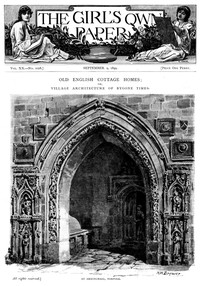
At the commencement of these papers we attempted to describe the growth of English villages and their origin as the surrounding adjuncts of the villa, or residence of the proprietor of the district, or lord of the soil. In Roman times this residence was called a villa; in Saxon and Norman times it became a castle, and after that important wave of civilisation which passed over this country in the 13th century, curtailing the power of the barons, it became “the manor house.” Now although the manor house of the 14th century was a less formidable building than the Norman castle, it was generally an important structure, and at times possessed considerable architectural beauty. Very few early manor houses are perfect now, or in any way complete, as they were nearly ruined, if not destroyed, during the “Wars of the Roses.” Sometimes, however, we may still trace fragments of them attached to modern cottages or houses. The finest fragment of the kind we know is to be seen at the little village of Arminghall, about ten miles from Norwich. A cottage or small farmhouse here possesses a doorway which is, perhaps, the finest example of domestic Gothic architecture in the country. It is improbable that it was originally intended to serve its present use as an entrance to a cottage porch, and the traditions of the place point to its having been a fragment of an ancient manor house, called by the people “The Old Hall.” Little or nothing seems to be known about it, and if it really did form a portion of some ancient mansion, with the solitary exception of this arch, everything else has disappeared. As will be seen from our sketch, it is a very elaborate work of remarkable design, and from its style there can be little doubt that it dates from the reign of Edward III. Between the mouldings which enclose the arch runs a broad band of carved foliage chiefly representing a vine, with lizards looking through the leaves. On either side of the arch are very elaborate niches in two ranges filled with statues of knights and ladies. Delicately-treated pinnacles and finials adorn these niches, and the whole work is remarkable for elegance and most finished workmanship, somewhat resembling the fragment of the hall of the bishop’s palace at Norwich. The inner doorway of the porch forms no portion of this beautiful work, as it is late Tudor, and the curious slabs over the doorway look like seventeenth century carvings. Now whether this magnificent doorway is a portion of some mansion which was completed at the same time, or whether no portion of the architectural scheme, except the doorway, was carried out, or, what is perhaps still more probable, whether after the work had been abandoned for centuries, it was again resumed, and carried out in a much plainer and less costly style, of which the inner doorway is the only existing portion, it is quite impossible to say. However the case may be, there can be no doubt that this cottage at Arminghall has the most beautiful doorway of a house in England. There is nothing whatever of interest in the cottage itself apart from its entrance.
Manor houses of the Tudor times are by no means uncommon in our English villages, but it should be pointed out that most of the mansions erected in what is called the “Elizabethan style” are really works of the time of James I., or that of Charles I.
We have now completed our task of describing the cottages and other architectural objects in English villages as they existed in bygone times, a few have escaped destruction down to our own day, but it is too much to be feared even these will, in a few years, have ceased to exist. The last half century, over which our personal recollection extends, has witnessed such a vast amount of destruction that it is difficult to believe in anything remaining at the end of another half century.
The fact is, railways, competition, machinery, the concentration of our “industrial classes” in large cities, the gradual extinction of the yeoman class, and the difficulty to obtain a bare subsistence as a small tenant farmer, have completely changed the condition of country life, and if we are ever again to have pretty villages they will be inhabited by ladies and gentlemen glad to escape occasionally from the toil of town life, and to recruit themselves in pretty cottages amidst charming scenery, pleasant gardens, and all the sweetness of a country life without its sordid toil, losses and vexations. We give a view of a home of this kind situated amidst the exquisite scenery of the Surrey hills as a pattern cottage of the future.
VARIETIES.
A LADY PHYSICIAN IN THE HOLY LAND.
A Scottish clergyman tells us that when travelling recently in Palestine, not far from the fountains of Banias, he saw the Stars and Stripes fluttering in the breeze.
“Coming up,” he says, “we found a cluster of tents, and standing to welcome us an American lady who is doing a splendid work as a physician in Palestine and northern Syria. For eight months of the year she lives in tents, moving from Acohs in the south to Baalbek in the north. Having a full medical qualification, she is the only lady permitted to practise in Syria, and as she is something of a specialist in eye diseases, she draws patients from far and near.”
WHO WANTS WORK?
We cannot all be heroes, And thrill a hemisphere With some great daring venture, Some deed that mocks at fear; But we can fill a lifetime With kindly acts and true; There’s always noble service For noble souls to do.
C. A. Mason.
TO WHICH CLASS DO YOU BELONG?—“The human race is divided,” says Oliver Wendell Holmes, “into two classes: those who go ahead and do something, and those who sit and inquire, ‘Why wasn’t it done the other way?’”
BORROWED MONEY.
Mrs. Smiley: “I make it a rule never to ask a lady to return money she has borrowed from me.”
Mrs. Dobson: “Then how do you manage to get it?”
Mrs. Smiley: “Oh, after I have waited a considerable time, if she fails to pay up, I conclude that she is not a lady, and then I ask her.”
MUSICAL PERFORMERS.—The question has recently been asked whether it is justifiable for a pianist to express to her hearers what she conceives to be the emotional characteristics of the music she is playing by facial play and gesticulations? Certainly not.
THE HOUSE WITH THE VERANDAH.
BY ISABELLA FYVIE MAYO, Author of “Other People’s Stairs,” “Her Object in Life,” etc.
In this hour of domestic desertion, Miss Latimer, remembering Mrs. Grant’s injunction, allowed Lucy to do most of the necessary housework, while she herself undertook the outdoor errands and the function of “answering” the door bell.
A letter duly arrived from Clementina’s relatives at Hull. It said little more than the telegram, save that she had come there very “worn out and ill,” having found her place “too trying” for her. She would have to take “a long rest.” It was requested that her box should be packed up and forwarded “along with the month’s wage due to her.”
Clementina had taken her departure when only twenty days of that “month” had elapsed. But Lucy resolved to take no notice of that fact, but to send the full sum. She herself packed the box and despatched it. She found therein about half a packet of mourning envelopes of such singular width of border that she showed them to Miss Latimer and Mr. Somerset, who, however, kept their own counsel on this head. Lucy did not accept Mr. Somerset’s advice about the letter in which she enclosed her postal order. He wished her to ignore all that had been discovered since Clementina’s departure and to let the whole matter drop. Lucy could not accept this as her duty. As soon as she knew of Clementina’s safety and whereabouts, she had telegraphed to Mrs. Bray’s Rachel, that her mind too might be set at ease about her old acquaintance. In return she had received a very simple, straightforward letter from Rachel, expressing sincere regret that all this trouble had been caused to Mrs. Challoner through one whom she had introduced. She reiterated the perfect respectability of the Gillespies and the high esteem in which they had been held in their own neighbourhood. Rachel was naturally deeply concerned about Clementina herself. “People can’t help going out of their mind,” she wrote, “but then it ought to be somebody’s duty to keep them from troubling others or disgracing themselves.”
The same point impressed Lucy. She felt herself bound to tell the plain truth to those who were now harbouring Clementina, and whose actions might decide that unhappy woman’s future course. Tom was inclined to say, “Let them find her out for themselves, as we had to do”—a blunt egotism which didn’t influence Lucy for a moment. Mr. Somerset gave counsels of reticence, but did not support them by any moral reasons. In fact he candidly admitted, “I am thinking chiefly of you, Mrs. Challoner, and advising you for your own sake. I don’t want you to have any more trouble. I know how—in ninety-nine cases out of a hundred—such a warning as you wish to give will be received.”
That decided Lucy. If something was right to do, then she was not to be withheld by any self-consideration from doing it.
“How should I feel,” she asked, “if some morning I open the newspaper and find that Clementina has taken another situation and has perhaps killed a baby or set a house on fire? It would be bad enough if she only made others suffer as we have done; but of merely that, of course, we should never hear.”
“‘To care for others that they may not suffer As we have suffered is divine well-doing, The noblest vote of thanks for all our sorrows,’”
quoted Miss Latimer, “and I’ve often seen that work in many ways which shallow sentimentalists do not recognise.”
“I know that few lunatics who eventually fall into terrible crime have not given forewarnings which, if heeded, might have spared them and their victims,” Mr. Somerset conceded. “But still, under all the circumstances, I feel as if it is our first duty to consider Mrs. Challoner and to save her from the abuse and insult which her interference on this score may probably bring.”
But Lucy determined on her course, and she wrote a brief account of what had happened during Clementina’s stay and had been discovered since her departure.
“At best there will be no answer,” remarked Mr. Somerset.
“That will be very rude,” said Miss Latimer.
“I shall be quite satisfied with that,” returned the gentleman significantly.
They were still awaiting developments when, a morning or two afterwards, the door bell summoned Miss Latimer to receive a bright-faced, pleasant-voiced woman, who inquired for “Mrs. Challoner,” and asked to be announced as “‘Mrs. May from Deal—Jarvist May’s widow.’ Mrs. Challoner will recollect me.”
No announcement was needed. Lucy, who, according to her new nervous habit, had been listening on the stairs, was instantly sobbing in the arms of this woman, who had gone through all the worst which Lucy had to fear. The blessed tears had come!
To “Jarvist May’s widow” Lucy found it easy to confide the fears—nay, the absolute despair—which now filled her concerning Charlie’s fate. To none of the others had she done this. They had tendered their hopes to her, and she, little knowing how faint they felt them, had made as though she could at least entertain these. In that way they had sought to comfort her, and she had accepted their kind intention, even as gentle hearts accept the little useless gifts of childish good-will. But this widowed woman brought consolation up from great depths lying calm beneath whatever wind might rise.