Public-domain ebook
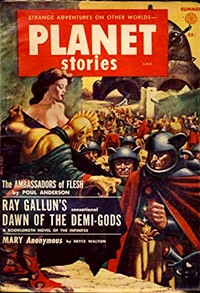
Dawn of the Demigods
English445 downloads on Project GutenbergDownload EPUB
Public-domain ebook sourced from Project Gutenberg #63797.
Public-domain ebook
English445 downloads on Project GutenbergDownload EPUB
Public-domain ebook sourced from Project Gutenberg #63797.
The opening · free to read
As unheralded as ghosts, but as significant as a new dawn of history, there came to Earth from distant Ganymede's glowing crescent--three micro-androids, minuscule beings, carrying the moot treasure of immortality.
[Transcriber's Note: This etext was produced from Planet Stories Summer 1954. Extensive research did not uncover any evidence that the U.S. copyright on this publication was renewed.]
Somebody invented the first locomotive. Then came the nuclear bomb. I guess that people were somewhat scared of newness both times.
Mostly, it has been worse ever since.
World War III was also before my day. But then fear, the protective emotion, played a reasonable part. So no cities were actually vaporized. But our side came out the victors with bombers so high-flying that they were already atom-propelled rocket ships of space. We had artificial satellites circling the Earth, and a fortress on the Moon.
I missed the first exploration of the solar system, too. There was hot Mercury, carbon dioxide-smothered Venus; Mars and its ruins and quiet colors; and what was left of Planet X, whose people destroyed the Martians in war, though their planet itself got blown all to bits in the same struggle, its fragments now being known as the asteroids.
The moons of Jupiter and Saturn were also invaded by men, as were the frozen-methane-and-ammonia blizzards of Uranus and Neptune, and the frigid mountain peaks of Pluto, farthest world of all.
There were always yarns about "Little Men" and whatnot, of course. Yet no contemporary intelligent races were found across space. There were just queer skeletons and dried up corpses millions of years old. Rusting on Mars, or floating free and broken among the Asteroids, were the remains of inventions, and other cultural evidences. Space ships had wandered as far as Pluto during those past ages, too; and various relics were left on this sphere or that. Scientific study of these things meant more speed for our technical progress in medicine, atomics, metallurgy, almost anything you could mention.
Three cheers for us, and wasn't progress wonderful? But I guess plenty of folks felt dumb and slow and confused.
I, Charles Harver, was born in Chicago, March 9th, 2014. But in my earliest, murky memories, Earth was only a place known from television, picture books, and the nostalgic remarks of my parents. We had a house and a flower and vegetable garden under a transparent airdome of dark blue plastic. The sun would shine among the stars for what I heard was fourteen days; then, for another two weeks the solar lamps would burn in the dome top.
The region where we lived was called the spaceward lunar hemisphere. Earth never shone there, but life was good. There were other kids, and school, and the usual dreams about being a bold space wanderer, speeding out to find unimagined marvels.
Dad was a technician in the research labs, just a few miles from our house by tube train. I could see the walls of the buildings in the bleak volcanic distance.
Dad used to pretend he was wrestling with me. "Charlie," he'd say, "a kid better grow up tough and flexible these days. Not mean but rugged--ready for anything. Don't ever go soft on me, Charlie, with all the temptations of modern comforts. You know one thing the labs are looking for, already? Yeah, a way to reach the planets of the stars! Maybe a means--and an engine powerful enough--really will be invented to force a shortened, interdimensional path across the light-years if the structure of space itself doesn't burst under test! Keep your head down, kid! The work is much too dangerous to be conducted on the densely populated Earth. There could be an awful blow."
Dad was a big, dark man. Talking like that, he looked thrilled and scared.
Dad used to bring Dr. Shane Lanvin out to our house to enjoy Mother's cooking, which, even considering the aid of a fine automatic kitchen, was something special. Dr. Lanvin was a wispy little man with a ragged blond mustache. He was much older than Dad; though Mom used to say that even if he was a famous scientist, he was part child in his interests; that he liked even toys.
"I always did enjoy things in miniature, Lillian," he'd admit.
Dr. Lanvin was an instrument specialist, which meant designing and assembling parts that you could scarcely see, so small were they. Once he made me a toy. It was a ball that absorbed the energy of sunshine, and rolled after me wherever I went, in the plastic-sealed, tree-lined streets of the lab staff housing area. Following the sounds of my footsteps, it seemed half alive. Maybe it was a forerunner of all that was to come.
Once Dr. Lanvin showed me a bit of quartz, like a grain of sand. It was mounted in a little round case, fitted permanently to a powerful pocket microscope. Through the scope you could see one flat face of the quartz grain, glinting. Carved on it, unmistakable, were horizontal rows of symbols.
My spine tingled. "Did you engrave them, Dr. Lanvin?" I demanded. I was eight or nine, then.
"I could have, Buggsie," he answered, using my nickname. "With a micro-manipulator and a diamond-chip. Only I didn't."
"Then who did?" I pursued.
"I wish I knew," he replied. "A friend of mine collected some two thousand of these tiny, non-ferrous--not iron-bearing, that is--meteors, floating free in the asteroid belt, and mailed them to me. My microscope revealed this unusual one. The symbols are about the same as those used by the beings of Planet X in their full-sized inscriptions, before some vast nuclear charge from Mars blew up their world. But no man can read such writing. That's about all I know--yet."
This remained almost our only information on this particular subject, until years later.
We might all have been blown to Kingdom Come there on the Moon, had any of the lab experiments gotten seriously out of control. There were minor blasts. But I lived out my time there safely. I even worked in those labs myself for several months, and by then even the stars seemed technologically nearer. Dr. Lanvin had left the Moon, accepting a professorship at the University of Chicago, and it was soon decided that I'd be sent there to complete my education.
Mom said an odd thing as she and Dad saw me off at the Tycho spaceport: "I wish we were going there, too, Charlie. I wish we had a little country place, far off from everything, and a cow and some chickens."
"That's a primitive mouthful for a modern woman, with no idea of modern farming, let alone such an antique setup," Dad chuckled. "Well, sometimes I yearn for simplicity, too. We're weak, slow-adjusting characters, left a little behind by the onrush of the times. So long, Charlie, watch yourself. It seems funny that I, an Earthian, have a son who'll actually have to get used to Earth."
Yes, that turned around situation, characteristic of our era, seemed odd. I was nervous about my big, sophisticated, native planet, as if it was an alien world! As a youngster, men had kidded me that I couldn't even endure its huge gravity!
The new university outside Chicago proper was beautiful. As arranged, I went to live at Dr. Lanvin's house. I adjusted to Terra, even though, within twenty-four hours of my arrival, there was a catastrophe that couldn't have happened in a previous age.
A freighter coming from Mars to the Chicago spaceport, couldn't decelerate. Nobody knows completely what errors of human stupidity were committed aboard the doomed ship under the goad of panic; but the Venetian Prince came down like a colossal meteor, fortunately in almost open country miles from the port. Yet a town of fifteen thousand nearby was wiped out. At Dr. Lanvin's house we felt the shock wave and the hot wind. The western horizon glowed red. No doubt a crater will stand for ages at the site of the crash.
As I watched from Doc's dooryard, all the loved romance of space and the future seemed to turn sour on me.
"Disasters that afflict innovations always affect people about the same, Charlie," Doc breathed heavily, not calling me Buggsie, now. "Train wrecks, the sinking of an ocean liner, the crash of a great plane. Now a space ship destroying a town. The magnitude just gets bigger, more terrible. There'll be an investigation, terror, grief, complaints; laws will be changed. But wider and better interplanetary travel will go marching on, with everything else."
I got in on the ground floor of Dr. Lanvin's work in advanced robotics. Robot devices had been used for various purposes for many years. But Doc had invented some much improved ones. I tried handling several. Then, like part of my obscure destiny, the chance came to really prove one of them.
Fire broke out in an unrenovated warehouse near the edge of the city one night. Doc and I drove to the scene in his autocar. There was a lot of inflammable and possibly explosive material. Someone shouted that a watchman had been overcome by smoke inside the building.
"Get him out, Charlie," Doc said. "Your body is more agile than mine; your control of an artificial one will be the same."
Sitting in the car, I put the control helmet over my head. In it there was no old fashioned television screen, and no complicated guide levers. What the helmet did was detect and sidetrack the motor impulses from my brain, broadcasting their pulsations by short wave radio to the robot, which I thus guided as if it were my own form. Similarly, sensory impressions were radioed back to the helmet, there to be reconverted into impulses directly perceptible to the sensory centers of my brain, without the intervention of my eyes, ears, and other sense organs.
So, in effect I was living in a shape not handsome in a human way, stronger than my own, and far less limited. Like a demon I stepped out of the rear seat of the autocar on asbestos-shod feet. Propelled by steel muscles energized by a motor drawing current from an atomic battery, I walked past less intricately robotized fire-fighting equipment. Through smoke that would have strangled an unprotected man, I climbed a ladder and went through a window from which a plume of flame belched. I felt no inconvenience whatsoever. There was a thrill in that--like being something super.
After that I was a bit lost. But a voice growled instructions near me--in the car, that is; I had almost forgotten that I was really there, and not in the blazing warehouse. Muffled and harrassed, it reached my own ears through the control helmet:
"Walk your robot inward, kid, for cripes sake! Follow a beam if there's no floor left! There'll be a little office room...."
I knew that it must be some chief of the fire fighters who was giving me directions.
With flames all around, I--or the machine--scrambled along a steel support, and through an opening in an inside wall. Flames had not penetrated there, and automatically I saw through the opaque smoke by radio waves sent out by, and bouncing back to eyes that belonged to the robot; parabolic antennas, they were. The images were visual and unblurred, and lacked only color.
The book keeps going
Reading is free forever. Sign up and watch scenes appear while you read.



Scenes Storieta drew for other classics.
New illustrated classics
Once or twice a month: the latest books to get full character casts, scene art, and free comic editions. No account needed.