Public-domain ebook
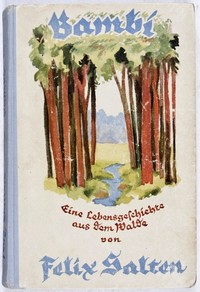
Bambi
by Felix Salten
Language: en1,371 downloads on Project Gutenberg
Subjects
In: Children & Young Adult Reading·Novels
Public-domain ebook sourced from Project Gutenberg #63849.
Public-domain ebook
by Felix Salten
Language: en1,371 downloads on Project Gutenberg
Subjects
In: Children & Young Adult Reading·Novels
Public-domain ebook sourced from Project Gutenberg #63849.
The book is a nature story that follows the very first days of a young deer named Bambi. It opens with a frantic magpie interrupting the quiet of the forest, marveling at the newborn’s ability to stand, while Bambi’s mother, weary from labor, tends to her fawn with gentle licking and warm massage. The opening passage immerses the reader in a richly described woodland: hazel, dogwood, maples and oaks form a green roof, while a chorus of birds, pheasants, woodpeckers and even a falcon fills the air. The newborn, still unable to comprehend the forest’s myriad sounds and scents, clings to his mother’s body, feeling only her warmth and the soft rustle of his coat as she whispers his name.
The narrative voice is lyrical yet straightforward, echoing early‑20th‑century Austrian storytelling. Felix Salten’s prose blends detailed observation of flora and fauna with the innocent curiosity of a fawn learning the rules of the woods. Readers who enjoy gentle, animal‑centric tales that explore growth, survival and the subtle politics of forest life will find this work rewarding, especially those who appreciate a measured, descriptive style that lets the natural world speak for itself.
The opening · free to read
“What a beautiful child!” declared the magpie.
She had rushed to the place, drawn by the breathy groans she heard forced from Bambi’s mother by her pain. Now the magpie sat on a branch nearby. “What a beautiful child!” she exclaimed again. No-one answered her and she continued speaking excitedly. “And he can already stand up and walk. That’s amazing! That’s so interesting! I’ve never seen anything like it in me life. Well, I’m still young of course, it’s only a year since I left the nest, but I expect you know that. But I think it’s wonderful. A child like this ... he’s only been born a second and he can already stand. I think it’s very noble of him. And most of all, I find that everything done by you deer is very noble. Can he already run too?”
“Of course,” answered Bambi’s mother gently. “But you’ll have to excuse me, I’m not really in a good condition to chat with you. There’s a lot that I’ve got to do ... and besides, I’m feeling quite tired.”
“Oh, don’t let me disturb you,” said the magpie, “I’m in a bit of a rush today, too! But it’s not every day that you see something like this. I ask you, think of how awkward it is for us in these things, and how much hard work! The children just can’t do anything when they first hatch from the egg, they just lie there in the nest quite helpless, and need to be looked after, they always need to be looked after I tell you, I’m sure you’ve got no idea what it’s like. It’s so much hard work just to keep ‘em fed, and they need to be protected, it’s so worrying! I ask you, just think how strenuous all that is, getting food for the children and having to watch over them at the same time so that nothing happens to ‘em; if you’re not there they can do nothing for themselves. Am I not right? And you have to wait so long before they start to move, so long before they get their first feathers and start to look a bit decent!”
“Please forgive me,” Bambi’s mother said, “I wasn’t really listening.”
The magpie flew away. “Stupid person,” she thought to herself, “noble, but stupid!”
Bambi’s mother barely noticed, and continued vigorously washing her newborn. She washed it with her tongue and so performed several tasks at once, care for his body, a warming massage and a display of her affection.
The little one staggered a little under the weight of the stroking and pushing that gently touched him all over but he remained still. His red coat, which was still a little unkempt, had a sprinkling of white on it, his face, that of a child, still looked uncomprehending, almost as if he were in a deep sleep.
All around them grew hazel bushes, dogwoods, blackthorn bushes and young elder trees. Lofty maples, beech trees and oaks created a green roof over the thicket and from the firm, dark brown ground there sprouted ferns and wild peas and sage. Down close to the ground were the leaves, close together, of violets which were already in bloom and the leaves of strawberries which were just beginning to bloom. The light of the morning sun pierced its way through the thick foliage like a web of gold. The whole forest was alive with the sounds of countless voices which pierced through the trees with an air of gay excitement. The golden oriole performed a ceaseless song of joy, the doves never stopped cooing, the blackbirds whistled, the finches flapped their wings, the tits chirruped. The quarrelsome screech of the jay penetrated through all this, and the joking laughter of the blue magpie, the bursting, metallic cook-cook of the pheasants. From time to time the harsh short celebrations of a woodpecker would pierce through all the other voices. The shrill, bright call of a falcon would penetrate across the forest canopy and the choir of crows never stopped ringing out their raucous call.
The little one understood not a one of these many songs and calls, not a word of their conversations. He was still too young to listen to them. He also paid no attention to any of the many smells that the forest breathed. He heard only the gentle rustling that ran over his coat as it was washed, warmed and kissed, and he smelt only the body of his mother, close by. He nuzzled close to this body with the lovely smell, and hungrily he searched around it and found the source of life.
As he drank his mother continued to pet him. “Bambi,” she whispered.
Every few moments she would lift her head, listen, and draw the wind in.
Then she kissed her child again, reassured and happy. “Bambi,” she repeated, “my little Bambi.”
Now, in the early summer, the trees stood still under the blue sky, they held their arms out wide and received the power of the sun as it streamed down on them. The bushes in the thicket were coming into bloom with stars of white or red or yellow. On many of them the buds of fruit were beginning to be seen again, countless many of them were sitting on the fine tips of the branches, tender and firm and resolute they looked like little clenched fists. The colourful stars of many different flowers came up out of the ground so that the earth, in the subdued light of the forest, was a spray of silent but vigorous and gay colours. Everywhere there was the smell of the fresh foliage, of flowers, of the soil and of green wood. When morning broke, and when the sun went down, the whole wood was alive with a thousand voices, and all day from morning to evening the bees sang, the wasps buzzed, and the bumble-bees buzzed even louder through the fragrant stillness.
That is what the days were like when Bambi experienced his earliest childhood.
He followed his mother onto a narrow strip that led between the bushes. It was so pleasant to walk here! The dense foliage stroked his sides gently, and bent slightly to the side. Everywhere you looked the path seemed to be blocked and locked, but it was possible to go forward in the greatest comfort. There were routes like this in the woods, they formed a network going all through the forest. Bambi’s mother knew them all, and whenever he stood in front of what seemed to him like an impenetrable green wall she would immediately seek out the place where the path began.
Bambi asked her questions. He was very fond of asking his mother questions. For him, it was the nicest thing in the world to keep asking her questions and to listen to whatever answer she gave. Bambi was not at all surprised that he always thought of one question after another to ask her. It seemed entirely natural to him; it was such a delight for him. It was also a delight to wait, curious, until the answer came, and whatever the answer was he was always satisfied with it. There were times, of course, when he did not understand the answer he was given but that was nice too because he could always ask more questions whenever he wanted to. Sometimes he stopped asking questions and that was nice too because then he was busy trying to understand what he had been told and would work it out in his own way. He often felt certain that his mother had not given him a complete answer, that she deliberately avoided saying everything she knew. And that was very nice, as it left behind a certain kind of curiosity still in him, a feeling of something mysterious and pleasing that ran through him, an expectation that made him uneasy but cheerful.
Now he asked, “Who owns this path, mother?”
His mother answered, “We do.”
Bambi continued asking. “You and me?”
“Yes.”
“Both of us?”
“Yes.”
“Just you and me?”
“No,” said his mother, “we deer own it ...”
“What’s a deer?” asked Bambi with a laugh.
His mother looked at him and laughed too. “You’re a deer, and I’m a deer. That’s what deer are. Do you understand now?”
Bambi jumped into the air with laughter. “Yes, I understand. I’m a little deer and you’re a big deer. That’s right, isn’t it.”
His mother nodded. “There, you see now.”
Bambi became serious again. “Are we the only ones, or are there other deer?”
“Certainly,” said his mother. “There are lots of them.”
“Where are they?” Bambi exclaimed.
“They’re here, they’re all around us.”
“But ... I can’t see them.”
“You’ll see them soon enough.”
“When?” Bambi’s curiosity was so strong that he stopped walking.”
“Soon.” His mother walked calmly on.
Bambi followed her. He said nothing, for he was trying to work out what she could have meant by “soon.” He reached the conclusion that “soon” was certainly not the same as “very soon.” But he was not able to decide when it was that this “soon” would stop being “soon” and start to be “a long time yet.” Suddenly he asked, “Who was it who made this path?”
“We did,” his mother replied.
Bambi was astonished. “We did? You and me?”
The book keeps going
Reading is free forever. Sign up and watch scenes appear while you read.



Scenes Storieta drew for other classics.
New illustrated classics
Once or twice a month: the latest books to get full character casts, scene art, and free comic editions. No account needed.