Public-domain ebook
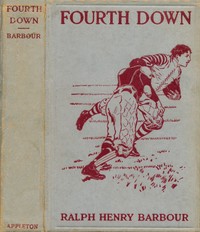
Fourth Down!
Language: en589 downloads on Project Gutenberg
Subjects
In: Children & Young Adult Reading·Novels·Sports/Hobbies
Public-domain ebook sourced from Project Gutenberg #63892.
Public-domain ebook
Language: en589 downloads on Project Gutenberg
Subjects
In: Children & Young Adult Reading·Novels·Sports/Hobbies
Public-domain ebook sourced from Project Gutenberg #63892.
The opening · free to read
“We ought to be there in about twenty minutes,” observed Arnold Deering, glancing at his watch.
One of his companions in the day-coach tossed the magazine he had been idly glancing through, to the top of the pile of suitcases beside him, yawned widely, and nodded without enthusiasm.
“If nothing happens,” he agreed.
“What’s going to happen, you chump?”
“Nothing, I suppose. Only, something might. There might be an earthquake, or the train might jump the track, or――――”
“Or you might talk sense, Frank! As for jumping the track, this old train couldn’t jump a crack in the floor! I guess you’re wishing something would happen so you wouldn’t have to go back.”
“Oh, I don’t know,” Frank Lamson answered doubtfully. “I guess I don’t mind――much. School’s all right after a day or two. It’s getting into the swing, just at first, that’s hard.”
“In the interest of education,” proclaimed Arnold pompously, “I move that summer vacations be abolished.”
“Put it the other way around,” said Frank, “and I’ll second the motion. Joking aside, though, summer vacations are fine, but they certainly spoil a chap for hard work.” He shook his head dolefully. He was a heavily-built youth of seventeen, but the heaviness was that of bone and sinew rather than of fat. With regular features, dark hair and eyes and a healthy skin, he was undeniably good-looking, although the mouth somehow suggested a sort of lazy arrogance and led an observer to the conclusion that he was not invariably as amiable as at present. He was almost painfully correct as to attire.
“Work!” sighed Arnold. “Why introduce unpleasant subjects? Ever since I struck Yardley fellows have dinned it into me that this year is the toughest of all. ‘If you think Third Class is hard,’ they said, ‘just wait till you’re in Second!’ It doesn’t sound good to me, Frank!”
“Piffle! Fellows always talk that way. Even First Class fellows shake their heads and tell you they’re the hardest worked bunch in school, and any one with a grain of sense knows that the last year’s a perfect cinch. Anyway, you don’t need to worry. You’re starting clean. I’ve got a condition to work off, worse luck. I’m the one who ought to be sore.”
“Too bad,” said Arnold sympathetically. “Still, ‘Old Tige’s’ bark is worse than his bite, Frank. You’ll get clear all right.”
“Hope so.” Frank leaned across the piled-up luggage to look through the window. A fleeting glimpse of the sun-flecked surface of Long Island Sound met his vision, and he frowned, mentally contrasting the lazy, frolic-filled days of the passing summer with the duties drawing nearer every minute. “Light House Point,” he said, nodding. “Greenburg in ten minutes.”
“If nothing happens,” quoted Arnold, with a smile. Like the boy opposite him, he was seventeen years of age, and, like him, too, he was extremely well-dressed. But in Arnold Deering’s case the attire appeared to stop short of effort, or it may have been that he was less conscious of it. While it is fair to call Frank good-looking it is no exaggeration to say that Arnold was handsome. A straight nose under a broad forehead, deep brown eyes, a mouth showing good-temper, and a round chin, all went to make up a countenance extremely attractive. He wore his dark brown hair brushed straight back, a style that went well both with his face and with his height and slenderness. There was nothing effeminate about him, though. He was not what fellows contemptuously call a “pretty boy” and his slim frame was well-muscled and suggested the best of physical condition.
“Don’t think I’d mind if something did happen,” answered Frank, rather disconsolately, “so long as it put off the evil day.”
“Cheer up, old thing!” laughed Arnold. “To-morrow you’ll be as gay as a lark, won’t he, Toby?”
The third member of the party, who, next the window, had been occupied with a magazine for the last half-hour, turned a pair of very blue eyes toward the speaker and smiled. Although he had been following the story closely, the conversation of his companions had not been entirely lost to him, and Arnold’s question had reached him between the last word on page 19 and the continuation on an elusive page 134. “I’d never expect to see Frank as gay as a lark,” he replied readily. “If you had said as happy as a seagull, though――――” He returned to the search for page 134.
“Seagull?” protested Arnold. “The silly things never are happy! They’re always crying and making a fuss.”
“Oh, they’re happy enough,” said the other, with a twinkle in his eyes, “but they don’t want to think so!”
Arnold laughed and Frank said, “You go to the dickens, Toby,” but grinned a little as he said it. There had been a time when he would have taken Toby Tucker’s jest not so amiably, but closer intimacy with that youth had rendered his dignity less tender.
“Toby’s got you sized up, Frank,” laughed Arnold. “You do like to grouch a bit, you know.”
“We all do, at times,” said Toby, comfortingly. He found the page he was seeking and settled back again. But Arnold plucked the magazine from his hands and tossed it to the opposite seat.
“We’re nearly in Greenburg, T. Tucker,” he said. “Sit up like a gentleman and talk to us.”
Toby looked reproachfully at his friend and regretfully at the magazine. Then he smiled. He had rather a remarkable smile, had Toby. It made you forget that his nose was too short, his chin almost aggressively square, his tanned face too liberally freckled, his hair undeniably red. It made him almost good-looking and eminently likable. Tobias Tucker’s smile was a valuable asset to him, although he didn’t know it.
“What shall I talk about?” he asked. “Want me to tell you a dreadfully funny story?”
“What’s it about?” demanded Arnold, suspiciously.
“About old Cap’n Gaines,” replied Toby, innocently. “He――――”
“_Help!_” cried the others with unflattering unanimity.
“If you ever try to tell that again, Toby,” added Arnold, very stern and very solemn, “we’ll――――”
But what was to happen in such an event was never told, for what happened at that moment very effectually ended Arnold’s discourse. There was a terrific grinding of brakes, a loud hissing sound, and an irresistible tendency on the part of every one and everything in the day-coach to proceed hurriedly to the front door. Because of various obstructions none succeeded, but all did their best. Arnold landed in Frank’s lap and Toby draped himself over the piled-up luggage, his head hanging over the back of the seat ahead. A cloud of unsuspected dust filled the car as, with a series of emphatic and uncomfortable jerks, the train came to a standstill. To the accompaniment of a vocal confusion of cries, exclamations, and grunts, the occupants of the car disentangled themselves from each other or picked themselves from the floor.
“Get――off――me!” groaned Frank. “You’ve――broken――my neck!”
“What was it?” gasped Arnold, relieving the other of his unwelcome embrace. “Are we wrecked?”
“I am, anyway!” growled Frank. “Where’s my hat? Oh, thanks!” He accepted it from a dazed occupant of the seat ahead. Toby Tucker retired from his graceful position atop the suitcases and observed Arnold questioningly, his straw hat tilted down to the bridge of his nose. Arnold chuckled. “Guess it was Frank’s earthquake,” he said.
“Keep your places!” admonished a trainman, putting his head in the forward door. “Obstruction on the track! No danger!”
“Gee!” muttered Toby. “That was some stop, fellows!”
“It sure was!” agreed Frank emphatically, feeling doubtfully of his neck. “It nearly snapped my head off! And then Arn landed on me like a ton of bricks.”
“Let’s go see,” said Toby. “What’s this?” He raised a foot from which dangled Arnold’s hat. “I’m sorry. Sort of mussed, I’m afraid.”
Arnold took it, viewed it ruefully and put it on. “It’s all Frank’s fault,” he grumbled as he joined the exodus through the nearer door. “He insisted that something was going to happen, and it did!”
How near that something had come to being a catastrophe was revealed to them when they pushed their way through the throng at the head of the train. Not eighty feet distant from the pilot of the throbbing locomotive stood a lone box-car, its forward truck lodged against its rear. It was loaded and sealed and marked “Greenburg.” A curve in the track behind had hidden it from the fireman’s sight until there had remained just space in which to avert a collision.
“How do you suppose it got here?” asked Frank.
The book keeps going
Reading is free forever. Sign up and watch scenes appear while you read.



Scenes Storieta drew for other classics.
New illustrated classics
Once or twice a month: the latest books to get full character casts, scene art, and free comic editions. No account needed.