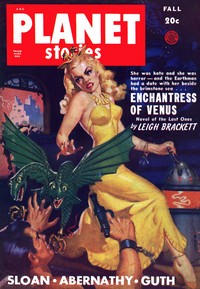
Earth set itself grimly to meet them with corrosive fire, determined to blast them back to the stars. But they erred in thinking the Old Ones were too big to be clever.
[Transcriber's Note: This etext was produced from Planet Stories Fall 1949. Extensive research did not uncover any evidence that the U.S. copyright on this publication was renewed.]
In the last hours the star ahead had grown brighter by many magnitudes, and had changed its color from a dazzling blue through white to the normal yellow, of a GO sun. That was the Doppler effect as the star's radial velocity changed relative to the Quest III, as for forty hours the ship had decelerated.
They had seen many such stars come near out of the galaxy's glittering backdrop, and had seen them dwindle, turn red and go out as the Quest III drove on its way once more, lashed by despair toward the speed of light, leaving behind the mockery of yet another solitary and lifeless luminary unaccompanied by worlds where men might dwell. They had grown sated with the sight of wonders--of multiple systems of giant stars, of nebulae that sprawled in empty flame across light years.
But now unwonted excitement possessed the hundred-odd members of the Quest III's crew. It was a subdued excitement; men and women, they came and stood quietly gazing into the big vision screens that showed the oncoming star, and there were wide-eyed children who had been born in the ship and had never seen a planet. The grownups talked in low voices, in tones of mingled eagerness and apprehension, of what might lie at the long journey's end. For the Quest III was coming home; the sun ahead was the Sun, whose rays had warmed their lives' beginning.
Knof Llud, the Quest III's captain, came slowly down the narrow stair from the observatory, into the big rotunda that was now the main recreation room, where most of the people gathered. The great chamber, a full cross-section of the vessel, had been at first a fuel hold. At the voyage's beginning eighty per cent of the fifteen-hundred-foot cylinder had been engines and fuel; but as the immense stores were spent and the holds became radioactively safe, the crew had spread out from its original cramped quarters. Now the interstellar ship was little more than a hollow shell.
Eyes lifted from the vision screens to interrogate Knof Llud; he met them with an impassive countenance, and announced quietly, "We've sighted Earth."
A feverish buzz arose; the captain gestured for silence and went on, "It is still only a featureless disk to the telescope. Zost Relyul has identified it--no more."
But this time the clamor was not to be settled. People pressed round the screens, peering into them as if with the naked eye they could pick out the atom of reflected light that was Earth, home. They wrung each other's hands, kissed, shouted, wept. For the present their fears were forgotten and exaltation prevailed.
Knof Llud smiled wryly. The rest of the little speech he had been about to make didn't matter anyway, and it might have spoiled this moment.
He turned to go, and was halted by the sight of his wife, standing at his elbow. His wry smile took on warmth; he asked, "How do you feel, Lesra?"
She drew an uncertain breath and released it in a faint sigh. "I don't know. It's good that Earth's still there." She was thinking, he judged shrewdly, of Knof Jr. and Delza, who save from pictures could not remember sunlit skies or grassy fields or woods in summer....
He said, with a touch of tolerant amusement, "What did you think might have happened to Earth? After all, it's only been nine hundred years."
"That's just it," said Lesra shakily. "Nine hundred years have gone by--_there_--and nothing will be the same. It won't be the same world we left, the world we knew and fitted in...."
The captain put an arm round her with comforting pressure. "Don't worry. Things may have changed--but we'll manage." But his face had hardened against registering the gnawing of that same doubtful fear within him. He let his arm fall. "I'd better get up to the bridge. There's a new course to be set now--for Earth."
He left her and began to climb the stairway again. Someone switched off the lights, and a charmed whisper ran through the big room as the people saw each other's faces by the pale golden light of Earth's own Sun, mirrored and multiplied by the screens. In that light Lesra's eyes gleamed with unshed tears.
Captain Llud found Navigator Gwar Den looking as smug as the cat that ate the canary. Gwar Den was finding that the actual observed positions of the planets thus far located agreed quite closely with his extrapolations from long unused charts of the Solar System. He had already set up on the calculator a course that would carry them to Earth.
Llud nodded curt approval, remarking, "Probably we'll be intercepted before we get that far."
Den was jolted out of his happy abstraction. "Uh, Captain," he said hesitantly. "What kind of a reception do you suppose we'll get?"
Llud shook his head slowly. "Who knows? We don't know whether any of the other Quests returned successful, or if they returned at all. And we don't know what changes have taken place on Earth. It's possible--not likely, though--that something has happened to break civilization's continuity to the point where our expedition has been forgotten altogether."
He turned away grim-lipped and left the bridge. From his private office-cabin, he sent a message to Chief Astronomer Zost Relyul to notify him as soon as Earth's surface features became clear; then he sat idle, alone with his thoughts.
The ship's automatic mechanisms had scant need of tending; Knof Llud found himself wishing that he could find some back-breaking task for everyone on board, himself included, to fill up the hours that remained.
There was an extensive and well-chosen film library in the cabin, but he couldn't persuade himself to kill time that way. He could go down and watch the screens, or to the family apartment where he might find Lesra and the children--but somehow he didn't want to do that either.
He felt empty, drained--like his ship. As the Quest III's fuel stores and the hope of success in man's mightiest venture had dwindled, so the strength had gone out of him. Now the last fuel compartment was almost empty and Captain Knof Llud felt tired and old.
Perhaps, he thought, he was feeling the weight of his nine hundred Earth years--though physically he was only forty now, ten years older than when the voyage had begun. That was the foreshortening along the time axis of a space ship approaching the speed of light. Weeks and months had passed for the Quest III in interstellar flight while years and decades had raced by on the home world.
Bemusedly Llud got to his feet and stood surveying a cabinet with built-in voice recorder and pigeonholes for records. There were about three dozen film spools there--his personal memoirs of the great expedition, a segment of his life and of history. He might add that to the ship's official log and its collections of scientific data, as a report to whatever powers might be on Earth now--if such powers were still interested.
Llud selected a spool from among the earliest. It was one he had made shortly after leaving Procyon, end of the first leg of the trip. He slid it onto the reproducer.
His own voice came from the speaker, fresher, more vibrant and confident than he knew it was now.
"One light-day out from Procyon, the thirty-third day by ship's time since leaving Earth.
"Our visit to Procyon drew a blank. There is only one huge planet, twice the size of Jupiter, and like Jupiter utterly unfit to support a colony.
"Our hopes were dashed--and I think all of us, even remembering the Centaurus Expedition's failure, hoped more than we cared to admit. If Procyon had possessed a habitable planet, we could have returned after an absence of not much over twenty years Earth time.
"It is cheering to note that the crew seems only more resolute. We go on to Capella; its spectrum, so like our own Sun's, beckons. If success comes there, a century will have passed before we can return to Earth; friends, relatives, all the generation that launched the Quest ships will be long since dead. Nevertheless we go on. Our generation's dream, humanity's dream, lives in us and in the ship forever...."
Presently Knof Llud switched off that younger voice of his and leaned back, an ironic smile touching his lips. That fervent idealism seemed remote and foreign to him now. The fanfares of departure must still have been ringing in his ears.
He rose, slipped the record back in its niche and picked out another, later, one.
"One week since we passed close enough to Aldebaran to ascertain that that system, too, is devoid of planets.
"We face the unpleasant realization that what was feared is probably true--that worlds such as the Sun's are a rare accident, and that we may complete our search without finding even one new Earth.
"It makes no difference, of course; we cannot betray the plan.... This may be man's last chance of escaping his pitiful limitation to one world in all the Universe. Certainly the building of this ship and its two sisters, the immense expenditure of time and labor and energy stores that went into them, left Earth's economy drained and exhausted. Only once in a long age does mankind rise to such a selfless and transcendent effort--the effort of Egypt that built the pyramids, or the war efforts of the nations in the last great conflicts of the twentieth century.
"Looked at historically, such super-human outbursts of energy are the result of a population's outgrowing its room and resources, and therefore signalize the beginning of the end. Population can be limited, but the price is a deadly frustration, because growth alone is life.... In our day the end of man's room for growth on the Earth was in sight--so we launched the Quests. Perhaps our effort will prove as futile as pyramid-building, less practical than orgies of slaughter to reduce pressure.... In any case, it would be impossible to transport very many people to other stars; but Earth could at least go into its decline with the knowledge that its race went onward and upward, expanding limitlessly into the Universe....
"Hopeless, unless we find planets!"
Knof Llud shook his head sorrowfully and took off the spool. That was from the time when he had grown philosophical after the first disappointments.