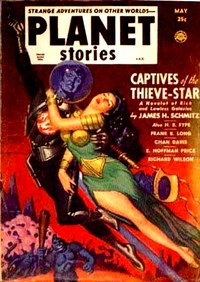
Being immortal, the Bryd was a very wise and resourceful Thing--but even so, the problem of saving Dale Stevenson was a dilly. So much had to be done in one-fourth of a second!
[Transcriber's Note: This etext was produced from Planet Stories May 1951. Extensive research did not uncover any evidence that the U.S. copyright on this publication was renewed.]
The Bryd was awakened with a rude jolt. It didn't even have time for a mental yawn. Something terrible was going on in Dale Stevenson's mind, and the turmoil there made the Bryd most uncomfortable. It shook off the lethargy of its long sleep. It knew instinctively that Dale Stevenson was about to get in trouble and make his mind unsuitable for the Bryd's occupancy.
The Bryd sighed. These humans were so unstable, so impulsive. The Bryd took a look around.
They--Dale Stevenson and he--were not on Earth. They seemed to be in space somewhere, 5,100 miles from Earth. Well, well, so men finally were breaking the shackles of gravitation. The Bryd became a little more interested.
But Dale Stevenson was reaching for a button that would fire a rocket to position the mirror and burn a path across the biggest city in Europe. Hey! what was going on here, anyway?
The Bryd had about a quarter of a second to do a lot of research. What was Dale Stevenson doing up here? What had he done with himself in the twenty-four years since the Bryd had curled up in the boy's cozy four-year-old mind and settled down for a long nap?
The Bryd could have stayed Dale's hand for a while, but the Bryd very much believed in minding its own business. It didn't like to interfere with humans; that was policy. So it decided to get busy. It had a quarter of a second to find out things and decide what, if anything, to do about them. Certainly it couldn't expect to stay comfortably in a mind as upset as Dale Stevenson's ... so it got busy.
The first thing to do was get oriented. The Bryd took a quick look around. Dale Stevenson, doctor of physics, was in charge of this sun-station, which was a man-made island in space, some three miles in diameter. The rim of the island was composed mainly of a steel framework like the rim of a wheel, with little cabins at various intervals to house a power plant, various controls, rocket berths, repair shops, and living quarters for the sun-station's crew.
The center area of the sun-station was a giant mirror, three miles across, made up of thin sheets of metallic sodium fastened to a skeleton of wire nets. The sodium was very light in weight, and being in airless and heatless space, was inert. Also it was highly reflective.
The whole business was kept at a point approximately 5,100 miles from Earth, where Earth's gravitational attraction approached neutrality and where the entire space-station could be maintained in a given position or moved at will with a minimum expenditure of energy.
Technically the station was owned by Night Sun, Inc., along with nearly a hundred others around Earth, and this particular station, No. 18, was under contract to furnish illumination at night over Paris, France, by staying out of Earth's shadow and reflecting sunlight on Paris during the night.
Management of such a station involved many mathematical factors in distance, triangulation with Paris, velocity and angulation, and control of the curve of the mirror. Normally this was a parabolic curve, but it was constantly varied with other factors to produce the desired degree of illumination.
No. 18 was under the sole control of Dale Stevenson, who had been psych-tested and certified by the United Nations licensing board.
That made the Bryd feel a little better. It looked as if he had made a mistake twenty-four years ago, but it also looked as if the licensing board had been fooled within the last year, for Dale certainly was getting ready to cause a lot of trouble in Paris. He could actuate the controls to expand or contract the rim of the station and thus vary the focal length of the sodium lens, and if he should actually concentrate the sun's rays in a small area, he could draw a flaming path of ruin through the center of Paris.
Reluctantly the Bryd checked again, and found that that was exactly what Dale Stevenson was about to do. The Bryd wondered why. It groaned. Humans were always up to something. Why couldn't they relax so the Bryd could rest?
The Bryd had been so happy back in 2250--or let's see, was it up in 2250? (This was 2045.) That was when Bob What's-his-name and that cute girl had landed on Pluto and given him a chance to get away. The long, lonely eons in Pluto's absolute zero had been quite monotonous to the Bryd, which was nothing but pure energy but which certainly had its feelings. After almost a third of a billion years marooned on Pluto it had sometimes almost wished it had not been so adventurous in its youth and hopped that stray comet as it had swept by its home on Arcturus.
For it had tired of the comet and jumped off on Pluto, and then had discovered it didn't have enough range of its own to get from Pluto to another planet. Then it was that Bob and Alys had come along on their 'round-the-system honeymoon, and the Bryd had hitched a ride to Earth (unknown to them), for it was pretty darned lonesome by that time.
It lived very happily with them until they got old, and then it decided to go back in time to 1950. There it found a nice friendly mind in Joe Talbott, and after it saved Joe from blowing up the Lithium Mountain and half the earth with it, it had settled down to snooze in Joe's mind and hadn't awakened until Joe died of old age. Then the Bryd had hunted a nice, stable mind and had finally picked Dale Stevenson, who was four years old, and had curled up for another long, quiet snooze. But now it was only twenty-four years later and Dale was in a bother.
The Bryd went deeper into Dale's mind to see what was going on. Dale was worried about something. In fact, he had worried so much it had upset his normal mental balance. It seemed to have started back about twenty years ago, a few years after the Bryd had entered Dale's mind.
It seemed that Dale's parents had been killed in an atomic blowup, and Dale, eight years old, had been taken care of by his older sister.
"Don't you worry, Dale," she had told him stoutly. "I'll take good care of you. And I'll buy your clothes and your school-books and everything. You won't have to go to a home. I won't let them take you."
That's what Dale had been scared of--going to a home. He was happy with Marillyn. She took good care of him, and somehow managed to keep the authorities from finding out that a thirteen-year-old girl was supporting a small boy.
Dale had understood all those things later, when he started to the university and they became curious about his background. He realized then what she had done.
"I'll remember all those things," he told her in the first fullness of young maturity and his sudden realization of her loyalty. "You've practically devoted your life to me. I appreciate it. You'll see," he said, embarrassed in this new knowledge, but humbly grateful.
He got a chance to show her; for six months after his graduation, while he was being trained at Station No. 18, he insisted that she should come to visit his new post. Marillyn never had ridden a rocket because she was afraid of them, but she recognized the honor he was conferring on her, for very few persons but employees had ever set foot on a sun-station. She agreed to go. Dale arranged passage. Then she was severely injured in the take-off.
Dale was devastated. He called in specialists, consultants, diagnosticians.
"Don't worry about it," he said. "I'll take care of everything. You'll be all right in no time."
But she wasn't. She was badly crippled, paralyzed from the waist down, and she became pitifully thin.
Dale spent most of his salary on her. Doctors told him it was useless, nothing could help, that a part of her brain cells had been destroyed and could not be rebuilt, that she might live fifty years but she would always be helpless.
Dale refused to believe it. "She's got to get well," he said. "It isn't right--after all the things she did for me. When she was just a kid and should have been skating and dancing and going with boys, she was working to keep me from going to a home. She's entitled to some fun now."
But she didn't have a chance. Her recovery would have been contrary to all medical experience.
Dale's salary grew until he was getting twenty-five hundred a month, but most of it he spent on Marillyn--largely against her wishes.
"Dale, I wish you wouldn't insist on trying every new-fangled cure that comes along. I know what the situation is. I can read. I know I won't get well. I can't. When that brain-tissue is destroyed, it's gone forever. You go out and have some fun. Please."
But Dale, worried but stubborn, said, "Do you remember that winter you sold papers on the street so I could have skates and a sled? Do you think I can forget that?"
"I didn't mean it to become a burden to you," she said softly.
He smiled. "It isn't a burden. I'm doing these things because I want to--because I want to see you active and pretty again. I'll do it, too. You'll see. Next month you're going to the spa at Carlsbad."
She tried to dissuade him, but next month she was bundled up and carried to the train to go to Prague.
It was in Prague that Dale met Ann Wondra, last daughter of a long line of Polish nobility. Ann was dark-haired, quick-eyed, and she could laugh in a way that warmed a man's blood. At any rate, she warmed Dale Stevenson's.
They went hunting together. They ate dinner together. They rode together. They visited Marillyn together, and after they came away from Marillyn in her wheelchair, Ann said, when he stopped the car on the top of a high hill in the moonlight from where they could see her ancestral castle, "You're determined that she shall get well, aren't you, Dale?"