Public-domain ebook
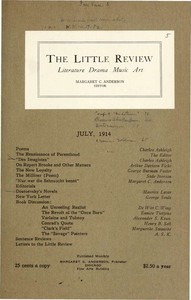
The Little Review, July 1914 (Vol. 1, No. 5)
by Various
Language: en774 downloads on Project Gutenberg
Subjects
In: Poetry·Essays, Letters & Speeches·Journals
Public-domain ebook sourced from Project Gutenberg #64083.
Public-domain ebook
by Various
Language: en774 downloads on Project Gutenberg
Subjects
In: Poetry·Essays, Letters & Speeches·Journals
Public-domain ebook sourced from Project Gutenberg #64083.
The opening · free to read
Hear the rational people say: "Jealousy is a primitive thing. A thing of the emotions; not of reason." Fools! You do not know scarlet desire, full-flooded!
Ah, my dearest, Graal of my heart's longing, Your stolen kiss is fresh upon my neck. My lips are full of my secret kiss upon your neck.
You are with another, whom I hate; whom I like well for himself, but hate because he possesses you ...
Your possessor is old and ugly; He can not love you as I can. I can pour out for you the scented treasures of my young love.
Dear night of hope, when you gave me the whispered promise to come to me ...
Stealthy was I and cunning. Friendly and attentive was I to your old lover (if lover he may be called, who is almost incapable of love). And, all the time, I was scheming for you. When the old man was away for an instant-- Oh, golden moment,-- I poured my whispered passion into your ears. When he looked away, or, for a moment, was distracted, with swift undertones I declared myself to you. How dear was your welcoming glance and your quickly toned assent! You had a face so proud. So quiet and poised among the throng. Yet, for once, you gave me your eyes and, in so doing, gave me your priceless body and warm, comradely soul. Ah, flash of answering love that transformed your face! As a jewel of my memory's treasure-casket may it be preserved.
When the drinking-place was closed, we walked along the dark street. Do you remember? We were four, luckily, and the old man was kept busy in conversation, half drunken as he was.
And we, with our secret between us, walked behind. Our hands were tight clasped in the folds of our dress. Tight clasped with the clinging hand caress; you and I trying to put into our hands all the longing that was in us. All the time we were apprehensive of a sudden turning of the old man or the other ...
Then, the whispered troth, and the meeting-place appointed.
And, then, later, boldly, so openly and audaciously it brought no suspicion, Under seeming of wine-induced jollity, we kissed. And they laughed; it seemed a trivial jest to them. But to us it was a sacrament.
But, best of all, my beloved, was the hurried clasping and kissing when we were alone in the dark. Promise of joy to come. Foretaste of the coming ecstasy.
And then we had to part. I and my unaware friend. You and the old man.
As I walked home that night, How I hated him! How I looked up at the pale-golden moon high-hung in the purple sky, and sang in my heart your praise and cursed in my heart your possessor ...
But we will out-wit him.
Young I am and young are you and the Law of Life bids us mate. And a whole world standing between us would be melted and destroyed by the fire of our youth's desire.
I swim with the tide of life towards the new; I reach out hungered arms to flowing change.-- I smash the awesome totems of my kind; My smarting vision bursts its cramping range.
A thousand voices yell within my soul; A thousand hymns are chanting in my heart.-- I blast the mist of worlds and years apart; I sense the blending glory of the whole.
The sap of flowers and trees, it mounts in me. I feel the child within me cry and turn; The crimson thoughts within me writhe and burn.-- I stand, with craving arms high-flung, before the rimless sea.
And every whirling, passionate star sings melodies to Me; And every bud and every leaf has sought my private ear; And to the quickening soul of Me has told its mystery, As I sit in state in the heart of the world, As I proudly hug the core of the world, As I make me a boat of the whole, wide world ...
And then for new worlds steer.
There seems to be a kind of renaissance of motherhood in the air. Ellen Key has just done a book with that title which has come to us too late to be reviewed adequately in this issue; Mrs. Gasquoine Hartley has written The Age of Mother Power which will be brought out in the fall; and in Shaw's new volume of plays (Misalliance, Fanny's First Play and The Dark Lady of the Sonnets) there is a preface of over a hundred pages devoted to a discussion of parents and children which says some of the most refreshing and important things about that relationship I have ever read.
The home, as such, is rapidly losing its old functions--perhaps it is more accurate to say that it is changing its standards of functioning, and that the present distress merely heralds in a wonderful new conception of family potentiality. But a generalization of this sort can be disputed by any family egotist, so let's get down to particulars. It's all right for the enlightened of the older generation to preach violently that the family is a humbug, as Shaw does; that the child should have all the rights of any other human being, and that there is nothing so futile or so stupid as to try to "control" your children. It's not only all right; it's glorious! But what I'm more interested in, still being of the age that must classify as "daughter," is this:--what are "the children" themselves doing about it? Have their rebellions been anything more than complaints; have they made any real stand for liberty; have they proved themselves worthy of the Shavian championship?
Well--I got hold recently of a human document which answered these questions quite in the affirmative. It was a rather startling thing because, while it offered nothing new on the theory side of the matter, it showed the theory in thoughtful action--which, for all the talk on the subject, is still rare. It was a letter of some twenty pages written by a girl to her mother at the time of a domestic climax when all the bonds of family affection, family idealism and obligation were tending to smother the human truth of the situation, as the girl put it. She was in her early twenties; she had a sister two or three years younger, and both of them had reached at least a sort of economic independence. She had come to the conclusion, after a good many years of rebellion, that the whole fabric of their family life was wrong; and since it was impossible to talk the thing out sensibly--because, as in all families where the children grow up without being given the necessary revaluations, real talk is no more possible than it is between uncongenial strangers--she had decided to discuss it in a letter. That medium does away with the patronage of the parents' refusal to listen seriously:--that "Oh, come now, what do you know about these things?" If the child has anything interesting to say, if he puts any of his rebellion into his writing, the chances are that the parent will read the letter through; and the result is that he'll know more about his child than he has learned in all the years they've been trying to talk with each other and not succeeding. I'm enthusiastic about this kind of family correspondence; it's good training in expression and it clears the air--jolts the "heads" of the family into realizing that the thinking and planning are not all on one side. I once did it myself to my father--put ten pages of closely-written argument on his office desk (so that he'd open it with the same impersonality given to a business communication), in which I explained why I wanted to go away from home and learn to work, and why I thought such a course was an intelligent one. The letter accomplished what no amount of talking would have done, because in our talk we rarely got beyond the "Oh, now, you're just a little excited, it will look different in the morning" stage. Father said it was rather a shock to him because he didn't know I had ever figured things out to that extent; but we always understood each other better after that.
However--not to get lost in personalities--this is the letter the girl showed me and which she allows me to quote from partially:
If we are to continue living together in any sort of happiness and growth the entire basis of our present life will have to be changed. We can do it if we're brave enough to do what people usually do only in books:--face the fact squarely that our family life is and has been a failure, and set about to remedy it. It will mean an entire change of home conditions, and these are the terms of the new arrangement:
When I said to you the other day that things would have to go my way now, you were horrified at the conceit of it. To get to facts, there's no conceit in it--because my way is simply the practise of not imposing one's will upon other people. I made the remark merely as a common sense suggestion, and made it out of a seriousness that is desperate. I say "desperate" because I mean that literally: the situation isn't a question of a mere temporary adjustment--just some sort of superficial arrangement so that we can get on pleasantly for a while before the next outbreak comes. The plans Betty and I have discussed have been made in the interest of our whole future lives:--whether we're going to submit (either by surrender or compromise or by just drifting along and not doing anything) to an existence of bickering, nagging, hours spent in the discussion of non-essentials, hideous lack of harmony--the whole stupid programme we've watched working for years and achieving nothing but unhappiness, folly, and a terrible "human waste." You ask us to continue in your way; but from at least three points of view that way has been a failure. I ask you to adopt my way--which has not yet failed. That's why I say it's not conceit, but common sense.
My way is simply this: that we three can live together and work in peace and harmony if this awful bugbear of Authority is dropped out of the scheme. Each of us must go her own way; we're all different, and there's no reason why one should impose her authority on the lives of the others. You say that you should because you're our mother. But that's the thing I want to discuss.
Motherhood isn't infallibility. If a woman is a wise woman she's a wise mother; if she's a foolish woman she's a foolish mother. Because you're our mother doesn't mean that you must always be right; before being a mother you're a human being, and any human being is likely to be wrong. To get down to brutal facts, we think you are not right about the whole thing. We've thought so for years, but now it's come to the time when our thinking must be put into action. We're no longer children; but even as mere infants we thought these things--without having the right to express them. What I'm trying to do now is to express them not as a daughter, but quite impersonally as a human being, as a mere friend, a sister, or anyone who might come to you stating that she believed with all her soul that you were wrong, and also stating, just as impersonally, that she wouldn't think of modeling her line of conduct after that pattern which appeared to her so wrong. We must face the facts; if you do that squarely it doesn't seem so bad, and you stop flinching about it. You get to the point where you're not afraid to face them boldly, and then you begin to construct. And this is the only way to clear up the kind of rottenness and decay that flourishes in our family life.
The book keeps going
Reading is free forever. Sign up and watch scenes appear while you read.



Scenes Storieta drew for other classics.
New illustrated classics
Once or twice a month: the latest books to get full character casts, scene art, and free comic editions. No account needed.