Public-domain ebook
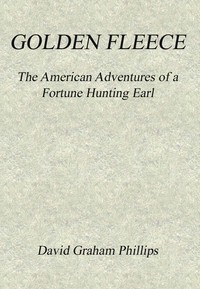
Golden Fleece: The American Adventures of a Fortune Hunting Earl
Language: en498 downloads on Project Gutenberg
Subjects
In: Novels·American Literature
Public-domain ebook sourced from Project Gutenberg #64301.
Public-domain ebook
Language: en498 downloads on Project Gutenberg
Subjects
In: Novels·American Literature
Public-domain ebook sourced from Project Gutenberg #64301.
The opening · free to read
Two hours after Surrey’s letter came his sister Gwen rode over to Beauvais House eager to tell Evelyn the news of his luck in America. It was almost five o’clock in the beautiful autumn afternoon, and she found Evelyn at tea on the porch that looks out upon the Italian garden.
“It’s settled,” she said. “They’re to be married on the 5th of November--only two months! And George says she is sweet and lovely--not at all like the Americans we know. And her dot is a million and a half--he calls it seven and a half, but he means in their money, which sounds bigger, but counts smaller, than ours. She’ll get twice that when her father dies--and he’s nearly seventy and not strong. And I’m so glad and so sorry that I don’t know whether to laugh or cry.”
“What’s her name? You told me, but I forget.” Evelyn’s hand was trembling just a little as she gave Gwendoline a cup of tea. She spoke slowly, in the clear, monotonous, but agreeable, English tone. Her voice, always calm, seemed stagnant.
“Dowie--Helen Dowie. He sent me a proof of a photograph they had taken together.” Gwendoline took a letter from the bosom of her shirtwaist, drew from it the proof, and handed it to Evelyn. She took it, lowered her head so that Gwen could not see her face. She looked long and intently, and, if Gwen had seen, she would have wondered how eyes could be so full of tears without shedding a single one.
“Quite aristocratic,” she said at last, giving it back. “How much style those American girls have!”
“But don’t you think her rather pert-looking?” asked Gwen discontentedly. “She looks ill-tempered, too. I’m sure we sha’n’t get on. Mother and I are making ready to go to Houghton Abbey at once. We’d have a jolly uncomfortable time of it, I wager, if she were to catch us at the Hall.”
Evelyn was gazing into her tea and stirring it absently.
“It seems a shame to have an American nobody come in,” continued Gwen, “and throw us out neck and crop from a house where we’ve always lived. Now, if it were an English girl of our own class,--you, Evelyn,--we shouldn’t mind--at least, not so much, or in the same way.”
Evelyn paled, and her lips contracted slightly.
“But it’s of no use to think of that. We need her money--everything is in tatters at the Hall, and poor George is down to the last seventy pounds.” Gwen laughed. “Do you remember what a time there was getting the five hundred for his expenses out of Aunt Betty? We’ve got to cable him another five hundred--he can’t begin on her money the very minute he’s married, can he now?”
“Arthur must go over,” said Evelyn suddenly, with conviction. “We’re worse off than you are. Old Bagley was down yesterday. He and Arthur were shut in for two hours, and Arthur’s been off his feed--horribly--ever since.”
Gwen, two years younger than Evelyn, could not conceal her feelings so well. She winced, and a look of terror came into her big blue eyes.
“We can’t hold on another year,” continued Evelyn. “And it’s quite impossible for Arthur to take Miss Cadbrough. She’s too hideous, and too hideously, hopelessly middle-class. She could never, never learn not to speak to ladies and gentlemen as if she were a servant.”
Evelyn pretended not to notice Gwen’s unhappiness. She glanced in at the great drawing room, with splendid furniture, and ceiling wonderfully carved by a seventeenth-century Italian. Then her eyes wandered away to the left, to the majestic wing showing there, then on to the brilliant gardens, the fountains and statuary. Her expression became bitter. “And we’ve been undisturbed for nine centuries!” she exclaimed.
Gwen, in spite of her inward tumult, remembered that this boast was rather “tall,” that the Beauvais family had, in fact, been changed radically several times, and only the name had been undisturbed. Her mind paused with a certain satisfaction on these little genealogical discrepancies, because, though she was the sister and the daughter of a duke, she was the granddaughter of a brewer, who had begun life as an apprentice.
“George wishes Arthur to go over to the wedding,” she said reluctantly, after a silence.
A servant appeared--his gaudy livery was almost shabby, but his manners were most dignified, and his hair was impressively--or ridiculously, if you please--plastered and streaked with powder. “His Lordship says he will have tea in his study, Your Ladyship.”
“Please tell him that Lady Gwendoline Ridley is here,” said Evelyn.
A few minutes later, a strongly-built, fairish young man of perhaps six and thirty came lounging out upon the porch. He had pleasing, but far from handsome, features--a chin that was too long, and hung weakly, instead of strongly, forward; uncertain blue eyes, with a network of the wrinkles of dissipation at the corners. A large, frameless, stringless monocle was wedged, apparently permanently, into the angle of his right eye-socket. He was dressed in shabby light grey flannels, and he looked as seedy as his clothes. He shook hands with Gwen. “Thanks. No tea. I’m taking whiskey,” he said to Evelyn. And he seated himself sprawlingly. The servant brought his whiskey and a note for his sister.
“Is the man waiting for an answer?” she asked, when she had read it.
“Yes, your ladyship.” She left her brother and Gwen alone.
“George is marrying the heiress,” Gwen began.
“So he wrote me,” replied Frothingham sullenly.
“Evelyn says you must go and do likewise.”
He scowled. “But I’d rather stay here and marry you.”
“Don’t be silly,” said Gwen, with a shrug of her athletic young shoulders. “You’ve got nothing. I’ve got nothing. So--you must do your duty.”
“Duty go hang!” said Frothingham fretfully. “Sometimes, do you know, Gwen, I come jolly near envying those beggars that live in cottages, and keep shops, and all that.”
“Now, you’re slopping, Arthur. You know you don’t envy them; no more do I.”
“Did Eve tell you old Bagley was down?”
“Yes. Ghastly--wasn’t it?”
Frothingham sighed. “I shouldn’t be so cut up if I’d had the fun of spending it.”
“You did spend a lot of it.” She was thinking what a great figure the young Earl had cut in her girlhood days; she had always listened greedily when her brother, with admiring envy, or Evelyn, with sisterly pride, talked of his exploits on the turf, and let us say elsewhere, to shorten a long story.
“Only a few thousands that weren’t worth the keeping,” said Frothingham, a faint gleam of satisfaction appearing in the eye that was shielded by the monocle--he liked to remember his “career,” and he liked the women to remind him of it in this flattering way. “All I really got was the bill for the governor’s larks, and his governor’s, and his governor’s governor’s. It’s what I call rotten unfair--jolly rotten unfair. The fiddling for them--the bill for me.”
“Buck up, Artie,” said Gwen, stroking him gently with her riding whip. “See how Georgie has faced it. And perhaps you won’t draw such a bad one, either. She couldn’t be worse than Cadbrough.”
“But I want you, Gwen. I’m used to you, you know--and that’s everything in a wife. I hate surprises, and these American beggars are full of ’em.”
Evelyn came back. “Go away somewhere, both of you,” she said. “Charley Sidney’s just driving up. I wish to talk with him about the States.”
Gwen paled and flushed; Frothingham grunted and scowled. They rose, made a short cut across the garden, and were hidden by the left wing of the house. Almost immediately the servant announced “Mr. Sidney,” and stood deferentially aside for a tall, thin American, elaborately Anglicised in look and dress, and, as it soon appeared, in accent. He had a narrow, vain face, browned and wrinkled by hard riding in hard weather in those early morning hours that should be spent in bed if one has lingered in the billiard room with the drinks and smokes until past midnight.
“Ah, Lady Evelyn!” He shook hands with her, and bowed and smirked. “I’m positively perishing for tea.”
“You mean whiskey?”
“Ah, yes--to be sure. I see there is whiskey.”
The book keeps going
Reading is free forever. Sign up and watch scenes appear while you read.



Scenes Storieta drew for other classics.
New illustrated classics
Once or twice a month: the latest books to get full character casts, scene art, and free comic editions. No account needed.