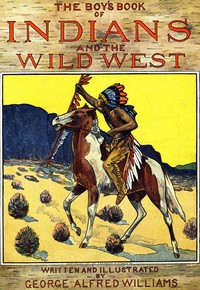
When the white man discovered America, he found a great, primeval wilderness of fertile valleys, high mountains and deep forests. Tall trees had grown for centuries and their towering tops, reaching up to the blue sky, shut out the sunlight from the gloom of the forest solitude. In the deep recesses of this wilderness the red man, or Indian, lived in wild freedom. Skilled in woodcraft and the art of savage warfare, he was lord and master of this vast domain, now called the United States.
Although divided into numerous tribes or families, each speaking a different language, the Indians were, in traits of character and general appearance, very much alike. In war they were courageous, but at the same time intelligently cautious. Treacherous and deceitful to their foes, they preferred to slay an enemy by a secret rather than an open blow. Brave and successful a warrior as the Indian was, he excelled even more when he became a hunter. To be victor over the beast in the chase and hunt meant to the Indian plenty to eat and stout clothing to wear, so he developed remarkable skill in using his chief weapon, the bow and arrow.
Before the white man came to America the Indians were clad almost entirely in the skins of animals which they themselves cured and dressed to perfection, fastening various pieces together with the tendons and tough strips of skin very much as we sew to-day. These garments, gayly ornamented with shells and colored stones, made very useful and picturesque clothing.
The Indian boy was taught from early childhood to believe that his highest attainment was to be a brave warrior and a great hunter, and to look with scorn upon any other work. So upon the Indian women fell the task of tilling the soil. For this reason farming never became a real industry among them and they were amply satisfied to grow maize, or Indian corn, from which they made many kinds of dishes and bread. A very rich and fertile soil furthered their ambitions, for with but little attention to farming they reaped abundant crops.
For houses the red men had wigwams. These they constructed by fixing long poles in the ground, tying them together at the top, and covering them with skins of animals joined together as they sewed their clothing. They made an opening in the top to serve as a chimney. Such crude structures could be quickly taken down and as readily put up again, and admirably suited the needs of their owners, who loved to wander from place to place. This peculiarity was probably due to the fact that after living in one spot for a certain length of time they would find their natural resources for food becoming exhausted, and perhaps an enemy had hunted out the encampment for ravage. Then, too, it was the Indian’s nature to rove in wild natural haunts and, no doubt, a place long inhabited lost its charm for him. A few of the tribes, however, did build permanent villages, with streets and regularly spaced wigwams, around which they extended palisades of logs for protection against attacks from their enemies.
The greatest of all the Indian families, or tribes, was the Iroquois, also called the Five Nations, originally found in what is now western and central New York State. Of the many strange legends and stories common among the Indians, one of the most beautiful is the story of Hiawatha, which is the tale of the origin of the Iroquois.
Tradition tells us that Owayneo, as Indians call their Creator, made the five nations from five handfuls of seed. One day he assembled his children together and said: “You have sprung from five different kinds of seed and are therefore five individual nations, but you are brothers and I am your father because I made you all.” The Mohawks, he made bold and valiant and gave them corn for their principal food. The Oneidas, he made patient and charitable and bade them eat freely of nuts and the fruits of the trees. The Senecas he made industrious and active, and for their chief food gave them the nourishing bean. To the Cayugas he gave green nuts and instructed them to grind them, and also every kind of fruit, for they were destined to be strong, friendly and generous. Squashes, grapes and tobacco were his gift to the Onondagas, for they were to be a nation wise, just and eloquent. To all in common Owayneo gave the beasts, birds and fishes to eat and the life-giving water to drink. “Now,” said he, “be just to all men, and kind to strangers that come among you.”
On the Trail
Following the advice of Owayneo, the Indians received the white explorers and settlers with great kindness and hospitality. But the white men were cruel and crafty and took advantage of the friendly red men because they wanted the Indian land and schemed by dishonest methods to obtain possession of large tracts. Soon the Indian saw his hunting grounds taken and his wigwam threatened with destruction. This injustice roused his warlike and cruel nature, and relations between the white man and the red man developed into a ceaseless warfare that penetrated into every section of the great continent. The former peace of the wilderness was then marred by one long succession of fierce fights and terrible massacres.
Indian warfare was always one of surprises, and ambuscades and fighting in a land of forest and thicket made such a method possible. For centuries the Indian youth had been taught this strange mode of attack. Trained by tests of endurance and of skill, and by knowledge gained from a hunter’s life of suffering, danger and fatigue, the Indian boy grew to manhood. He longed for the time when he, too, might strike the enemy and make a name for himself. The chiefs of the tribe instructed him in the language of the sky and the earth, in the smallest detail of woodcraft and in the keenest methods of finding a trail.
The most ferocious and skilled warriors were the Mohawks. When, in the early days of the Massachusetts colony, they made war on the New England Indians, it is told how these Indians, upon discovering the enemy, raised the cry from hill to hill, “A Mohawk! A Mohawk!” and fled without making any resistance. On the trail their keen sight and sense of hearing made them enemies much to be feared. No forest or thicket was so dense that they could not find a way through. A broken twig or a disturbed leaf, a bit of clothing or strand of hair was all they needed to follow, with deadly surety, the most difficult of trails.
So well could they imitate the calls of the birds and animals that many a white hunter was lured to his death, and when they took a captive they were most unmerciful and tortured their prisoners in many cruel ways. Burning at a stake and running the gauntlet were among the most popular methods. To accomplish the latter, they first made their prisoner run between two rows of women and children who, armed with sticks, stones and clubs, were expected to hit him. Then the captive was tied to a stake and the braves and chiefs threw knives and tomahawks, so that they came as close as possible to the victim without inflicting wounds. After this ordeal fagots were piled around the stake and set on fire. So in a most cruel fashion the Indians’ bloodthirsty nature and their desire for vengeance were satisfied.
With so many traits of savage instinct awakened, it is no wonder that the white settlers, who were now penetrating every section of the land, had a hard time of it. While working in the fields or doing other peaceful tasks some one in the settlement had to be constantly on the watch for an Indian attack. Riding through the wilderness to visit a neighbor or to buy supplies at the nearest town was extremely dangerous, for no one knew the hour or minute when the war-whoop would sound and the tomahawk fall.
Attacks on the Settlements
Every ship sailing from Europe brought new colonists, and as the settlements grew and thrived on the sea coast civilization advanced further and further into the great wilderness. The Indians became more ferocious and warlike, and day and night the settlers were in constant fear of attack. Men built strong palisades of logs around their homes and at each corner of the enclosure they placed block-houses, which were simply square buildings two stories high with loopholes, through which the defenders could fire their guns and still be hidden.
In the daytime the gates of these crude forts were thrown open, and those who tilled the ground went out to their work while men stationed on the outskirts of the fields guarded the settlement. But with all these precautions there are many sad tales of Indian attacks accompanied by bloodshed and cruel torture.
For long periods the Indians would remain silent in the deep forests and not show themselves at all. Then peace seemed to prevail in the land, and naturally the settlement became careless and the guards grew less vigilant. At just such times the crafty Indians made their most successful raids. Silently and stealthily their scouts watched the men at work in the fields and the children playing outside of the stockade. Warriors came from all directions out of the forest depths and gathered around their leader. Then, when all was in readiness, the terrible war-whoop sounded and the dusky foes fairly leaped from behind every bush, rock and tree. A wild scene of confusion ensued. Men rushed for their arms while women and children crowded into the block-houses. The strong doors were closed and barred and the fierce fight began.
The Indians made every effort to get close enough to set fire to the buildings, and it was the supreme danger against which the defenders had to contend. Many times the settlers were thus forced to run out into the midst of their foes to defend themselves by a hand-to-hand encounter. If the Indians were successful in the attack a terrible massacre followed, in which women and children were scalped and the men bound and tortured. After the cruel scenes were over only a pile of charred and smoking embers remained of the once prosperous settlement. But usually, because of their superior arms, the white men were victorious and the advance across the continent went ever onward toward the Great West. Encountering many hardships and thrilling adventures, these brave people made possible for us the happy, peaceful and bountiful land in which we now live.
Young boys grew to a hardy manhood through trial and privation and gave their lives to conquering the vast wilderness of the Far West.
One incident of border life shows the bravery and fearlessness of the backwoods boy.
Two brothers, one aged eleven, the other thirteen, were stolen while at play by two Mohawk warriors. The Indians struck a trail leading into the deep forest and at nightfall were far enough away from the settlement with their captives to rest without danger of being overtaken. After a light supper they lay down to sleep, each holding one of the boys in his arms. The oldest boy, too excited to feel sleepy, only pretended to go to sleep, and managed with great care to wriggle free from his sleeping captor’s arms. He crossed over to his brother and gently released him from the embrace of the other sleeping Indian and carefully carried him a short distance from the savages before waking him.