Public-domain ebook
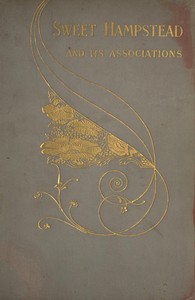
Sweet Hampstead and Its Associations
English3,899 downloads on Project GutenbergDownload EPUB
Public-domain ebook sourced from Project Gutenberg #64394.
Public-domain ebook
English3,899 downloads on Project GutenbergDownload EPUB
Public-domain ebook sourced from Project Gutenberg #64394.
Caroline A. White’s Sweet Hampstead and Its Associations is a locally‑focused historical survey that sets out to fill the gap between scholarly tomes and ordinary guidebooks. The work opens with a self‑conscious preface in which White explains why she has finally returned to a project begun three decades earlier, acknowledging the many friends and illustrators who helped her assemble the material. She then moves into an introductory chapter that frames the book as a “labour of love,” promising a mosaic of topographical notes, anecdotes, and references to earlier writers such as Lysons, Park, and Baines. The detailed contents list, spanning the Heath’s geology, its ponds, notable houses, and even a fragment of local flora, shows that the text will be organized by place and theme, offering a comprehensive portrait of Hampstead from its early days through the nineteenth century.
The narrative voice is that of an earnest Victorian‑era woman scholar, combining personal reminiscence with the measured tone of a antiquarian. White’s prose is rich in descriptive detail, peppered with literary allusions and occasional poetic quotations, reflecting the genteel, educated style of late‑19th‑century historical writing. Readers who enjoy meticulously illustrated local histories, garden‑walk narratives, or studies that blend archival research with vivid landscape description will find this book rewarding. It especially appeals to those with an affection for London’s suburbs, heritage enthusiasts, and anyone seeking a nuanced, picture‑filled account of Hampstead’s evolution beyond the usual tourist sketch.
The opening · free to read
As illustrating the very common axiom that extremes meet, a preface at the beginning of a book is, as a matter of course, the last thing that is written. In the present instance, having stated my reasons for writing ‘Sweet Hampstead’ in the introductory chapter, a preface seems almost redundant. Moreover, I have an idea that prefaces as a rule are not popular reading, but literary custom being stronger than private opinion, I must revoke my heresy.
It is very many years since the thought of writing the story of Hampstead occurred to me. I found that previous writers had left the most important period of its local history, and the most interesting personages who had vitalized it, with little more than a passing reference; and thence it was that the desire to occupy unbroken ground took possession of me.
But the years alluded to were amongst the busiest of a busy life, when I was ‘coining my brains for drachmas,’ or their equivalent in British currency, and had no time for the dreamland of topographical speculation. The engagements, however, that hindered my design opened up many sources of material for future use; and as topography is always a literary mosaic, their diversity tended to enrichment.
Thus it came to pass that the first draft of my book was laid aside, but never forgotten, for more than thirty years, and has only recently been reverted to—a task that has been a delight, bringing back—though sometimes through a mist of tears—images of the past, with pleasant memories of sunny days that, looked at from the perspective of eighty-nine years, seem brighter even than sunshine is itself.
From such a pile of years I almost lose the author’s dread of the critic. Praise or blame are to me now much the same; but, being a woman, I still prefer the praise.
I cannot close these preliminary words without expressing my obligations to Mr. P. Forbes for the eight sketches he has permitted to be copied for the beautifying of the book; to Messrs. Oetzmann for some illustrations so kindly lent; to Mr. Baines, not only for a similar favour, but for help from his valuable ‘Records of Hampstead’; and to the proprietors of the Municipal Journal for the charming picture of the viaduct.
My thanks are also due to Mrs. Rosa Perrins, to Miss Kemp, Miss Quaritch, and Mr. M. H. Wilkin, who have all kindly assisted me. I also desire to acknowledge my indebtedness to Mr. Lloyd, of Highgate, for information gathered from his clever lecture on ‘Caen Wood and its Associations.’ To the courtesy and kindness of Mr. G. W. Potter I owe much original material, and many interesting notes; and I also desire to thank Mr. C. A. Ward for the personal interest he has taken in my work, and the great help he has ungrudgingly given me in preparing and correcting it for the press. I can only add that should my book be found so readable as to convey to others some share of the pleasure I have felt in writing it, or lead in more capable hands to future research and a fuller development of a delightfully interesting topic, ‘Sweet Hampstead’ will have fulfilled its intention, and I can sing with an unknown poet of the sixteenth century:
‘Now cease, my lute: this is the laste Labour that thou and I shall waste, And ended is that we begun; Now is this song both sung and past: My lute, be still, for I am done.’
CONTENTS.
The book keeps going
Reading is free forever. Sign up and watch scenes appear while you read.



Scenes Storieta drew for other classics.
New illustrated classics
Once or twice a month: the latest books to get full character casts, scene art, and free comic editions. No account needed.