Public-domain ebook
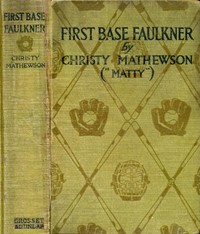
First Base Faulkner
English428 downloads on Project GutenbergDownload EPUB
Public-domain ebook sourced from Project Gutenberg #64435.
Public-domain ebook
English428 downloads on Project GutenbergDownload EPUB
Public-domain ebook sourced from Project Gutenberg #64435.
The opening · free to read
“Lucky” Faulkner arrived in Amesville, Ohio, shortly before seven o’clock of a cold morning in the first week of January. He wasn’t known as “Lucky” then, and he certainly didn’t look especially fortunate as he stepped from train to platform and blinked drowsily at this first sight of the strange city that was to be his new home. He had travelled nearly six hours in a day-coach, sleeping fitfully with his head on the arm of the car seat, and his clothes were creased, his hair rumpled and his face tired and pale under its coating of train dust. He wore a good-looking gray ulster and a cap to match, and carried a big valise whose sides bulged tremendously and which bore the inscription “J. C. F.” in neat old English characters.
On the platform he set the bag down, took a trunk-check from a pigskin purse and gazed inquiringly about him. The passengers who had left the warmth of the cars had hurried to the restaurant to make the most of the ten minutes allowed them for breakfast, and it was much too early in the day for loiterers. It was a boy of about his own age――which was sixteen――who, stopped in his mad career of dragging a mail-sack along the platform, supplied information.
“Huh? Expressman? Sure! Around back. Ask for Gus Tenney.”
Gus, a small, crabbed-looking negro, was loading a huge sample-trunk into a ramshackle dray when discovered.
“I’ve got a trunk on this train,” said the new arrival. “Will you take it to Miss Teele’s, on Brewer Street, please? And how much will it be?”
“Brewer Street? What’s the number, Boss?”
“One-twenty-eight.”
“Fifty cents, Boss.”
“I’ll give you a quarter. Can you get it there by eight?”
“I can’t tote no trunk ’way up to Brewer Street for no quarter, Boss. You’ll have to get someone else to do it.”
“All right. Is there anyone else around?”
“Don’t see anyone, Boss. Reckon I’se the only one here.”
“Will you take my trunk up there first and let me ride along with you?”
“I got to deliver this to the Commercial House first, Boss.”
“How far is that from Brewer Street?”
“’Most a mile.”
“And Brewer Street’s near the City Hall, isn’t it?”
“Well, it ain’t so mighty far.”
“And the Commercial House is near the City Hall, too, isn’t it?”
“Look here, Boss,” said the negro peevishly, “maybe you-all knows my business better’n I do and maybe you don’t. I got to deliver this trunk right away ’cause the gentleman’s waitin’ for it.”
“All right. Don’t let me keep you, then.”
“Well, you give me that check an’ I’ll get your trunk up just as soon as I can, Boss.”
“No, I’ll wait for someone else. It isn’t worth more than a quarter.”
The negro hesitated and muttered as he gave the sample-trunk a final shove. Then: “All right, Boss, I’ll do it. Seems like folks nowadays don’t want anyone to make a livin’, I ’clare to goodness it does!”
“Will you get it there by eight?”
“I’ll get it there in half an hour, Boss, if that old mare of mine keeps on her feet. It’s powerful mean goin’ today, with so much snow.”
The boy yielded his check, saw his trunk put on the dray, and, after getting directions from the negro, trudged across Railroad Avenue and turned eastward past the row of cheap stores and tenement houses that faced the tracks. There had been a good deal of snow since Christmas and it was still piled high between sidewalk and street. Overhead a gray morning sky threatened more, and there was a nip in the air that made the boy set his bag down before he had traversed a block and slip on a pair of woollen gloves. Behind him a door opened and an appealing odour of coffee and cooking was wafted out to him. As he took up his valise again he looked wistfully through the frost-framed window of the little eating-house and mentally counted up his change. Evidently the result prohibited refreshment, for he went on, the heavy valise dragging and bumping as he walked, and at last turned the corner and struck northward. Here, after a short distance, the buildings became comfortable homes, many of them surrounded by grounds of some extent. From chimneys the gray smoke was ascending in the frosty air and now and then the tantalising vision of a breakfast table met his sight. The sidewalks hereabouts had been cleaned of snow and walking was easier, something the boy was heartily glad of since that valise was gaining in weight at every step.
It was not, he was thinking as he trudged along, a very inspiriting morning on which to arrive in a strange place. Perhaps if the sun had been shining Amesville would have seemed less gloomy and inhospitable to him, but as it was he found nothing to like about the city. On the contrary, he was convinced that it was far inferior in every way to Akron and that he would never care for it, no matter how long he stayed there. However, he forgot to take into consideration the fact that he was tired and hungry and cold, neglected to realise that almost any city, approached from its least attractive quarter and viewed in the dim light of a cloudy Winter morning, looks far from its best.
He set his valise down at a corner, rubbed his chilled fingers, and went on once more with his burden in the other hand. He was wondering now what Aunt Sarah would prove to be like. He had never seen her to remember her, although his mother had tried to recall to his recollection an occasion when Aunt Sarah had visited them in Akron. But that had been when he was only four or five years old and his memory failed him. Aunt Sarah was not a real, bona-fide aunt, for she was his mother’s half-sister. But she was the closest relative there was and when it had become necessary to break up the home in Akron it was Aunt Sarah who had written and offered to take them in. There would be practically no money left after his father’s affairs had been settled up and all the bills paid, and Mrs. Faulkner had been very glad to accept Aunt Sarah’s hospitality for her son. She herself had obtained, through the influence of a friend of her husband’s, the position of housekeeper in a hotel in Columbus. Since her son could not be with her she had decreed that he was to go to Amesville, finish his schooling there, and remain with Aunt Sarah until enough money had been saved to allow of the establishment of a new home. He had pleaded hard to be allowed to leave high school and find work in Columbus, but Mrs. Faulkner wouldn’t hear of it.
“You may not realise it now, dear,” she had said, “but an education is something you must have if you are ever to amount to anything. And there’s just one time to get it, and that’s now. If you study hard you’ll be through high school next year. You’ll be eighteen, and that’s quite young enough to start earning a living. Meanwhile Aunt Sarah will give you a good home, dear. I shall pay her a little, as much as I can afford, so you needn’t feel that you are accepting charity. You must try to be nice to her, too. She――she doesn’t always show her best side, unless she’s changed since I saw her last, but she’s as good as gold, for all her sharp tongue. And I want you to try and remember that, dear.”
He recalled the words now and tried to banish the mental picture of Aunt Sarah which he had unconsciously drawn: a tall, thin, elderly maiden lady with sharp features and a sharper tongue, dressed in a gingham gown of no particular colour and wearing a shawl over her shoulders. But the preconceived vision wouldn’t be dispelled, and consequently, when a few minutes later, the door of the little yellow house with chocolate-coloured trimmings opened to his ring and Aunt Sarah confronted him, he was not a bit surprised. For she was, with the exception of gingham dress and shawl, so much like what he had imagined that it was quite as if he had known her for a long time.
“This is Joseph?” she asked as he took off his cap on the threshold. “You’re late. I’ve been expecting you for a quarter of an hour and breakfast is stone-cold likely. Come in, please, and don’t keep the door open. Take your bag right upstairs. It’s the first room to the left. When you’ve washed, and dear knows you need it, come right down again. I dislike very much having folks late to their meals.”
During this announcement, uttered levelly in a sharp voice, she shook hands rather limply, closed the door, pushed the rug straight again with the toe of a sensible boot and smoothed the front of her black merino gown. That black gown was the only thing that didn’t fit in with his picture of her and he rather resented it as, tugging his bag behind him, he went up the narrow, squeaky staircase. That colourless gingham he had mentally attired her in would, he thought, have been less depressing than the black merino.
The room in which he found himself was small, but, in spite of the cheerless weather outside, bright and homelike. There were some surprisingly gay cretonne curtains at the two windows, the paper was blue-and-white in a neat pattern, the brass knobs of the single bed shone like globes of gold, and Joe noted with approval that the gaslight was convenient to the old-fashioned mahogany, drop-front desk. On the table at the head of the bed were three books, disputing the small surface with a candlestick and a match-safe, and while he hurriedly prepared for breakfast he stole time to examine the titles. “Every Boy’s Handy Book,” he read, “Self-Help,” “Leather Stocking Tales.” He smiled as he turned away. On the walnut bureau――it had a marble slab and an oval mirror and a lidded box at each side――was a Bible. He made a quick toilet and returned downstairs. A pleasant fragrance of coffee guided him to the dining-room. Aunt Sarah was already in place and a large black cat was asleep on a chair between the windows.
“That will be your place,” said Miss Teele, indicating a chair across the table with a nod. “Do you eat oatmeal?”
“Yes, ma’am, thanks,” replied Joe as he settled himself and opened his napkin. Aunt Sarah helped him and passed the dish. A glass percolator was bubbling at her elbow and, after serving the oatmeal, she extinguished the alcohol flame underneath and poured a generous and fragrant cup of coffee. Joe ate hungrily and finished his oatmeal in a trice. He would have liked more, but none was offered. Then an elderly, stoop-shouldered woman entered with a quick, curious glance at Joe from a pair of faded eyes and deposited a platter of bacon and eggs before her mistress.
“This is Mildred Faulkner’s boy, Amanda,” announced Miss Teele. “You may hand the coffee, please.”
Amanda nodded silently in reply to Joe’s murmured “How do you do?” and quickly departed, to return a moment later with a toast-rack. Joe had never seen toast served that way before and was viewing it interestedly when Aunt Sarah, having served him with a generous helping of bacon and a fried egg, and tasted her coffee, remarked:
“You’ll find the food here plain but wholesome, Joseph. And I guess you’ll always get enough. If you don’t I want you to tell me. I don’t hold with skimping on food. How’s your mother?”
“Quite well, thank you. She goes to Columbus today.”
The book keeps going
Reading is free forever. Sign up and watch scenes appear while you read.



Scenes Storieta drew for other classics.
New illustrated classics
Once or twice a month: the latest books to get full character casts, scene art, and free comic editions. No account needed.