George Carlin had ruthlessly trampled his way to industrial power. Naturally, to win undying gratitude, he had to buy a one-way ticket to the moon.
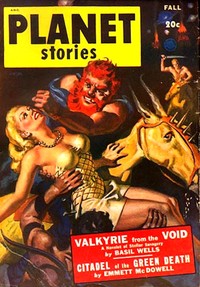
[Transcriber's Note: This etext was produced from Planet Stories Fall 1948. Extensive research did not uncover any evidence that the U.S. copyright on this publication was renewed.]
Every day people travel great distances to stand in silence before the statue at Southwestern Spaceport. It is a shrine.
The figure stands with arms raised in an upreaching, yearning gesture that invokes thoughts of man's potential greatness, and the face seen beneath the helmet wears an expression of inspired nobility and idealism. In the indestructible impervium alloy image that is his masterpiece, Hayden Brush successfully captured the spirit of enthusiasm and adulation which swept the world. In a strange way it is not so much a statue of an individual as of an idea, for the sculptor worked entirely from photographs taken with a telephoto lens. He never met his subject.
A plaque on the granite base carries numerous words--sacrifice for the Greater Good--advancement of Man's frontiers--conquest of disease and death. And a name, George Carlin. Whenever I read that I recall the ancient witticism about this history being the fabric of accepted lies. In it there is much truth.
On the moon is another shrine, unvisited because the surface of Luna is still a perilous and inhospitable place. No compelling work of art is to be found there. Nothing but a roughly circular blasted area containing scattered fragments of spaceship hull that scorch in the direct sunlight and freeze in the unrelieved darkness, riddled by colonies of creeping moon-lice that penetrate the toughest metal.
That is the real, the veritable shrine.
The idea of building a spaceship did not enter George Carlin's mind until after he contracted the dread--and at that time incurable--Matson's Disease. And then he thought of it only as the most spectacular form of suicide ever devised. That was typical of the man.
George Carlin, owner of Carlin Industries and indubitably the richest and worst spoiled individual on the North American continent, was an irresponsible egocentric who had never done anyone a good turn in all his thirty-six years of life. Bad turns he had done in plenty.
Take just this one example. A doctor had the effrontery to submit to a medical journal an article suggesting a possible connection between the bone-destroying virus infection called Matson's Disease and Carlin Industries' highly profitable operations in thawing Antarctic areas with atomic heat. He hinted that age-old spores might have been released from the melting ice, and been carried to seaports.
Carlin's private intelligence operatives got wind of the article before publication, and Carlin himself ordered that measures be taken. The campaign was short and filthy, ending with the unfortunate doctor discredited and barred from practice on framed evidence. The article was not printed.
And then came a morning when George Carlin noticed a slight soreness in his ribs and his fingers detected a peculiar flexibility. For a while he could not believe it. Such things just did not happen to him. To others perhaps, but he was above them. For he was George Carlin.
But when the symptoms not only persisted but increased he was at last forced to a realization of doom. Gradually his bones would soften and dissolve, until in a year or two he would be a mere lump of quivering flesh without a skeleton to give it shape. He did not tell his physician. That was useless, for the atypical plague had defied all efforts of medical science. Instead he reacted in characteristic fashion by getting grossly and disgustingly drunk.
During the hangover he decided upon suicide. There was nothing unique about this; thousands upon thousands of victims had taken the short road rather than helplessly endure the horrors of the final stages. But mere suicide was not enough for George Carlin. He was not just anybody. He was different.
With his money it had always been easier to arrange spectacular gestures than to force himself through the hard work necessary for more constructive achievements, and the substitutes had been just as satisfying to his ego. This habit of thought persisted even in planning his own death.
Verne Harris was an obscure junior engineer at one of Carlin Industries' minor branch plants. A confidential report rated him as extremely brilliant and original, although somewhat visionary and inclined to overlook commercial possibilities. His very obscurity was one of the reasons he was placed in charge of constructing the spaceship. He could be handled, and the impression would be given in all publicity releases that George Carlin himself was the moving force.
Carlin was annoyed at their first personal interview. Harris appeared fascinated by the technical problems presented and insufficiently impressed by George himself. Carlin felt slighted, but Harris possessed the ability. The only stipulations upon which Carlin insisted were that work be rushed and that all major arrangements should be made through him personally. It pleased him to keep the reins in his own hands.
And so the spaceship went into design and then production, with all other projects of Carlin Industries postponed or cancelled outright. Nothing, absolutely nothing, was allowed to interfere, and money was no object.
Once Harris recommended that three particular specialists be hired to work on the navigation equipment. When Carlin discovered that the men were under exclusive contract to American Calculator Company, which did not wish to release them, he issued orders backed by eighty million dollars. When the flurry of reorganization was over he owned majority control of American Calculator and took revenge for the slight delay by instituting policies that soon forced the other directors into bankruptcy.
Seven months later the ship lay in its launching rack on the Arizona desert. It was sleek and relatively small, built to carry a single man and fuel for a one-way trip to the moon, with oxygen and supplies to last five weeks. Harris had performed miracles of design, including several intricate devices intended to insure a not-too-rough landing, and in the nose compartment was stored a huge folding reflector and high-intensity light which could be set up and operated from the ship's electron-displacement power packs. Trajectory and power settings had been worked out and set up in the automatic control equipment.
The ship was intended to land in the dark of the moon, as Harris had calculated it would be easier to generate heat than to dissipate it on an airless surface.
Harris tried to explain to Carlin why he had not used the almost unlimited power of nuclear fission in the driving rockets. No shield against the deadly radiations had been devised and a human would have lived less than five minutes. But Carlin had not been interested. He lacked a technical education, and he was quite content that the ship was incapable of a round trip. It was more spectacular that way.
There had been a tremendous barrage of publicity throughout the construction period, but all of it dealt with Carlin Industries or George Carlin himself. Not a single public mention of Verne Harris had been made.
Carlin had spent those seven months alternating between prolonged drinking bouts and periods of flogging his organization to ever more frantic activity. Anything to avoid thinking. And it required increasingly clever and time-consuming use of cosmetics to hide the progress of his disease. Concealment was a compulsive psychological necessity, for Matson's Disease was so common, so plebian, that he felt deeply ashamed. More and more he insisted upon being entirely alone, afraid his secret might be discovered, conducting his affairs by telephone and radio.
Then one evening, with the ship awaiting only final loading, Harris drove over from the technicians' camp to the luxurious desert villa which Carlin had caused to be built near the launching site. The two men had come face to face only half a dozen times.
It was a thinner, older-looking Verne Harris than the young engineer who had accepted the assignment with such enthusiasm, and the haggard lines in his face showed the almost inhuman lengths to which he had driven himself.
"Arrangements for the liquid oxygen are complete and I'll be ready to blast off next Tuesday morning, right on schedule," the engineer opened the interview. "I came over to thank you for the wonderful opportunity you are giving me, and I promise you, sir, that I shall make the most of it."
Carlin came out of his chair with a roar.
"You don't think you are going to take that ship out?" he bellowed.
Verne looked profoundly shocked. No words had passed between them about who was to handle the vessel and Harris had assumed unquestioningly it would be he. It was only logical. Carlin had been smart enough to let him think that way, knowing that thus he would receive Harris' greatest efforts.
"Then who is?" the engineer asked.
"Me. I'll take it myself. That's why I had it built."
Harris looked incredulous. "But why?"
Carlin did not believe he owed him any explanation--he was receiving a fair salary--but something, perhaps a couple of drinks, made him speak.
"The ship is my way out," he said. "A way by which I shall be remembered. I have Matson's Disease."
If he had expected sympathy he was disappointed.
"So have I," Harris announced. "Can't you see?"
Carlin could, now that his attention was called to it. That subtle softening of the lines....
A flush spread across Harris' hollowed cheeks and his eyes took on an almost maniacal glitter.
"Look here, you. To you this is just a great big childish show-off trick. Like those people who hesitate and draw a big crowd before jumping from some tall building. And it will accomplish just about as much. You'll either louse up the controls and crash, or else you'll have enough liquor aboard to stay in a drunken stupor until your oxygen runs out."
The book keeps going
Keep reading, and see it illustrated
Reading is free forever. Sign up and watch scenes appear while you read.
Scenes Storieta drew for other classics.