Public-domain ebook
Against the Stone Beasts
by James Blish
English424 downloads on Project GutenbergDownload EPUB
Public-domain ebook sourced from Project Gutenberg #64630.
Public-domain ebook
by James Blish
English424 downloads on Project GutenbergDownload EPUB
Public-domain ebook sourced from Project Gutenberg #64630.
The opening · free to read
Down the time-track tumbled Andreson, to land in a continuum of ghastly matter-and-space reversal--and find a love that shattered the very laws of life!
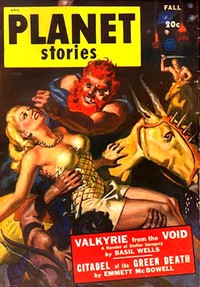
[Transcriber's Note: This etext was produced from Planet Stories Fall 1948. Extensive research did not uncover any evidence that the U.S. copyright on this publication was renewed.]
The letters on the fly-specked glass were simple, almost dogmatic. Andreson eyed them with some amusement. Art agents seldom have any taste, he thought; can't afford to.
The sign repeated, Special Showing of Surrealist Paintings, and declined to offer further information. Andreson started to walk on, then hovered indecisively. Modern arts of all kinds were his province in preparation for a doctorate thesis. It wouldn't do to let the smallest example go by without inspection. He went in.
The improvised gallery was musty with the odor of departed vegetables, and very cold. Like the sign, the show had been set up with a braggart simplicity. No programs, no furniture, no eager guides--there were not even any guards. Andreson wondered what was to stop a thief from stooping under the heavy rayon rope, which kept the frames out of reach of curious or greedy fingers, and making off with the whole collection.
With his first look at the paintings themselves, Andreson was blessing his good daemon fervently for having guided his footsteps. He could not place the works in any specific category; they certainly were not surrealistic, unless the word had been used in its original meaning of "super-realistic." The artist had used fantasy for his sources, true enough, but the results were not the usual shapelessness.
He angled his long body over the rope and inspected the nearest one. It was a huge canvas, reaching almost to the floor, and it depicted a building or similar structure like a glistening glass rod, rising from a forest of lesser rods toward a red sun of almost tangible hotness. A single figure, man-like, but borne aloft on taut, delicate wings which suggested a bat rather than a human, floated over the nearest of the towers. A quick glance revealed that all the paintings but one contained several of these shapes; the one exception was a field of stars with a torpedo streaking across it.
His quick glance confirmed another suspicion. The scenes were in deliberate order, as if attempting a pictorial history of the flying people. He felt vaguely disappointed. This stuff was garden-variety fantasy, verging on the conceptions of science-fiction. Still, there was a magnificent technique behind it all--a blending and effacing of brush-strokes which made the Dutch look like billboard-splashers, and a mastery of glaze which made each scene glow like an illuminated transparency.
This last painting by the door, for instance. It showed the translucent city again, with approximately the same details--but with a barely-perceptible dimming of the red sunlight, a single tower jaggedly shattered, a few other tiny touches, the artist had given it an atmosphere of almost unbearable desolation. It was the same fabulous metropolis--but it was tragic, deserted, lost. Peering hopelessly from the summit of the broken tower was a tiny face, looking directly upward at Andreson.
He allowed himself an appreciative shudder, and methodically went around the gallery, following the history the pictures built up. It seemed commonplace enough: a race of space-travellers who had colonized the Earth, perhaps some time in the dim past, had built a civilization, and had finally succumbed to some undepicted doom. What was amazing was the utterly convincing way the well-worn story was told. It was real--super-real, indeed, for it commanded more belief and sympathy than the everyday human tragedies.
Andreson took out his fountain pen and an unopened letter and walked toward the door. He must get the address of this place and attempt to locate the artist. John Kimball's inscription on the envelope reminded him that Johnny, though a scientist, dabbled in the arts and would be interested. He ripped open the flap, then stopped in mid-stride, ducked under the rayon cord to look at the spaceship scene.
In many ways this was the most wonderful of the lot. Even a night sky or a telescope field has no depth; it is merely a black surface containing spots of light; but the picture surpassed nature. It had a stereoscopic quality, all the more startling because it was impossible to ascertain how it was done. Andreson noted with a chuckle that the agent had placed the paintings in such order that there was a strong draft blowing toward the picture, as if being drained away into that awesome vacuum. A strictly phony trick, but clever nonetheless. Curious in spite of his better instincts, he put out a tentative finger to the surface of the scene--
The fountain pen clattered to the floor.
He gaped idiotically, and stirred with his finger at the nothingness where the picture still seemed to be. In his shock-numbed mind two words burned fiercely:
It's real.
Ridiculous. Tensely he forced himself to move his hand in deeper, against the yelling of his nerves. It struck a slight, tingling resistance, like a curtain of static electricity--and then the blood was pounding in each finger as if trying to burst through the skin. He snatched the hand back. There was a vacuum there; cut off from the room by some unseen force through which the air was leaking rapidly.
Teetering on the edge of panic, he struggled to make better sense of the facts. The prickly pounding he had felt in his fingers might well have been electrical and only that, and Johnny Kimball had once demonstrated for him the "static jet" which might explain the draft of air. Three-dimensional television, perhaps--
He shook his head. No inventor would set up a demonstration like this, in an abandoned grocery, without any announcement or literature; nor would there be likely to be eighteen screens, each one showing a motionless and quite impossible scene. No; it was insane, but these garish things were--
Windows.
Into what? Clutching at his frayed emotions, he took a step toward the next frame. His foot crunched on the forgotten fountain pen. For a second he flailed in terror at nothing, and then pitched head foremost over the low ledge.
Andreson said nothing and stared fixedly at the crimson glow underneath his eyelids. Physically he was unhurt, but his sanity was precarious. In his mind, behind the closed lids, it happened over and over again: the long twisting fall, with the great city spinning and growing beneath him in a riot of color, and damp hot air gushing past him, the sudden swooping of the dark figure and the thrum of wings. He tried to pass out again and awaken on the floor of the gallery, but the cold, chiming voice jabbed him awake again.
"This is quite real. You are intelligent enough to accept it--stop thinking like an infant."
The motherly reprimand under such circumstances planted a small germ of amusement somewhere in his mind, and he grasped it frantically and began to laugh, still keeping his eyes clenched shut. Even without seeing its face, he could feel the creature's alarm at his hysteria, but he allowed the shaking to exhaust him into a sort of calmness. Only when his breathing had become controlled and even did he allow himself a second look.
Red sunlight played harshly in upon him through the translucent walls of the small room, and burned sullenly within the crystal bar which crossed above his head. One wall was recessed with what seemed to be bookshelves, and odd articles of furniture stood here and there; but evidently none of them had been designed for humans, for he was lying on the smooth floor, his jacket bunched under his head. The cowled shape still arched over him with Satanic solicitude, black against the glare, and somehow smaller than he had expected it to be. He hoped that that cape would not expand into wings--not yet--for his new calm still stood at the shimmering verge of madness.
"Thank you," he said carefully. "I owe you my life."
The silhouetted head moved as if to dismiss the matter. "Your sudden appearance in mid-air was startling. We were fortunate that I happened to be in flight at the time."
With a whispering sound, like the rustling of heavy cloth, the figure moved out of the direct rays of the sun and settled gracefully against one of the furniture-like things. The light struck it full, and Andreson gasped and sat bolt upright.
She was winged, no doubt about that. But the bat-like impression those wings had given him seemed to have been only a product of distance. Seen in closeup, the wings were tawny and delicate, and traced with intricate veins, their ribs were close-set, the webbing like the sheerest silk. They rose from the girl's back where her shoulderblades should have been, and at rest curved around her sides and made a backdrop for her legs and feet.
Except for those gorgeous pinions, which set her off like two great Japanese fans, she might have been human, or close to it. She no more suggested the rodent than the goddess Diana would have suggested a female gorilla. The wings, something about the bony structure underlying her face, a vague otherness about her proportions--except for these minute differences she could have passed anywhere for a strikingly lovely human girl. Her clothing was brief and simple, and not weighted with ornaments, for she needed free limbs and no useless baggage for flight.
Andreson realized that he was goggling and rearranged his face as best he could. She did not seem to take his amazed inspection as anything but normal, however. "Are you a time-traveller?" she asked, tilted her head curiously. "We could think of no other explanation. Are you from our track?"
"I don't know," Andreson confessed. "My trip was accidental, and the mechanism is a mystery to me." He considered asking about the gallery, but the girl's questions had already told him it would be fruitless.
He masked his emotions in the mechanism of locating and lighting a cigarette, while the girl waited with polite patience. It was hard to forget that there was an obscure doom prophesied--or had it been merely narrated, as historical fact?--for this exquisite creature and her whole civilization, and he was determined to say nothing about it until he knew what he was talking about.
"I discovered in my time a sort of gateway to your time, and to seventeen other nearly synchronous moments, set up by a scientist unknown to me. Each of the gates seems to open upon one single specific instant. For instance: before I fell into the one which brought me here, I saw a figure I'm sure was yours. And it was motionless above the city, all the time that I was watching it."
He broke off suddenly. "Wait a minute. If this is another time--well, suppose you tell me: am I speaking your language, or do you know mine? Or are you a telepath?"
She laughed, each sound a clear, musical tone, as if she had been struck by a desire to sing the Bell Song. "Don't you know your own language when you hear it? No, the Varese are not telepathic--few races are. But a truly telepathic race allied with us has provided our culture with a good stock of equipment for tapping various parts of the mind. We use it for education. We simply tapped your language centers while you were unconscious."
The book keeps going
Reading is free forever. Sign up and watch scenes appear while you read.



Scenes Storieta drew for other classics.
New illustrated classics
Once or twice a month: the latest books to get full character casts, scene art, and free comic editions. No account needed.