Public-domain ebook
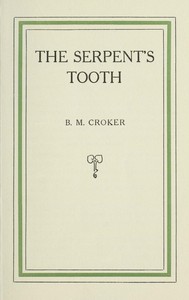
The Serpent's Tooth
by B. M. Croker
English464 downloads on Project GutenbergDownload EPUB
Public-domain ebook sourced from Project Gutenberg #64660.
Public-domain ebook
by B. M. Croker
English464 downloads on Project GutenbergDownload EPUB
Public-domain ebook sourced from Project Gutenberg #64660.
The opening · free to read
Colonel Fenchurch stood on his own hearthstone--that is to say, the smoking-room rug--with his back to the fire, and a cup of tea in his hand. He was a good-looking dapper little man, with a neat white moustache, a cheery voice, and an unfailing flow of talk.
“I say, Doodie,” turning to a lady in a splashed habit, who was meditatively consuming buttered toast, “weren’t the roads beastly? Just look at my boots and leathers!”
Doodie, his wife, nodded, but made no other reply.
“A clinking run,” he continued, “and a lot of those thrusters got left--you went well--eh?--that was a nasty place out of the round plantation!--on the whole--a good hard day!”
Once more his better-half inclined her hatted head; evidently her mind was preoccupied. She was staring fixedly at a certain pattern in the carpet, with a remote and far-away gaze; a plain weather-beaten lady whose age--much discussed among her acquaintances--was probably five-and-forty; her habit displayed a slight square-shouldered figure; a pot hat pushed to the back of her head disclosed the inevitable red mark, a long but aristocratic nose, and a clever resolute countenance.
Dorothy Fenchurch was a notable example of the strong-willed active woman, mated to a weak, easy-going, good-tempered man: and the match had proved a conspicuous success. In the opinion of Tom Fenchurch, no wife in the County was fit to hold a candle to his wonderful Dorothy--what a housekeeper, horsewoman, companion!--and for her part, his Dorothy was contented. Greedy of influence, social and domestic, she thoroughly enjoyed the rôle of manager and mentor. How much more satisfactory to rule in a small establishment, and over a limited circle, than to languish at home, the insignificant member of an important house, who kept their women-folk inflexibly in the background; and so it came to pass that twelve years previously, the Honourable Dorothy Claremont bestowed her hand and her fortune on agreeable Colonel Fenchurch, who had little to offer her, besides his handsome face, his retired pay, and his heart.
The couple had settled down in a ramshackle old house, in a ramshackle old village in the Midlands, inconveniently remote from the railway, but within easy reach of the principal Meets of a well-known sporting pack. The bride’s relations--who had not favoured the alliance--shrugged their shoulders and commiserated ‘poor Dorothy.’ They little knew that ‘poor Dorothy,’ now thoroughly free and independent, was as happy as the day was long!
Here, in the sleepy hamlet of Thornby, the Honble. Mrs. Fenchurch soon made her presence felt. She, so to speak, ‘took hold’ with both hands; stirred up the villagers, the parson, and the doctor; improved the old manor out of all recognition--and that at no great expense.
This energetic lady had the good fortune to discover a priceless treasure in the village carpenter, and he and a journeyman mason, a few odd men, with Mrs. Fenchurch as architect, threw out a window here, shut up a door there, and boldly altered the principal staircase. By and by when visitors arrived to call, and were beholders of these amazing triumphs, more than one exclaimed:
“Why on earth did we not think of taking The Holt, and doing it up? It is perfectly delightful--who would have guessed at its capabilities?”
But these envious folk never considered that its present tenant was endowed with an unusual supply of brains, enterprise, and courage. She was a born decorator, a skilled upholsteress, and had a positive genius for gardening. Before long, the attractions of The Holt were famous within a radius of ten miles--Mrs. Fenchurch seemed to know exactly where to find the prettiest chintzes, the most unique furniture, the newest roses; and her cleverness in picking up prizes in old curiosity shops had become a proverb. It was said, that in a back street of the county town she had actually bought a wonderful old Chippendale sideboard for fifteen shillings--but this would appear to be incredible.
For twelve years The Holt was acknowledged to be one of the pleasantest houses in the County, its inmates the most popular, important, and influential couple of the neighbourhood, and here Doodie Fenchurch (with good-natured Tom as her consort) reigned alone and supreme.
But now a change was imminent; a princess was about to enter into this kingdom--yes, and to enter within half an hour. Possibly this was why its mistress seemed so unusually silent and distrait.
The only sister of Colonel Fenchurch had made a runaway match with a harum-scarum Irishman, who was killed in India, leaving his widow almost penniless. She died soon afterwards, and the unnecessary infant who ought to have accompanied her mother, survived to be supported by the Fenchurch family--themselves uncomfortably impecunious. Now this girl was seventeen, and in spite of Mrs. Fenchurch’s lamentations, protestations, and suggestion that she should remain another year, Letty Glyn had left school, and was on her way to take up her abode with darling Uncle Tom, and dearest Aunt Dorothy.
Apparently dearest Aunt Dorothy was not warmly enthusiastic respecting her niece by marriage; but she was a woman who sedulously studied appearances. If Tom’s niece were turned out to earn her bread as companion or governess, what a talk there would be! There was positively no alternative, the girl must make her home at The Holt, in the character of le fâcheux troisième.
As a child, Letty had promised to be rather pretty, and Mrs. Fenchurch believed that with her own social advantages, she would marry her off ere long; but before arriving at this happy period, she resolved to make the poor relation useful in the house. She should dust china, arrange flowers, pour out tea, help in the garden, and take over the Mothers’ Sewing Club. Her own hands were more than full both at home and abroad (indeed, the influence of Mrs. Fenchurch now radiated far and wide), she was secretary here, treasurer and chairwoman there, and was often sorely pressed for time. Oh yes, Letty would have her uses; but all the same a girl in the house--a girl, who was always en evidence, to whom one must be a sort of model and sheep dog, would undoubtedly be an intolerable nuisance.
“I say,” began her husband, breaking in upon her reflections. She looked up at him quickly. “Isn’t Letty due about now? Six-thirty?”
“Oh yes, if the train is pretty punctual; but you know what these cross lines are.”
“Do you think she will be a little hurt at no one going to meet her--eh?”
“Hurt! My dear boy, what nonsense!”
“Well, of course, hunting is hunting, and Garfield Cross is our best meet. By the way, I suppose you sent the brougham? It’s an uncommonly cold, raw night.”
“The brougham? Certainly not! I sent the governess-car--yes,” in answer to his exclamation. “You see, dear, Collins has had three horses to do up--you know you had out two--you extravagant man, and I really couldn’t ask him to leave them all to James, so the boy took the car with the garden pony, and her luggage will come up to-morrow by the market-cart.”
“I say, old girl,” suddenly putting down his cup and going over to her, “it’s not a very warm reception, eh? The child has not been near us this five years--and it’s a long journey from Dresden, eh?” Then, in another and more caressing tone, he added, “You will be good to her, Doodie darling, won’t you? You can make it so awfully nice, if you like to, you know!”
“Am I not always what you call ‘good’ to my guests?” she demanded rather sharply.
“Oh, hang it all, Doodie, but she won’t be a guest! Letty is one of us, eh--isn’t she, old woman? Of course, I know it’s hard on you, and she has only her little bit of a pension; but a girl in the house will be cheery, eh? And you’ll take to her, I know,” and he put his arm round her neck, and gazed into her shrewd, thin face, and repeated, “Eh, darling, won’t you?”
Just at this moment the door opened, and a formal voice announced ‘Mrs. Hesketh.’
Mrs. Hesketh, a middle-aged lady with a stately carriage and the remains of great beauty, entered just in time to witness the caressing attitude of Colonel Fenchurch.
“We have had a row, you see!” he explained to the visitor with the gaiety of a schoolboy; “the old woman and I have had a shake-up, and been making it up--she will pound me out hunting. I call it deuced bad form, eh?”
Mrs. Hesketh, a widowed cousin who lived in the only other ‘house’ in the village, carefully removed her heavy sables before she replied.
“I should think, Tom, that you are used to that by this time. Had you had a good day?”
“Ripping!”
“Many out?”
“Oh, the usual lot, and Hugo Blagdon. By Jove! he does have wonderful cattle. I hear he pays as much as five hundred for a hunter. Yes, and he can ride them too,” he added with unusual generosity.
“But what brings him over to this side?” enquired Mrs. Hesketh with languid curiosity.
“He’s only staying at the ‘Black Cock’ at Ridgefield for a week or so--it’s more central than Sharsley. Sharsley is a good bit out of the way for everything; seven miles from a railway station--monstrous, isn’t it in these days?”
“Yes, but we need not boast. Sharsley is a lovely old place; I shouldn’t mind living there myself!”
“No,” he answered with a laugh; “and a heap of other ladies will say ditto to Mrs. Hesketh, eh, Doodie?” appealing to his wife.
“I can’t think what’s keeping her,” was the irrelevant reply.
Mrs. Hesketh stared at her cousin with grave-eyed interrogation.
“Oh, I mean Letty Glyn, Tom’s niece, you know, Maudie. Didn’t I tell you that we expect her this evening, by the two o’clock from St. Pancras?”
The book keeps going
Reading is free forever. Sign up and watch scenes appear while you read.



Scenes Storieta drew for other classics.
New illustrated classics
Once or twice a month: the latest books to get full character casts, scene art, and free comic editions. No account needed.