Public-domain ebook
Alpha Say, Beta Do
Language: en359 downloads on Project Gutenberg
Subjects
In: Science-Fiction & Fantasy·Humour·Adventure
Public-domain ebook sourced from Project Gutenberg #64722.
Public-domain ebook
Language: en359 downloads on Project Gutenberg
Subjects
In: Science-Fiction & Fantasy·Humour·Adventure
Public-domain ebook sourced from Project Gutenberg #64722.
The opening · free to read
Precise Doyle Tindar and prim Kay Kanton had themselves duplicated, standard practice for trouble-shooting in space. But the duplicates fell in love--and what happened then was neither practice nor standard!
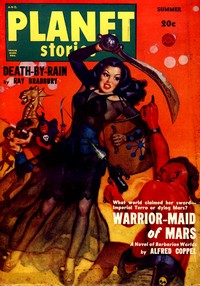
[Transcriber's Note: This etext was produced from Planet Stories Summer 1950. Extensive research did not uncover any evidence that the U.S. copyright on this publication was renewed.]
Doyle Tindar was awakened by the urgent buzzing of the visor-phone by his bed. He grumbled, rolled over, glanced at the view-plate and winced as he saw the fat, grim face of the Control Board Director, Sam Penset. He sat up, yawned, and snapped the set on.
"Yeah?"
"Listen, Tindar," Penset boomed and Tindar turned the volume down. "We've got a large pile of trouble. No reports from the mines on Bolus last night. Automatic radio communication absolutely dead. Power plant may have caught a meteor, but it would have to be a large one. Telescope won't tell us anything. Get out there, will you?"
"Say, I'm on vacation, if you don't mind," Tindar said. "What about Bedding? Or Teppen?"
"Bedding's on a honeymoon, damn him," Penset growled, "and Teppen's getting some new teeth planted. It has to be you."
"Miss Kanton's going out there tomorrow," Tindar insisted, not relishing a space trip since he was on his first vacation in a year.
"I've thought of that," Penset boomed back. "She couldn't report fully on the state of affairs. She's a meter-reader. Strictly a control-room worker. Nothing to do with the power plant or the actual mines."
"Okay," Tindar sighed, "I'll get on it. I'll leave Hessing Field this afternoon. Do I get a bonus?"
"Yeah, you thief," Penset smiled, "but get duplicated. You'll have enough work for two men."
"Okay."
"And, Tindar--" Penset signaled him to stay on the air--"I've just thought of something. Miss Kanton had better go to Bolus with you. Might as well clean up the whole mess at once."
"Okay," Tindar said, waved and shut the set off.
He climbed out of bed very slowly and shuffled across the room in a pair of frayed slippers. He went to the bathroom, mixed and drank a stimulant to snap him out of his stupor. He lit a cigarette and rummaged around in his closet until he found his space suit.
Since Miss Kanton was going to be on the trip with him, the job was more attractive. He mused about the very nice-looking Miss Kanton for a moment, then began dressing hurriedly. He'd have to get down to the duplication labs before the noon rush.
Washed, attired in the space suit he wanted his duplicate to wear, and considerably more awake, Tindar stood before the reception desk of the Central Commercial Duplication Laboratories of North America with his governmental certificates of permission for his "duping." The white-uniformed woman receptionist studied his certificates, handed him an identification disc and waved him on. She pressed a button on the desk and the information about him was wired to the other stations.
An attendant met and ushered him down a long, cool, white corridor to the section of the building devoted to the duplication of living matter. Another attendant took him from the first and whisked him up in an elevator to the floor where, as the somber sign stated, "Duplication of the Human Being" was carried on. He was directed to a pneumatic chair in the waiting room and he sat down.
Tindar had never ceased to wonder at the startling work done in this massive building, which most people, over the course of the last hundred years of its use, had come to consider a natural part of the bustling, scientific worlds. C.D. Labs, holding a benevolent monopoly on the process, could duplicate anything composed of atoms and smaller than a three-storied dwelling in a matter of minutes. The products of such duplication existed only for a period of about eighty hours, but it had proved to be a tremendously utilitarian device in duplicating oil and coal for immediate use; in duplicating the bodies of persons undergoing operations for dissection before the operation; for creating microbes of diseases and studying their effects upon the body, after which they would conveniently disappear, and for duplicating persons whose talents or brawn were needed briefly for special problems. This last use had been a great aid to industries by providing living, breathing, duplicates of specially trained men in times of need; which times were frequent since the peoples of earth were spread so thinly over seven planets and thousands of asteroids.
A nurse came into the waiting room with a glass of brown fluid on a tray. Tindar, no novice at duplication, smiled at the nurse in recognition, took the glass and drank it down. It was a sedative that would put him deeply to sleep in a few minutes, so that he could be pleasantly oblivious to the slight discomfort of the duplication cell.
He followed the nurse into the "Dupe" room and ran a familiar eye over the shining and ponderous equipment. He knew the theory vaguely. Space, warped, formed positive and negative fields. These fields, subjected to warping and energy changes, formed nascent matter, unstable and simple. Warped again, the inchoate matter formed into molecular substances identical with the pattern electrically projected into it. Whatever was placed in the primary chamber was pierced back and forth at every possible angle by a thousand different types of rays and emanations from the energy sources about the primary chambers. These rays were then the energy directed into the swirling haze of nascent matter. An identical object would take form in about five minutes time and the product's differences from the "pattern object" could not be detected by the strongest microscope.
"Simple," the man in the street might say. Tindar, more familiar with the theory of operation, was also more conscious of the hundreds and hundreds of years of research upon which the theory was based. He had always held a tremendous respect for the scientists who fathered the amazing invention.
Tindar climbed up onto the pneumatic cot and was slipped into the primary cylinder. He was slipping slowly into the mist of sleep as the door of the primary chamber clanked softly behind him. He gazed for a moment at the thousand lens-eyes on the curving walls about him. The eyes suddenly shown with all the colors of the spectrum and bathed his body in a weird and twisted rainbow of heterogeneous rays....
Two Tindars awoke abruptly and sat up on the pneumatic cots. They saw that the cots had been moved and rested against another in a corner of the room. They looked at one another.
"Who's who?" one of them asked.
"We'll have to wait for the attendants," the other shrugged. It was odd. That was practically all you ever had to say to yourself.
Down the hall feet slapped rapidly on the floor and approached the "Dupe" chamber. A taut-faced attendant looked into the room and waved at them frantically with a trembling hand.
"Don't get off your cots, please, sirs," he quavered and was gone.
The Tindars stared at one another.
"Something novel," they both said.
"Listen to the hell they're raising in the other room," one said, breaking the identity of their thought streams.
Visor-phones were buzzing; at least a dozen voices were raised in a furious discussion. Another voice could be heard, pleading and distraught. More attendants ran up and down the hall before the "Dupe" chamber. Three uniformed men with faces as white as their uniforms rushed through the waiting room and faced the Tindars.
"Dr. Bronsky will be here in a moment, sirs," one of them said.
"What's the matter?" one of the Tindars asked.
"Dr. Bronsky will be here presently, sirs," the attendant repeated.
Dr. Bronsky came into the room with a retinue of flustered assistants. He nodded to the Tindars and worked his lips around as he waited for a pale little man to shuffle nervously into the room.
"Now, Endicott, how did you move the cots around? Try to remember." The doctor spoke with a fatherly air to the little man.
"I don't know ... I was thinking of something else," Endicott whined. "I was polishing the floors. They have to be cleaned by ten o'clock. I was working with the sterilizer on the floors. I moved the cots to get them out of my road. I thought they were identified."
"Thought!" snorted Dr. Bronsky. "Since when does a damned fool think!"
"I'm sorry, Dr. Bronsky," the little man pleaded. "It's a rule. The floors have to be cleaned...."
The book keeps going
Reading is free forever. Sign up and watch scenes appear while you read.



Scenes Storieta drew for other classics.
New illustrated classics
Once or twice a month: the latest books to get full character casts, scene art, and free comic editions. No account needed.