Public-domain ebook
Tickets to Paradise
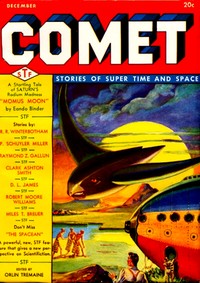
by D. L. James
Language: en375 downloads on Project Gutenberg
Subjects
In: Science-Fiction & Fantasy·Adventure
Public-domain ebook sourced from Project Gutenberg #64791.
Public-domain ebook
by D. L. James
Language: en375 downloads on Project Gutenberg
Subjects
In: Science-Fiction & Fantasy·Adventure
Public-domain ebook sourced from Project Gutenberg #64791.
The story opens as a first‑person narrator, Curt Lavin, is drawn into an impromptu archaeological expedition across Iran’s newly built “crazy” railroad. The narrator meets Dr Champ Chadwick, a diminutive, hard‑working archaeologist funded by a Pennsylvania university, who is hunting the legendary Ice Stone, a black, cursed block said to trap a man’s hand unless he amputates it. Their journey takes them through desolate towns, salt‑swamp valleys and remote mountain passes, where they encounter the enigmatic Rog Tanlu, a pale‑skinned stranger claiming to be a refugee from an Ice‑Age civilization and wielding futuristic devices that defy the surrounding world. The opening establishes a blend of desert travel, scholarly intrigue, and the first hints of speculative technology that will drive the tale forward.
The prose reflects the early‑mid‑20th‑century pulp tradition, with a brisk, dialogue‑heavy narrative that mixes dry observational detail and vivid, almost cinematic description of the Iranian landscape. The voice is that of an adventurous narrator who balances skepticism with curiosity, while the style leans toward the speculative‑science storytelling of the era, offering both archaeological mystery and a touch of time‑travel fantasy. Readers who enjoy tightly paced adventure set against exotic locales, and who appreciate a mix of hard‑boiled dialogue with speculative concepts, will find this opening compelling.
The opening · free to read
"I've been doing a little digging over in Iraq," he said offhand. "But things quieted down there. So now I'm bound for the desert and mountains to the north of here. This railroad has opened things up. It's difficult to get an expedition financed, you know, and transportation is sometimes the chief item."
I began to catch on that he was one of those guys who dig up ruins and things, and read a country's whole past from what they find. Then he went on to tell that he'd been sent out by a university in Pennsylvania, but that this present trip was just a sudden idea of his own.
And as he talked I began to like Dr. Chadwick. He was a serious-faced, rawboned little guy--not half my size--with steady eyes, a firm chin, and black hair plastered down slick on his head. By and by he got around to mention that he was looking for a strong-backed man to take along with him.
"I intend to strike out from Qum, the holy city," he said. "I'll try to get hold of a motor-truck there--and one of these desert men to drive it. They're rotten drivers though," he added, "and next to a dead loss on a trip like this." Then he sighed. "But I'm getting used to 'em."
"What do you expect to find up there?" I asked.
"The usual thing," he answered, as if that ought to explain everything. "This country is full of ruins. It's so old, in fact, that sometimes I think that everything that can happen has already happened here, at one time or another. Take Qum, for instance. A few years back there were twenty thousand ruined and deserted buildings still standing. These walled towns are like coral islands, surrounded and upheld by the dust and decay of their own past. But I'm looking for something farther back--much farther back."
He paused, then suddenly his eyes brightened. "There's one thing, though. I may have a try at finding the Ice Stone."
"The Ice Stone?" I echoed. "And what's that?"
"Perhaps just a legend. It isn't likely you would ever have heard of it. It's supposed to be a black stone, a huge, square block, set in the side of a mountain. If a man touches it, his hand sinks in, and he can get loose only by amputating. The queer part is, there seems to be some basis for the legend. All down through Iran's history there are disconnected references. The thing keeps cropping up. Vague reports from wandering tribes, with one or more cripples, minus an arm or leg, to verify the yarn. So, I may take a shot at locating the Ice Stone."
Queer stories like that are quite common in Iran. Ordinarily I'd have laughed and forgotten it. But as I say, I'd taken a sort of liking to this serious-faced little Dr. Champ Chadwick. And when you like a man you're bound to think twice before discrediting what he believes in.
"So you'll be taking a ride over this crazy railroad," I remarked thoughtfully, somewhat later.
He nodded. "What makes you call it crazy?"
Well, I told him. Of course he already knew quite a lot about Iran's new railroad--the many-million dollar toy of the "Brother of the Moon and Stars," as the fancy-tongued Iranians like to call their shah. This road writhes and twists and climbs through eight hundred miles of queer, mountainous country--a country of mud and rocks and salt-swamps--and carefully avoids all the important towns. You see, the "King of Kings"--another pet name for Shah Pahlavi--is afraid some of his neighbors might get control of the road and use it against him. These same neighbors sneeringly refer to it as the road that leads from "nowhere to nowhere."
Perhaps they aren't far wrong. But this road was the reason for my meeting up with Dr. Champ Chadwick.
The last spike, a gold one, had just been hammered into its tie by the "Most Lofty of Living Men" himself. That put our outfit out of a job temporarily. You see, I'd been working for McKardin-Malroy, an American contracting company, to whom the Shah had let out part of the constructional works on his railroad.
So, in the end, I of course took the job this Chadwick had sort of dangled under my nose. The pay wasn't anything worth mentioning; but, as I found out later, he himself was supplying the cash for this trip out of his own pocket. He didn't have much, and so expenses had to be cut to the limit.
Things moved fast after that. I'd always had an idea that such trips were planned carefully, months in advance, detail by detail. But this Doc Champ, as I got to calling him, didn't seem to plan anything--he just acted.
The next day Doc and I rode back over that crazy railroad I'd helped build--a road that winds through a maze of tunnels, one a grotesque spiral affair, over high bridges and gorge viaducts. We passed through Dizful, famed city of rats; Sultanabad, city of rugs; and on to the holy city of Qum.
Two days later, with Doc's whole scant outfit stored in the truck he'd managed to purchase, we were grinding out through squalid towns of ancient, one-story huts toward the salt swamp of Kavir and the lonely stretch of mountains to the north.
"Notice the way the dew lies there on the grass?" he said to me one morning, just as the sun was rising and we were breaking camp. "We slept right over the foundation walls of what was once part of an ancient city."
I squinted at where he was pointing, and, sure enough, I could see the grass was all marked out in big squares--showing up only in the way the dew sparkled, or didn't sparkle, in the slanting sunlight.
"Difference in heat and moisture conductivity," explained Doc. "Those walls are probably only a little way beneath the surface."
"You want to dig here?" I asked him.
He shook his head. Since that time when he told me about the Ice Stone, he'd never mentioned it again. But I had noticed him squinting at all the mountains we passed, and sometimes I'd see a queer expression on his face, like a man who catches himself doing something that hasn't got good sense back of it.
In fact, by the end of the week, I had about decided that he didn't have any better idea as to why we'd come out here than I did.
I think it was on the seventh day that we came upon a queer-looking country--isolated masses of rock, like big blocks, sticking up out of the ground. Beyond these was a range of low mountains, or big hills, whichever way you look at it.
"We'll camp here for a day," said Doc. "How's the water?"
"About gone," I told him.
"Good," he nodded. "We'll run the truck up to the foot of those big hills and find some."
I headed that old bus for a sort of fold in the hills ahead, and when the ground began to get pretty rough we stopped and went on afoot, each carrying a couple of empty water buckets. It wasn't long before we found a shallow stream.
"There may be a spring farther up," said Doc.
He started splashing along the creek bed, for it was bordered by dense thickets of "jangal"--birch and box--through which you could scarcely squeeze.
I followed him. Pretty soon I smelled smoke.
"Hey, Doc!" I called, "something's burning."
He stopped and turned around. There was a queer look in his eyes, almost like he wasn't all there--dopey.
"Yes," he said, not seeming surprised at all. Then he pointed ahead. "Smoke--I saw it some time back."
He started on again. The whole thing wasn't natural. For almost a week we had seen no living human being. And now, smoke--a wood fire, as I could tell by the scent--seemed to mean that we were getting near where someone lived. And yet, Doc hadn't thought it worth mentioning!
Well, I followed him on for a hundred yards. Then we turned a bend in the creek. The jangal opened up, and there, under the spread of a huge plane-tree, was the fire.
It was a small fire. Over it, roasting to a turn, were three dangling fowls; and near by stood a strange human figure--a man.
He beckoned to us. And as we approached he stood with folded arms, facing us.
The book keeps going
Reading is free forever. Sign up and watch scenes appear while you read.



Scenes Storieta drew for other classics.
New illustrated classics
Once or twice a month: the latest books to get full character casts, scene art, and free comic editions. No account needed.