Public-domain ebook
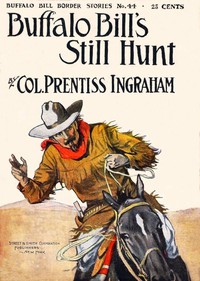
Buffalo Bill's Still Hunt; Or, The Robber of the Range
Language: en580 downloads on Project Gutenberg
Subjects
Public-domain ebook sourced from Project Gutenberg #64800.
Public-domain ebook
Language: en580 downloads on Project Gutenberg
Subjects
Public-domain ebook sourced from Project Gutenberg #64800.
The opening · free to read
(BUFFALO BILL).
It is now some generations since Josh Billings, Ned Buntline, and Colonel Prentiss Ingraham, intimate friends of Colonel William F. Cody, used to forgather in the office of Francis S. Smith, then proprietor of the New York Weekly. It was a dingy little office on Rose Street, New York, but the breath of the great outdoors stirred there when these old-timers got together. As a result of these conversations, Colonel Ingraham and Ned Buntline began to write of the adventures of Buffalo Bill for Street & Smith.
Colonel Cody was born in Scott County, Iowa, February 26, 1846. Before he had reached his teens, his father, Isaac Cody, with his mother and two sisters, migrated to Kansas, which at that time was little more than a wilderness.
When the elder Cody was killed shortly afterward in the Kansas “Border War,” young Bill assumed the difficult rôle of family breadwinner. During 1860, and until the outbreak of the Civil War, Cody lived the arduous life of a pony-express rider. Cody volunteered his services as government scout and guide and served throughout the Civil War with Generals McNeil and A. J. Smith. He was a distinguished member of the Seventh Kansas Cavalry.
During the Civil War, while riding through the streets of St. Louis, Cody rescued a frightened schoolgirl from a band of annoyers. In true romantic style, Cody and Louisa Federci, the girl, were married March 6, 1866.
In 1867 Cody was employed to furnish a specified amount of buffalo meat to the construction men at work on the Kansas Pacific Railroad. It was in this period that he received the sobriquet “Buffalo Bill.”
In 1868 and for four years thereafter Colonel Cody served as scout and guide in campaigns against the Sioux and Cheyenne Indians. It was General Sheridan who conferred on Cody the honor of chief of scouts of the command.
After completing a period of service in the Nebraska legislature, Cody joined the Fifth Cavalry in 1876, and was again appointed chief of scouts.
Colonel Cody’s fame had reached the East long before, and a great many New Yorkers went out to see him and join in his buffalo hunts, including such men as August Belmont, James Gordon Bennett, Anson Stager, and J. G. Heckscher. In entertaining these visitors at Fort McPherson, Cody was accustomed to arrange wild-West exhibitions. In return his friends invited him to visit New York. It was upon seeing his first play in the metropolis that Cody conceived the idea of going into the show business.
Assisted by Ned Buntline, novelist, and Colonel Ingraham, he started his “Wild West” show, which later developed and expanded into “A Congress of the Rough Riders of the World,” first presented at Omaha, Nebraska. In time it became a familiar yearly entertainment in the great cities of this country and Europe. Many famous personages attended the performances, and became his warm friends, including Mr. Gladstone, the Marquis of Lorne, King Edward, Queen Victoria, and the Prince of Wales, now King of England.
At the outbreak of the Sioux, in 1890 and 1891, Colonel Cody served at the head of the Nebraska National Guard. In 1895 Cody took up the development of Wyoming Valley by introducing irrigation. Not long afterward he became judge advocate general of the Wyoming National Guard.
Colonel Cody (Buffalo Bill) died in Denver, Colorado, on January 10, 1917. His legacy to a grateful world was a large share in the development of the West, and a multitude of achievements in horsemanship, marksmanship, and endurance that will live for ages. His life will continue to be a leading example of the manliness, courage, and devotion to duty that belonged to a picturesque phase of American life now passed, like the great patriot whose career it typified, into the Great Beyond.
BUFFALO BILL’S STILL HUNT.
The Rio Grande, the great dividing-line between Mexico and the United States, was swelling rapidly into a flood under recent rains, which had sent torrents dashing from the mountain lands toward the Gulf.
A carriage, drawn by two horses, had halted upon the banks at the ford, the Mexican driver on the box seeming afraid to venture into the turbid stream.
Within the vehicle were two persons, one in the garb of a nun of the Church of Rome, the other a young and beautiful girl of sixteen, with dark hair and glorious eyes that revealed her Spanish blood.
“Well, Pedro, why do you halt here?” asked the nun of the driver.
“It is dangerous to cross, Sister Felicite,” was the answer.
“And the river is rising?”
“It is, sister.”
“You know the ford, Pedro?”
“Perfectly, sister.”
“How deep will the waters come?”
“They will wash through the carriage, Sister Felicite.”
“Then what is to be done, Pedro?”
“Alas! I know not,” was the dejected reply.
“If you return, the road is dangerous, night is coming on, and there is no ranch within fifteen miles.”
“Very true, sister.”
“What shall we do, then?” the nun asked anxiously.
“Place greater weights in the carriage, sister; open the doors, to let the water run through and not wash it away; let me mount the box with Pedro, to use the whip, while he manages the horses, and we can get across.”
The speaker was the young girl, and the nun looked at her with an expression of amazed horror.
“Why, child, what do you mean?”
“Oh, Sister Felicite, I do not mind a ducking or danger, for I have crossed many a stream beyond its banks.”
“The señorita is right, Sister Felicite, for it is our only chance,” Pedro said.
“And the river is constantly rising, so that there is no time to delay,” Nina de Sutro remarked, in a determined manner, her face full of spirit and courage.
“What do you think, Pedro?” asked the nun.
“It is all that we can do, sister.”
“Then act upon the Señorita Nina’s suggestion at once.”
The driver sprang from his box, and at once began to pack the vehicle with stones to weight it down.
The baggage was taken from the boot and placed on top, and Sister Felicite mounted there, also, seated upon the cushions.
The book keeps going
Reading is free forever. Sign up and watch scenes appear while you read.



Scenes Storieta drew for other classics.
New illustrated classics
Once or twice a month: the latest books to get full character casts, scene art, and free comic editions. No account needed.