Public-domain ebook
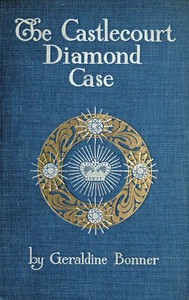
The Castlecourt Diamond Mystery
Language: en424 downloads on Project Gutenberg
Subjects
In: Crime, Thrillers and Mystery·Novels·British Literature
Public-domain ebook sourced from Project Gutenberg #64934.
Public-domain ebook
Language: en424 downloads on Project Gutenberg
Subjects
In: Crime, Thrillers and Mystery·Novels·British Literature
Public-domain ebook sourced from Project Gutenberg #64934.
The Castlecourt Diamond Mystery is a detective tale set in the glittering world of early‑20th‑century British aristocracy. The story is narrated by a long‑serving lady‑in‑waiting who has been in the Castlecourt household for two years, and she opens by recounting the moment the prized family diamonds vanish while the family is at the fashionable Burridge’s Hotel for the season. The opening scene establishes the social backdrop, London society, Paris excursions, and the opulent yet restless Marchioness of Castlecourt, while introducing the key players: the impatient lord, his flamboyant wife, the loyal footman Chawlmers, and the seemingly modest maid Sara Dwight, whose unassuming demeanor will later prove significant. The narrative promises a close‑up of the theft’s circumstances, focusing on the servant’s perspective rather than the ensuing investigation.
The voice is that of a dutiful, observant servant, written in a measured, slightly formal prose that reflects the Edwardian sensibility of the 1920s. Geraldine Bonner’s style blends detailed social description with a hint of intrigue, allowing readers to feel both the elegance of the setting and the tension of a missing heirloom. Fans of classic whodunits, especially those who enjoy mysteries that unfold through the eyes of domestic staff and feature the glitter of jewelry theft, will find this novel engaging. It also appeals to readers who appreciate period‑specific character sketches and the subtle interplay of class and suspicion.
The opening · free to read
Statement of Sophy Jeffers, lady’s maid to the Marchioness of Castlecourt.
Statement of Sophy Jeffers, lady’s maid to the Marchioness of Castlecourt.
I had been in Lady Castlecourt’s service two years when the Castlecourt diamonds were stolen. I am not going to give an account of how I was suspected and cleared. That’s not the part of the story I’m here to set down. It’s about the disappearance of the diamonds that I’m to tell, and I’m ready to do it to the best of my ability.
We were in London, at Burridge’s Hotel, for the season. Lord Castlecourt’s town house at Grosvenor Gate was let to some rich Americans, and for two years now we had stayed at Burridge’s. It was the third of April when we came to town--my lord, my lady, Chawlmers (my lord’s man), and myself. The children had been sent to my lord’s aunt, Lady Mary Cranbury--she who’s unmarried, and lives at Cranbury Castle, near Worcester.
Lord Castlecourt didn’t like going to the hotel at all. Chawlmers used to tell me how he’d talk sometimes. Chawlmers has been with my lord ten years, and was born on the estate of Castlecourt Marsh Manor. But my lord generally did what my lady wanted, and she was not at all partial to the country. She’d say to me--she was always full of her jokes:
“Yes, it’s an excellent place, the country--an excellent place to get away from, Jeffers. And the farther away you get the more excellent it seems.”
My lady had been born in Ireland, and lived there till she was a woman grown. It’s not for me to comment on my betters, but I’ve heard it said she didn’t have a decent frock to her back till old Lady Bundy took her up and brought her to London. Her father was a clergyman, the Rev. McCarren Duffy, of County Clare, and they do say he hadn’t a penny to his fortune, and that my lady ran wild in cotton frocks and with holes in her stockings till Lady Bundy saw her. I’ve heard tell that Lady Bundy said of her she’d be the most beautiful woman in London since the Gunnings (whoever they were), and just brought her up to town and fitted her out from top to toe. In a month she was the talk of the season, and before it was over she was betrothed to the Marquis of Castlecourt, who was a great match for her.
But she was the beggar on horseback you hear people talk about. Lord Castlecourt wasn’t what would be called a millionaire, but he gave her more in a month than she’d had before in five years, and she’d spend it all and want more. It seemed as if she didn’t know the value of money. If she’d see a pretty thing in a shop she’d buy it, and if she had not got the ready money they’d give her the credit; for, being the Marchioness of Castlecourt, all the shop people were on their knees to her, they were that anxious to get her patronage. Then when the bills would come in she would be quite surprised and wonder how she had come to spend so much, and hide them from Lord Castlecourt. Afterward she’d forget all about them, even where she’d put them.
Lord Castlecourt was so fond of her he’d have forgiven her anything. They’d been married five years when I entered my lady’s service, and he was as much in love with her as if he’d been married but a month. And I don’t blame him. She was the prettiest lady, and the most coaxing, I ever laid eyes on. She might well be Irish: there was blarney on her tongue for all the world, and money ready to drop off the ends of her fingers into any palm that was held out. There was no story of misfortune but would bring the tears to her eyes and her purse to her hand: generous and soft hearted she was to every creature that walked. No one could be angry with her long. I’ve seen Lord Castlecourt begin to scold her, and end by laughing at her and kissing her. Not but what she respected him and loved him. She did both, and she was afraid of him too. No one knew better than my lady when it was time to stop trifling with my lord and be serious.
It was Lord Castlecourt’s custom to go to Paris two or three times every year. He had a sister married there of whom he was very fond, and he and her husband would go off shooting boars to a place with a name I can’t remember. My lady was always happy to go to Paris. She’d say she loved it, and the theaters, and the shops--tho what she could see in it I never understood. A dirty, messy city, and full of men ready to ogle an honest, Christian woman, as if she was what half the women look like that go prancing along the streets. My lady spent a good deal of her time at the dressmakers, and she and I were forever going up to top stories in little, silly lifts that go up of themselves. I’d a great deal rather have walked than trusted myself to such unsafe, French contrivances--underhand, dangerous things, that might burst at any moment, I say.
The year before the time I am writing of we went to Paris, as usual, in March. We stopped at the Bristol, and stayed one month. My lady went out a great deal, and between-whiles was, as usual, at what they call there “_couturières’_,” at the jewelers’, or the shops on the Rue de la Paix. She also bought from Bolkonsky, the furrier, a very smart jacket of Russian sable that I’ll be bound cost a pretty penny. When we went back to London for the season her beauty and her costumes were the talk of the town. Old Lady Bundy’s maid told me that Lady Bundy went about saying: “And but for me, she’d be the mother of the red-headed larrykins of an Irish squireen!” Which didn’t seem to me nice talk for a lady.
We spent that summer at Castlecourt Marsh Manor very quietly, as was my lord’s wish. My lady did not seem in as good spirits as usual, which I set down to the country life that she always said bored her. Once or twice she told me that she felt ill, which I’d never known her to say before, and one day in the late summer I discovered her in tears. She did not seem to be herself again till we went to Paris in September. Then she brightened up, and was soon in higher spirits than ever. She was on the go continually--often would go out for lunch, and not be back till it was time to dress for dinner. She enjoyed herself in Paris very much, she told me. And I think she did, for I never saw her more animated--almost excited with high spirits and success.
The following spring we left Castlecourt Marsh Manor, and, as I said before, came to Burridge’s on April the third. The season was soon in full swing, and my lady was going out morning, noon, and night. There was no end to it, and I was worn out. When she was away in the afternoon I’d take forty winks on the sofa, and have Sara Dwight, the housemaid of our rooms, bring me a cup of tea, when she’d sometimes take one herself, and we’d gossip a bit over it.
If I’d known what an important person Sara Dwight was going to turn out I’d have taken more notice of her. But, unfortunately, thieves don’t have a mark on their brow like Cain, and Sara was the last girl any one would have suspected was dishonest. All that I ever thought about her was that she was a neat, civil-spoken girl, who knew her betters and her elders when she saw them. She was quick on her feet, modest and well-mannered--not what you’d call good-looking: too pale and small for my taste, and Chawlmers quite agreed with me. The one thing I noticed about her were her hands, which were white and fine like a lady’s. Once when I asked her how she kept them so well, she laughed, and said, not having a pretty face, she tried to have pretty hands.
“Because a girl ought to have something pretty about her, oughtn’t she, Miss Jeffers?” she said to me, quiet and respectful as could be.
I answered, as I thought it was my duty, that beauty was only skin deep, and if your character was honest your face would take care of itself.
She looked down at her hands, and smiled a little and said:
“Yes, I suppose that’s true, Miss Jeffers. I’ll try to remember it. It’s what every girl ought to feel, I’m sure.”
Sara Dwight had the greatest admiration for Lady Castlecourt. She’d manage to be standing about in doorways and on the stairs when my lady passed down to go to dinner and to the opera. Then she’d come back and tell me how beautiful my lady was, and how she envied me being her maid. While she was talking she’d help me tidy up the room, and sometimes--because she admired my lady so--I’d let her look at the new clothes from Paris as they hung in the wardrobe. Sara would gape with admiration over them. She spoke a little about my lady’s jewels, but not much. I’d have suspected that.
It was in the fifth week after we came to town--to be exact, on the afternoon of the fourth day of May--that the diamonds were stolen. As I’d been so badgered and questioned and tormented about it, I’ve got it all as clear in my head as a photograph--just how it was and just what time everything happened.
That evening my lady was going to dinner at the Duke of Duxbury’s. It was to be a great dinner--a prince and a prime minister, and I don’t know what all besides. My lady was to wear a new gown from Paris and the diamonds. She told me when she went out what she would want and when she would be back. That was at four, and I was not to expect her in till after six.
Some time before that I got her things ready, the gown laid out, and the diamonds on the dressing-table. They were kept in a leather case of their own, and then put in a despatch-box that shut with a patent lock. When we traveled I always carried this box--that is, when my lady used it. A good deal of the time it was at the bankers’. Lord Castlecourt was very choice about the diamonds. Some of them had been in his family for generations. The way they were set now--in a necklace with pendants, the larger stones surrounded by smaller ones--had been a new setting made for his mother. My lady wanted them changed, and I remember that Lord Castlecourt was vexed with her, and she couldn’t pet and coax him back into a good humor for some days.
One of the last things that I did that afternoon while arranging the dressing-table was to open the despatch-box and take the leather case out. Tho it was May, and the evenings were very long, I turned on the electric lights, and, unclasping the case, looked at the necklace.
I was standing this way when Chawlmers comes to the side door of the room (the whole suite was connected with doors), and asks me if I could remember the number of the bootmakers where my lady bought her riding-boots. Some friend of Chawlmers wanted to know the address. I couldn’t at first remember it, and I was standing this way, trying to recollect, when I heard the clock strike six. I told Chawlmers I’d get it for him. I was certain it was in my lady’s desk, and I put the case down on the bureau, and Chawlmers and I together went into the sitting-room (the door open between us and my lady’s room) and looked for it. We found it in a minute, and Chawlmers was writing it down in his pocket-book when I thought I heard (so light and soft you could hardly say you’d heard anything) a rustle like a woman’s skirt in the next room. For a second I thought it was my lady, and I jumped, for I’d no business at her desk, and I knew she’d be vexed and scold me.
The book keeps going
Reading is free forever. Sign up and watch scenes appear while you read.



Scenes Storieta drew for other classics.
New illustrated classics
Once or twice a month: the latest books to get full character casts, scene art, and free comic editions. No account needed.