Public-domain ebook
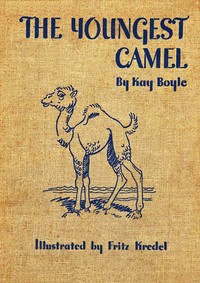
The Youngest Camel
by Kay Boyle
Language: en483 downloads on Project Gutenberg
Subjects
In: Children & Young Adult Reading·Adventure·Novels
Public-domain ebook sourced from Project Gutenberg #64988.
Public-domain ebook
by Kay Boyle
Language: en483 downloads on Project Gutenberg
Subjects
In: Children & Young Adult Reading·Adventure·Novels
Public-domain ebook sourced from Project Gutenberg #64988.
The opening · free to read
The beginning of the caravan’s trip was made through lovely country, through regions in which flowers such as tea roses and white and purple iris bloomed. When the caravan came through villages, boys ran out barefoot and half-naked to sell fruit to the travelers: baskets of peaches, pears, and melons. All the forty camels wore bells, each one several little silver-tongued bells attached to the harness he wore around his neck. The youngest camel was the only one who did not carry a bell, nor a load on his back. This was the first trip he had ever made across the desert and he followed close behind his mother. As long as she was there before him, he felt quite pleased with himself and not at all fearful of all the sights he saw.
After several days the caravan, like every other caravan that took this route, entered the badlands. Here the older camels fell into sudden rages and spat if anyone approached them. If the camel drivers jerked their nose cords, they flung their legs about and tottered as if they were about to faint. Now and then, towards sundown, when the hour to halt seemed near, they screamed aloud like humans. But the camels grew quieter as soon as the desert began and they felt their feet deep in the hot slipping sand.
The early mornings were now a clear icy blue, but as the day advanced the heat blazed up as if a fire were sweeping across the heavens towards them. The youngest camel didn’t mind how hot it was and he had such a good opinion of his own strength that he thought he could never possibly get tired. He came skipping and jumping along behind his mother, playing games with himself and laughing out loud when the dry sand ran swift as water between his toes. But when his mother complained of the terrible heat and the long way they had to go, he lifted his soft dark eyes and looked at her long legs before him, and her tail, and he thought: I love her. I love her elbows with the hair worn off them, like the old carpet the snake charmer sits on in the market place; I love the way her hump slumps when she has no more water in it, and I love the way her tail is eaten by the moths because she forgot to put it in camphor once about fifty years ago.
He was a very poetic young camel and rather musical besides. He had a beautiful singing voice, and in the evenings when they halted at an oasis he liked to play the harp and sing to her. Most of his songs were about himself and his own beauty and grace, but sometimes at night his songs were so tender in his love for her that she had to rise from her knees and break off great leaves from the banana trees and dry the tears from her aging face.
On the fifteenth night they halted at an oasis where the poplars and mimosas grew in great profusion, and where hares and antelope moved shyly in the cool green gorges. The stars were sprinkled out as fine as salt across the bluish night sky. The youngest camel lay close beside his mother in the moist grasses, and she said to him:--
“Flower of my heart, this trip you have followed close beside me, for you are my baby still, but soon you must prepare yourself for what will surely come. Perhaps when we reach the end of our journey you will be taken from me, and from then on you will travel with strange camels, carrying a load of your own.”
“A baby?” said the youngest camel in surprise, feeling a little annoyed. “Me, a baby?”
“Yes,” said his mother sadly, “and so, my earliest leaf, you will have to undergo the ordeal of loneliness.”
“What in the world is that?” asked the young camel, and he reached out for his harp and lightly touched its strings.
“The ordeal of loneliness is the thing we camels fear the most,” said his mother, and he sat listening to her rather impatiently, swinging his little golden chin back and forth as he chewed on a bit of grass. “Men have found out,” she went on, lowering her voice, “that what we fear above everything else is being left alone. So they take us one by one when we are very young like you, and they tie us fast and leave us in solitude three days and three nights in the desert. If we live through that and keep our reason, then we’re cured. After that we no longer fear the terrible sight of nothingness around us. But sometimes we do not live through it. You must be prepared for that.”
“What, me?” said the youngest camel with a laugh. “Do you think I’ll mind? Why, not at all. I’m a little bit afraid of fire, and I don’t quite like things that lie still and refuse to move any more. But generally I’m much more brave than other young camels, and I couldn’t possibly be afraid of being alone!”
He was so close to his mother’s side that this seemed like a fairy story she told him. And all around them the oasis was filled with sleeping life. Near the trees, the mules stood tethered, their tails swinging back and forth in the warm night air. Against the starry sky, the necks and heads of the forty kneeling camels stood out, peaceful as statues. Danger seemed a thing too far away to think of, even.
“Yes,” his mother went on as she smoothed his hair back from his brow. “At first you will be very much afraid, but you must try to remember there is nothing really to fear. Remember, it is only the beating of our own hearts that makes us tremble.”
The young camel laughed a little in contempt at the idea of being afraid of anything at all, and then he began to draw music from his harp. No one moved, nothing stirred except the mules’ tails slowly waving in the tall grass, but his mother began to cry silently while he sang.
When I am fourteen I shall wear tassels on my cheeks, And I shall dance for the Shah and the Lamas and the Raj With a tambourine tied to my tail. When they sprinkle coins before me and wash my hoofs in milk, I shall return to you rich from their palaces, Running fast as a king deer to you with jewels in his antlers.
I shall know you at once, no matter how many years have passed over, Because you have no upper teeth any more And because you have sores on your shoulders. I shall bring you patches to wear on your old knees, Mother, And ivory and basalt stronger than teeth To fill up your naked mouth.
The next morning the youngest camel awoke in high spirits and ran quickly to brush his teeth in the oasis pool. He felt so reckless that he swallowed all his toothbrush water on purpose, a thing his mother had told him particularly he should never do. Then he gargled so loud that nobody could hear the waterfall any more; so loud, in fact, that the mules craned their heads around and looked critically over their shoulders at him. Next he caught sight of a group of melancholy waders, some of them looking in the water for frogs and some of them standing mournfully on one leg in the shallows. So he crept along behind the bushes and then jumped out at them with such a shout that he scared them into fits before they collected themselves enough to spread their wings and fly away.
His mother was not at all pleased at the way he was going on. The sun was rising beyond the tamarisk trees and a day’s travel lay before them, so naturally she was not feeling in quite such a sentimental mood as on the night before. She kept darting black looks at him all the time she was being saddled and packed, but she couldn’t get near enough to him to say a word. He was dancing foolishly around with his harp and making a spectacle of himself before the mules, who, although they did not usually see anything funny in anything, had begun to show their teeth in quick unhappy smiles.
And now the caravan started off again across the sand, accompanied by the music of the camels’ silver bells. The young camel ran lightly along beside his mother, humming under his breath something about “love” and “the afternoon I met you” and “a love nest for two,” which were words from a song everybody was singing that year.
“The trouble with you is that you just can’t see things as they really are,” his mother said severely to him.
She reached out and tried to nip his ear, but he skipped quickly behind her and there he began to play with her tail, leaping and skidding, the way a kitten will bound after his mother’s tail if he is feeling full of milk and bold as brass.
“Whoops!” he cried, making another flying leap after her tail as she tossed it in irritation into the air. “And, anyhow, how are things really?”
“Don’t be absurd,” snapped his mother as she ambled along behind the next camel’s hind legs and tail. “Things are exactly as they are.”
The sun was rising higher above them, and every instant it grew hotter until the heat seemed to have bleached all the color out of the sky.
“For instance, this sand is getting unbearably hot,” his mother went on, “and there is no stopping place until we reach the oasis, which will be about sundown. Also, there is a sore on my right hip which is being rubbed at every step by my haunch strap. And, last but not least, you are behaving like a perfect ninny. Such things are. Whether you like it or not, you have to admit they’re there.”
“Where is there?” asked the youngest camel smartly, and his mother answered:--
“_There_, of course, means here.”
“I don’t see how there can be here when _there_’s over there somewhere,” said her son, and she answered shortly:--
“Don’t waste your time talking so ridiculously. One of the things that doesn’t exist is the green vale I had always hoped to settle in. At my time of life I ought to have a place like that where I could stretch out and eat all the fresh vegetation I wanted and drink as much cool water as I wanted--” The camel driver gave her mouth such a jerk that she had to stop speaking for a moment, and then she added bitterly: “That’s just one of the things that can never possibly be.”
“Why can’t it?” asked the youngest camel.
“Because it can’t,” snapped his mother. “Because your father didn’t take out any life insurance. Because things are or else they are not.”
“What about the caravan of white camels with solid gold hoofs that goes right around the earth like a belt?” asked the little camel, shifting his harp on his shoulder.
“Hooey,” said his mother. “A lot of hooey.”
“But a llama told me that back in Hindustan,” her son insisted. “They go right around the world through everything--cities, oceans, railway carriages, skyscrapers. They keep on going all the time and nothing can stop them and nobody except camels can see them. And whenever a camel is lost anywhere in the world he only has to join the caravan of white camels and in the end he’s bound to pass through his own country and find his family again--”
“Don’t be an ass,” said his mother. Her feet were beginning to hurt her very much. “You can be sure that’s one of the things that decidedly is not.”
“The llama said he knew a camel who--” he began, but his mother interrupted:--
“Llamas are notoriously untruthful.”
They went on in silence for a while, but presently the little camel began asking questions again.
“What about the two sides of the weather that Mohammed has for a fan?” he said to his mother. “The light blue side is turned towards him when he feels like dancing and singing, and then the dark side is turned out to us. And when he is in thought he fans himself with the dark side so the light won’t disturb him. That’s how we have good and bad weather.”
The book keeps going
Reading is free forever. Sign up and watch scenes appear while you read.



Scenes Storieta drew for other classics.
New illustrated classics
Once or twice a month: the latest books to get full character casts, scene art, and free comic editions. No account needed.