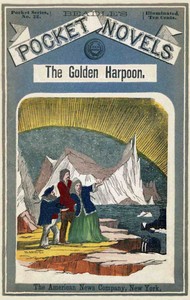
On the morning of the 25th day of April, 18--, the whale-ship Montpelier, of New London, anchored in one of the many bays that open along the coast of Kamschatka, where it is washed by the waters of the Sea of Ochotsk.
As soon as every thing was made snug alow and aloft, the skipper rubbed his hands with complacency, and a satisfied expression was seen to cross even the face of Mr. Briggs, the first mate, who was the ship’s grumbler.
“Good quarters,” remarked the captain.
“Ay, ay, sir,” responded Briggs, “the tide is easy here and I don’t think a gale would hurt us much--we are so shut in by the cliffs. But,” he suddenly added, turning his glance toward a large field of ice, about a league from the shore, “I don’t like the looks of yonder floe. It may come upon us and give us a jam.”
“It will drift past us,” replied the captain; “the current tends to the north’ard.”
“I’m not so sure of that,” said the mate, as he snatched a glass from the mizzen fife-rail, and directed it toward the ice. “Them undercurrents up this way sometimes plays the very smash. But if I ain’t much mistaken, I see a bear moving along the floe.”
As he spoke, he passed the glass to his companion, who immediately lifted it to his eye.
“Do you see the animal, captain?”
“Ay, ay, there it is, sure enough; a brown bear, I believe.”
“Uncle!” exclaimed a gentle voice at this instant, and a light hand fell upon the captain’s shoulder. “How wild! how picturesque! What place is this?”
The speaker was a girl of seventeen, with large brown eyes, a petite but well-rounded figure, and a countenance truly lovely in its purity and expression. From her neck, by a strip of blue ribbon, was suspended a golden harpoon of delicate workmanship, and about four inches in length. It was the gift of the captain--her only living relative--who had presented it to her on the day that he complied with her request to accompany him on his present voyage.
And why did she wish to go to sea?
Firstly, because the bold and handsome Harry Marline had shipped in the Montpelier as boat-steerer and harpooner’s aid. Secondly, because she was much attached to her relative, who, having no children of his own, always had treated his niece with the indulgent fondness of a father.
You might have known this, had you seen the smile that crossed his face as he turned and gazed with admiration upon the crimsoned cheek, and the expressive eyes of the young girl.
“Good-morning, Alice,” he said. “I am glad to see you stirring so early. How did you pass the night?”
“Very well, thank you,” she replied, raising herself upon the tips of her toes, and presenting her lips for a kiss, which was immediately granted. “Very well, indeed; but you have not answered my question. What place is this?”
“It has no particular name that I ever heard of,” replied the captain. “But, you have been long enough at sea, now, Alice, to perceive that I’ve chosen a good place for an anchorage--”
“If it wasn’t for the ice,” interrupted Briggs.
“An excellent place,” continued the captain, paying no attention to the words of his companion, “a position well sheltered, where the craft can lie while we fill her with oil--secure from every danger--”
“Except that of ice,” doggedly persisted the mate.
“Secure from every danger,” repeated the captain, turning sharply toward his first officer.
“Oh! I am so glad!” cried Alice, clapping her white hands with an enthusiasm natural to a girl of seventeen. “It is such a wild, beautiful place. And, on pleasant days, I can bring my sewing on deck. It will be very nice sitting here and looking up now and then at those great towering cliffs that rise so far above the tops of our mast-heads.”
“Until the ice comes,” said Briggs.
“Why, Mr. Briggs, what do you mean?” said Alice, turning toward the first officer with an expression of alarm upon her face; “this is the third time I’ve heard you speak about the ice. Is there really danger to be apprehended from it?”
“Ay, ay, Miss Alice, plenty of it,” bluntly responded the mate, “and unless--”
“You must not mind him, niece,” interrupted the captain. “He fancies there is danger from that floe that you see off the quarter; but, you may believe me, when I tell you, that it will have drifted past us before night.”
“There are undercurrents that’ll bring it upon us before the morning,” persisted Briggs. “This isn’t the first time I’ve sailed in these waters.”
“Oh, uncle!” said the young girl, placing both hands upon the captain’s shoulder; “the mate is an old sailer of this sea, while this is the first time that you have ventured in this quarter. I think you had better take his advice.”
“Fiddlestick!” exclaimed the captain; “what does a girl know about seafaring matters?”
“Ay, ay, sir, she’s a girl, but she’s got an uncommon wise head for all that. Mark ye, Captain Howard,” he added, feeling so highly gratified by the favorable remark of the skipper’s niece, that he was disposed to be complimentary--“mark ye, I’ve seen women enough in my day, but I’ve never seen one as had a longer head than Miss Alice!”
The maid blushed, and bit her lips to conceal a smile, while Briggs, believing that his words had pleased her, but fearing that she might think he had merely been trying to flatter, pursued the subject in a manner so earnest, that his sincerity could not be doubted.
“Ay, ay, sir--a long head has this young girl, and I don’t mean to flatter her when I say it. She’s about the first woman I ever saw with such a head. To look at her, it’s true, you mightn’t think that she was blessed in that way. But, my eyes! neither would you think that a horse’s head was so long as a flour barrel!”
“You had better stick to currents and icebergs, Mr. Briggs, and leave the complimenting of girls to those who understand the art better than you do,” said the captain, a little resentfully. “Young ladies, as a general rule, do not care to be told that they have long heads?”
“Indeed, uncle,” cried Alice, in a voice that faltered with the efforts she made to restrain her laughter, “indeed, uncle, I feel much obliged to the mate for the compliment he has paid me.”
“Oh, well,” said her uncle, dryly, “there is no accounting for tastes--especially for those of women. If Briggs’ remark pleased you, I have no more to say.”
“He was sincere, dear uncle, and you know that sincerity always pleases me.”
“Even when you are told that you have a long head?”
“That was a figurative expression on the part of Mr. Briggs.”
“Ay, ay, that’s it,” broke forth the mate, “figgerin’ is the word. I’m poor at figgers myself, but my eyes do me instead, for they have good sight and are good at measuring. And that’s why I can calculate almost to the minute when that ice-floe, which is now about a league from us, will be upon us, jamming our timbers.”
“It will never reach us,” replied the captain, in a decided voice; “you can even perceive that it is moving north’ard now, and--”