Public-domain ebook
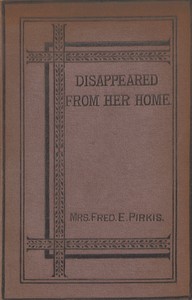
Disappeared From Her Home: A Novel
Language: en520 downloads on Project Gutenberg
Subjects
In: Crime, Thrillers and Mystery·Novels·British Literature
Public-domain ebook sourced from Project Gutenberg #65012.
Public-domain ebook
Language: en520 downloads on Project Gutenberg
Subjects
In: Crime, Thrillers and Mystery·Novels·British Literature
Public-domain ebook sourced from Project Gutenberg #65012.
The opening · free to read
The above handbill appeared one bright summer’s morning on the walls of Dunwich Police Station, and on all the principal buildings of that busy manufacturing town.
Hard-working men of business found time, in the midst of their buying and selling, to stop and read, and wonder how it was possible that any young lady, well looked after, as Miss Warden undoubtedly was, well-known, too, in the neighbourhood, and surrounded by relations, friends, and servants, could thus disappear from their very midst, at noon-day, and leave no trace of any sort.
Harleyford was situated about five miles from Dunwich, and Mr. Warden’s house about three from the local railway station. A well-traversed high road led from his estate to the market town—Dunwich. This the young lady had been seen to enter about ten o’clock on the morning of the 14th of August, by some country people, with whom she exchanged greetings. From that moment nothing more had been seen nor heard of her, and it was, as the country people expressed it in their broad Leicestershire dialect, “as though the earth had opened, and swallowed her up,” so completely had all traces of her been lost.
Well-to-do tradesmen and thriving farmers, passing by, read the handbill with a sort of shudder. Here was a young lady taking her usual morning walk on a bright summer’s day; she wishes her neighbours a gay good morning with a nod and a smile, goes on her way, and lo! nothing more is seen or heard of her. After this, who was safe? And with a sigh and a shiver, and a thought of their own young daughters at home, they went their way to ponder over the strange occurrence.
The county people by scores left their cards on Mr. and Mrs. Warden; heard how they had waited breakfast for their daughter, then luncheon, then dinner—how they had sent their men far and near to scour the country—how every river had been dragged, every infirmary and hospital searched, every railway official questioned and cross-questioned as to whether the young lady had been seen entering either station—how the parents had racked their brains to discover any possible or impossible pretext which could drive their daughter from her home—how that now, well-nigh broken-hearted, after a fortnight of wearying suspense, they had folded their hands and prayed for any news, even the worst that might come.
“It is beyond mystery,” said old Lady Nugent to her young lady companion, driving along the very same high road which had seen the last of poor Amy, and looking right and left in the hedges, as though she expected to find some traces of her there; “If the girl had had any love troubles, one could understand it better; for the young, foolish things at seventeen are often driven to some desperate folly by a man’s wicked eyes. But every one knows she could have made the best match in the county if she had liked. There’s young Lord Hardcastle, who absolutely worships her—fastidious and fault-finding as he is; and as for Frank Varley, the rector’s son, with his £10,000 a year, he is positively mad after her.”
“Yes, my lady,” responded the companion, “and it is well known that neither Mr. nor Mrs. Warden cared in the least whom she chose. Ah! she was always a coquette, even in the schoolroom. Those young, bright things with so much money, and so many chances generally choose badly after all, and run away with some groom, or footman. Depend upon it, my lady”—
“Don’t be an idiot, Matthews,” interrupts the dowager, “talk about things you understand. It has been ascertained beyond doubt that no one but Miss Warden is missing, far or near. Besides, the young lady, however playful and vivacious she might be with her equals in station, was too well-born and well-bred to permit the slightest familiarity from an inferior. She would not have suffered such a thing any more than I should myself,” with a withering glance at Matthews. “Tell George,” she added, pulling violently at the check-string, “to drive past the police station. I want to see what they have put in the handbills.”
And, as the old lady drives through the crowd of stragglers gathered about the station-house doors, two others, with white, anxious faces, are standing there, reading the printed lines. Tall, fair, muscular Frank Varley, the rector’s scapegrace son, the best rider, runner, and rower in the county—the first in all mischief—in all breakneck adventures—and yet more sought after at balls and garden parties, than the richest lord, or the most eligible unmarried baronet—his mother’s darling and pride, and a constant source of anxiety and apprehension to his father.
As he reads, his brow darkens. “By heaven!” he mutters through his set teeth, “there has been foul play somewhere. She held my hand for a moment only, at the ball the night before, under the large oleander tree, and called me her own Frank; and then, coquette as she is, the next minute she told me she meant her own brother Frank—I had been so good to her. Shall we all sit still with folded hands, and let a girl like that be stolen from our very midst? A thousand times, no!” And then aloud, with a full-drawn breath, “By heaven! no corner of the earth shall hide her from me; by land and by sea, by night and by day, I will search the whole world through, till I find her, living or dead.”
“You are right,” exclaims a voice at his elbow, and Lord Hardcastle’s dark pale face, with thin, clear-cut features, looks over his shoulder. (“Kid-gloved Hardcastle” he was sometimes called by his sporting and boating friends, on account of his super-refinement and dainty fastidiousness.) “You are right; there has been some foul play here—some deed of iniquity which must be brought to light. We, who have been rivals hitherto, may well join hands now.” He extends his thin white hand, which Varley grasps in a strong, firm hold. “I repeat your own words; ‘no corner of the earth shall hide her from me; by land and by sea, by night and by day, I will search the whole world through till I find her, living or dead.’”
WHILE the townspeople and country folks read and wondered at the printed handbills, the father and mother of the missing girl wandered about their now desolate home, listless, aimless, well-nigh broken-hearted. The first sharp pang, it is true, was past, and the sorrow had settled down to a dull leaden weight on heart and brain. The servants walked about the house slowly and silently, speaking in subdued voices. Day and night lay old Presto, Amy’s favourite deerhound, at the house door, waiting and listening, and never seeming to eat nor sleep. Her maid carefully each day fed her birds and watered her flowers, and every one in the household vied with each other in endeavouring to carry out every known wish or fancy the young lady had ever had (and it must be confessed they were not a few) as they would endeavour to carry out the wishes of some dear one dead. On every side, in every room, were traces of the lost darling. Here, the open piano with a roll of new music; there, the uncovered harp. In the little morning room piece after piece of unfinished needlework, and here in a little “studio,” as Amy was pleased to call it, numberless pencil sketches, an oil landscape commenced, a water-colour three-parts done, and a crayon head, “all but” finished. A whole tableful of china-painting accessories, and commenced cups, saucers, and plates; and there, in a corner, a cabinet of fret-work tools, with brackets, card trays, and picture frames enough to stock a small shop.
From all this it may be seen that the young lady’s tastes and pursuits were numerous and varied—change, to her, the one great necessity of life. A too great indulgence from her earliest infancy had developed in her character an impatience of restraint, an impetuosity and wilfulness which, unless it had been counterbalanced, as in her case it was, by an unusually loving, playful, tender disposition, would have rendered her imperious and domineering. As it was, every one in the household, from her father downwards, adored her and bowed to her sway. “I must not be kept waiting an instant” was a remark which might be heard every hour of the day from Miss Amy’s lips. And kept waiting she never was, for the simple reason that it was an impossibility to keep her in any posture of tranquillity for five minutes at a time. Every thought or idea that entered into her brain must be executed there and then and, scarcely completed, must be thrown on one side to make way for another.
“Were you ever thus in your very young days, Stephen?” Mrs. Warden would sometimes enquire of her husband. And the husband would smile and shake his head, and declare he had never been half so fascinating as his wilful, loving, teasing little daughter, “the music and sunshine of his life,” as he was wont to call her.
And now all was changed! The music was hushed, the sunlight had died out. Would the shadows ever be lifted from the home again? Would the quick, light step ever be heard again, and the sweet, young, ringing voice, exclaiming in its old familiar tones, “I must not be kept waiting an instant?”
So the father and mother asked themselves, as, standing side by side in their dining room verandah, they looked across the bright August landscape to where the groom was leading out Amy’s pony for its morning canter.
Mr. Warden, at this time, was about forty-five years of age, looking considerably younger. A well-featured, muscular man, with energy, determination, and many other good qualities plainly written on his face. A more complete contrast to him than his wife could not well be imagined. She was very tiny, very fair, very gentle, with amiability, want of will, and weakness of character marked in every line and feature. Her one god was her husband, her one thought how to please him, and her every opinion and wish was simply an echo of his.
“A doll, my dear, nothing more,” was old Lady Nugent’s summing up, after her first introduction to Mrs. Warden, some twelve years previously. Mr. Warden had come among them a perfect stranger, buying one of the largest estates in the county which happened to be for sale. He had resided, so he had said, nearly all his life in the south of France, but his family and connections were well known in the Midland Counties as wealthy and nobly connected. Of his wife, however, nothing was known, nor could be discovered, so she was set down, and perhaps justly, as having been an English governess in some French family, and as such, most probably, Mr. Warden had first known her.
“What men can see in dolls to induce them to marry them, I cannot see,” pursued the dowager, “they simply need a glass case, some good clothes, and their work in life is done.” Nevertheless, in spite of Lady Nugent’s comments, Mrs. Warden had been well received in Harleyford for her husband’s sake, and now, in the time of her sorrow, nothing could exceed the kindness and sympathy extended to her on all sides. Carriage after carriage sweeps along their drive, letter after letter is brought to the house, some containing wild and improbable suggestions, others opening here and there a door of hope, all full of warm and earnest sympathy, and offers of help.
The book keeps going
Reading is free forever. Sign up and watch scenes appear while you read.



Scenes Storieta drew for other classics.
New illustrated classics
Once or twice a month: the latest books to get full character casts, scene art, and free comic editions. No account needed.