Public-domain ebook
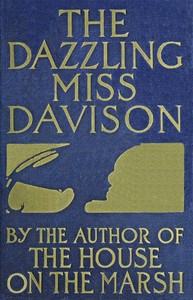
The Dazzling Miss Davison
Language: en336 downloads on Project Gutenberg
Subjects
In: Romance·Novels·British Literature
Public-domain ebook sourced from Project Gutenberg #65117.
Public-domain ebook
Language: en336 downloads on Project Gutenberg
Subjects
In: Romance·Novels·British Literature
Public-domain ebook sourced from Project Gutenberg #65117.
The opening · free to read
A roomy, comfortable, old-fashioned house in Bayswater, with high windows, big rooms, and little balconies just big enough to hold a wealth of flowers in summer and a very pretty show of evergreens when the season for flowers was past.
On October a row of asters, backed up by a taller row of foliage plants, made the house look bright and pretty, and the young faces that appeared at the windows of the drawing-room made it prettier still.
Mr. and Mrs. Aldington, the occupiers of the house, thought that there was nothing pleasanter in life than the gayety of young people, and so, as they had only two children, a son and a daughter, both grown up, they gave a general invitation to the younger generation, of which, particularly on a Sunday afternoon and evening, the contemporaries of their son and daughter were not slow to avail themselves.
Especially was it the pleasure of these good-hearted people to extend hospitality to those young folks whose lives were, for one reason or another, not so bright as those of their own children. And many a friendless young barrister waiting for a brief, young doctor struggling for a practice, and many a girl whose parents had a hard time of it in keeping up a fair position on an unfairly small income, found recreation and a warm welcome at the old-fashioned house in Bayswater.
Some of them found more than that. Gerard Buckland, for instance, a clever young barrister who was tired of hearing of the great things he was to do some day, since he was unable to get even small things to do to go on with, found at the Aldingtons something that he had stoutly resolved to do without until he had “got on.”
He found, in other words, his “ideal.”
It was on a bright Sunday afternoon, when the big drawing-room was full of lively people, mostly young, and all talking at once, that Gerard, having been introduced by Arthur Aldington two Sundays previously, took advantage for the third time of the general invitation given him by the host and hostess, and found himself surrounded by a dozen people among whom he knew no one except the Aldingtons themselves.
Whereupon Rose, the daughter of the house, made him sit by her, and, as he was shyly looking over a basketful of loose photographs which he had found on a table beside him, undertook the task of showman, and told him all about the pictures as he looked at them one by one.
It chanced that the second picture he picked up after Rose’s arrival was the portrait of a girl which attracted him at once.
“What an interesting face!” said he, as he looked at the photograph.
“And she’s an interesting girl too!” said Rose, who was a plain, amiable young woman of six-and-twenty, whom everybody liked and nobody had as yet chosen. “She’s the daughter of a Colonel, who speculated, and then died and left his wife and two girls with scarcely anything to live upon. Papa says it’s one of the saddest stories he knows. They’ve gone to live in a cottage somewhere, after living in one of the most beautiful houses you ever saw in the country, and having a flat in town as well.”
Gerard Buckland was looking intently at the photograph, which was that of a quite young woman with an oval face, delicate features, and an expression which combined vivacity with intelligence.
“She looks very clever,” he said.
“Yes, so she is--and very pretty too.”
“Yes, very, very pretty.”
He was fascinated; and when he was compelled to look at other photographs, he placed that of the girl whose story he had just heard at the side of the basket, in such a position that he could glance at it again from time to time, and amuse himself by speculating about this girl who was so handsome, so clever, and so unlucky.
Rose Aldington noticed his preoccupation with the picture, and said, with a smile--
“I see you admire her, just as everyone else does.”
“I was thinking the story a sad one,” said Gerard, rather confused at being discovered in his act of adoration.
“Oh, well, perhaps she’ll marry well, and her sister too, and then it will be all right. The sister is even better-looking than Ra--than she is, and just as nice. Only unluckily she hadn’t finished growing up when their father died, so she hasn’t had the benefit of such a good education as the elder.”
“It’s hard upon a girl, though, when she has to marry just for money,” observed Gerard.
“Oh, yes, of course. And I’m not sure that this particular girl would do it either. But that’s the usual thing to say, isn’t it, when a very pretty girl is left unexpectedly poor?”
“Yes.”
Gerard answered quite shortly, and looked at the photograph again. And at that moment the door opened, and an exclamation rose to his lips as he recognized in the new arrival the very girl whose picture he held in his hand.
He felt the blood rush to his face as he looked at her. He saw at once that the absence of color from the photograph had given him an altogether wrong impression of what the girl herself would be like. She was of medium height, slender, pale, brown-haired, brown-eyed, and her dress was plain almost to dowdiness.
But she carried herself so well, her figure was so graceful, her expression so intelligent, and her smile so charming, that she attracted instinctive attention in greater measure than any of the other girls in the room.
“Rachel!” cried Mrs. Aldington.
“Miss Davison!” cried her son Arthur at the same moment.
And the new-comer was brought into the group near the fire and surrounded, while Gerard Buckland, at a little distance, listened to the tones of her voice, and approved of them as he had done of every detail concerning her.
Only one thing about her seemed amiss. Well as she wore her plain, almost shabby clothes, neat and graceful as she looked in them, Gerard felt that they were not the clothes which she ought to be wearing, that her beauty demanded a better setting than the plain serge skirt, the black jacket, the gray felt mushroom hat with its trimming of a quill and a big black rosette, which, though they became her, were not quite smart enough either for the occasion or for her own type of womanhood.
Gerard saw the glance of Rose Aldington wander in his direction with a sly look, and he hoped she would not forget to find an opportunity to introduce him to the interesting guest.
He was not disappointed. Before tea was brought in, Rose had contrived the introduction, and Gerard found himself in conversation with the girl whom he felt to be the nearest he had yet met to the sort of floating ideal of what is most gracious in woman, which he, in common with most young men, carried about in his mind, ready to crystallize into the face and form of some human, breathing, living girl.
As she interested him, so did he, perhaps, interest her. The tall, shy, handsome fair man of five-and-twenty, who spoke so softly, but who looked as if his voice could be heard in other and stronger tones upon occasion, and of whom it had been whispered in her ear by Rose that he was “so clever, bound to make a name for himself at the bar,” was pleasant to look upon and to listen to, and the two young people, in that pleasant twilight which Mrs. Aldington loved, and which she would not too soon have broken in upon by gas and candles, soon began to find that they had many things to say to each other, as they sipped tea and nibbled cake, to the accompaniment of the other gay young voices, in the illumination of the leaping firelight.
Somebody had drawn the talk of the whole room into the old channel of woman’s rights and position, and immediately the whole company had broken up into interested little couples and groups to discuss it with the same freshness of interest as if it had never been discussed before.
Rachel Davison was rather bitter about it.
“It’s all very well to talk,” she said, “about the right of woman to act for herself, and to make a position for herself, and the rest of it. But you want more than the right: you must have the power. And that is what we shall never get,” she added, with a sigh.
Gerard argued with her.
“Why shouldn’t they have the power?” he said. “When once the barriers of prejudice are pulled down, what’s to prevent a woman from entering any field where she feels her talents will be best employed?”
She raised her eyebrows.
“When once the barriers of prejudice are broken down!” echoed she. “But that will be never. You don’t recognize how strong they are! Why, look at my mother, for instance; she’s more particular about little things, prejudices and that sort of thing, than about important ones. And she’s not alone, she’s one of a type, the most common type. She would rather see her daughters dead, I’m quite sure, than engaged in any occupation which she’s been accustomed to think unwomanly.”
The book keeps going
Reading is free forever. Sign up and watch scenes appear while you read.



Scenes Storieta drew for other classics.
New illustrated classics
Once or twice a month: the latest books to get full character casts, scene art, and free comic editions. No account needed.