Public-domain ebook
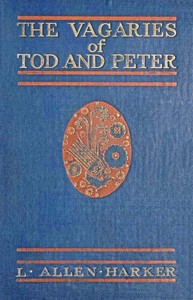
The Vagaries of Tod and Peter
Language: en511 downloads on Project Gutenberg
Subjects
In: Children & Young Adult Reading·Humour·Novels
Public-domain ebook sourced from Project Gutenberg #65162.
Public-domain ebook
Language: en511 downloads on Project Gutenberg
Subjects
In: Children & Young Adult Reading·Humour·Novels
Public-domain ebook sourced from Project Gutenberg #65162.
The opening · free to read
By the people who live in the same terrace they are known as “those dreadful twins.” By the more plain-spoken of the masters at the preparatory school which they attend they are distinguished by an adjective whose meaning is the reverse of “heavenly”; and their schoolfellows are filled with respectful admiration for the boys, the most resourcefully and superfluously naughty of their acquaintance, whose genius for making the most patient of masters lose his temper is unsurpassed.
The only person who takes them and their ways with calm philosophy is their mother. She, with that sense of proportion and balanced wisdom so frequently vouchsafed to mothers of large families, laughs and loves them, and believes in their ultimate regeneration. There is some ground for the faith that is in her; for when a woman has seen six sons fare forth into the world to cut no such indifferent figure in it, she is not apt to despair of the two youngest, roister they never so.
Moreover, she declares that most of their evil doings are “really Mr. Stevenson’s fault,” and there is truth in the charge, for from the moment that some thoughtless person, probably a godfather (I have known godfathers, living at a distance, who would present trumpets, nay, even concertinas! to the sons of men whom they have called by the name of friend), gave Peter a copy of “The Merry Men” and Tod “Treasure Island,” they have tried to fit their surroundings to the characters they are forever enacting; with the result that the plain workaday world, that knows not the “Master Mage” of Samoa, is always puzzled and generally wroth.
That genial “spirit of boyhood” had never so much as to beckon to them; he had but to hold out his friendly hands, and Tod and Peter, each clasping one in both their own, were his, body and soul, forevermore.
They are alike as the two Dromios, these twins; and the mistakes and complications arising from this likeness are a never-failing source of satisfaction to them. For instance, Peter will cheerfully undergo a caning intended for Tod that he may afterwards meekly demand of his chastener what he has done to deserve this discipline, gleefully watching the while the weary wonder on the master’s face grow to a disgusted certainty that he has, as usual, “punished the wrong one.”
The fact that they are rather noticeably comely boys--they came of a family where on both sides of the house good looks are the invariable rule--only serves to increase the confusion. Both are tall and straight, fair-haired, blue-eyed, ruddy, and of a uniformly cheerful countenance. But kind Nature has bestowed on Tod an accomplishment she has denied to Peter, to his lasting grief.
At certain seasons of the year Tod “moults” and can pull out quantities of his thick fair hair without the slightest inconvenience to himself. He generally chooses to perform this feat during the silent hours of “prep.” They have done their evening work at school ever since the night they were discovered grilling “Home Influence” and “A Mother’s Recompense” over the study fire, when they ought to have been wrestling with “Excerpta Facilia.” When the master in charge has walked down to the end of the long schoolroom where Tod “keeps,” and has turned to go back again, Tod is suddenly seized by a perfect paroxysm of despair, clutches at his hair with frantic though absolute noiseless gesticulations, and casts whole handfuls of fluffy curls on the floor about him.
Naturally his companions, including Peter, get lines for disturbing the placidity of “prep” with their unseemly giggles. And George, when he sweeps up the schoolroom next morning, may be heard to mutter:
“Wherever all this ’air do come from passes me!”
Tod’s real name is Percy--he is called after a wealthy and aristocratic relative--but he refuses point-blank to answer to it, for he fancies that it savours of those “eeny peeny” children in “Home Influence,” a work that earned their undying hatred when it was read aloud to them by a well-intentioned but mistaken aunt while they were recovering from measles.
On the occasion of its holocaust, before referred to, their mother, passing the study, and struck by the unwonted stillness reigning therein, opened the door softly and looked in. Both boys were stooping over the fireplace and prodding a solid yet feathery mass that glowed and gloomed in the heart of the embers.
“There goes Herbert, ‘the almost-angel boy,’ and ‘haughty Caroline,’ and ‘playful Emmiline,’” whispered Tod, poking viciously. While Peter, quoting from “Thrawn Janet,” added in an awful voice:
“_Witch, beldame, devil! I charge you, by the power of God, begone--if you be dead, to the grave--if you be damned, to hell._”
I regret to say that their mother’s sense of humor is stronger than her dislike of strong language, and that she stole away to laugh, leaving the conspirators unrebuked for the moment. But they did their “prep.” at school henceforth.
Peter’s manner is singularly misleading in its frank sincerity, and he will on occasion answer a sudden question in a way which is, to say the least of it, bewildering to his interlocutor.
For instance, one day in the football-field a new master asked him the name of a small boy some distance off who was “slacking” abominably.
“Who’s that chap with the red hair by the goal posts?” he said to Peter, who had been somewhat officiously putting him right on several points.
“Dumpkins, sir,” that youth replied, demurely, and strolled off to a distant part of the playground.
“Dumpkins!” bawled the master. “Dumpkins, why aren’t you playing up?”
But Dumpkins heeded not the voice of authority and continued to loll and gaze heavenward in easy inactivity.
“Dumpkins! Dump-kins!” again he bellowed.
But Dumpkins only took an apple out of his pocket and began to eat it.
He is a hasty-tempered young man that master, and he strode toward the hapless Dumpkins and shook him angrily, exclaiming:
“Why don’t you answer when I call, you cheeky little beggar?”
“Please, sir, you never called me, sir,” expostulated the boy, wriggling in the master’s grip.
“Why, I’ve been shouting ‘Dumpkins’ all over the field for the last five minutes!”
“But, please sir, my name is Jones!”
It was this young master who rechristened the twins when Peter next day insisted that “a point has position but no gratitude.”
Strangely enough “The Merry Men” finds even greater favor with them than “Treasure Island,” and with the enigmatical decision of childhood their favorite of all the stories is “Markheim,” not “Will o’ the Mill,” beloved of critics. It is doubtful if they understand much of it, but nevertheless they read it over and over again to each other aloud, or silently with their curly heads pressed together, till they knew it by heart. To be sure, “Thrawn Janet” has a dreadful fascination for them, and they acted one of the principal scenes with somewhat direful results.
Peter made Tod “tie him by the neck” to the bed with red worsted, while Tod, in his character of the minister, had to creep in, candle in hand, to discover the dread spectacle; and Peter’s representation of the fearsome Janet was so truthful and blood-curdling that Tod dropped the candle and fled downstairs howling at the top of his voice, and such was his haste that he fell and sprained his wrist. Meanwhile, the candle had set fire to the valance of the bed, and altogether there was a fine hullabaloo; there was also an end put to their dramatic efforts for a week or two.
Nothing daunted, however, about a month later, on a Sunday evening when the servants were all at church, and their mother writing for dear life the long weekly letters that have to be written when a woman has husband and four sons scattered about the globe, Tod and Peter sought the seclusion of the kitchen and determined to “act” “Markheim.”
All went well and quietly for a long time; the firelit kitchen with loud ticking clock answered admirably as the scene of the murder, the dialogue between Markheim and the mysterious stranger went without a hitch, and Tod sallied forth into a “wonderful clear night of stars,” while Peter shut the back door softly after him. Peter, in his character of Markheim, was bent upon making the speech with which the story concludes, where the maidservant rings the door-bell and Markheim opens to her with the words: “You had better go for the police; I have killed your master!”
Poor Tod had to be the maidservant--he always had to follow where Peter led. He shivered as he ran up the area steps; it was a cold night, he had not troubled to provide himself with a coat, and his heart was heavy, for, to tell the truth, he has far more imagination than Peter, and sometimes their plays are to him one long agony of apprehension.
He positively dreaded ringing that area bell, and the sinister announcement that would follow on the act. No longer was he Tod, but a trembling servant lass who was forced by fate to ring a bell which sounded a tocsin of dreadful import.
He ran down to the end of the terrace and stood under a lamp that he might brace himself for the final effort.
Meanwhile, Peter, swollen with importance at the thought of the mighty sensation he would make in a minute or two, stood squeezed against the hinge of the door waiting for the fateful ring.
Then came a patter of light feet down the area steps and someone gave the bell a modest pull. Peter drew open the door with great suddenness upon himself, exclaiming in a deep and tragic voice, the result of long practice in solitary attics:
“_You had better go for the police; I have killed your master!_”
The visitor gave a piercing shriek and rushed up the steps again, calling breathlessly upon Heaven and the police. Peter, behind the door, wagged his head, exclaiming admiratively:
“How well that kid does act; I could almost declare I heard skirts rustling.”
The book keeps going
Reading is free forever. Sign up and watch scenes appear while you read.



Scenes Storieta drew for other classics.
New illustrated classics
Once or twice a month: the latest books to get full character casts, scene art, and free comic editions. No account needed.