Public-domain ebook
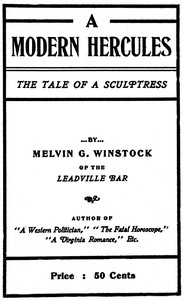
"A Modern Hercules," the Tale of a Sculptress
English411 downloads on Project GutenbergDownload EPUB
Public-domain ebook sourced from Project Gutenberg #65318.
Public-domain ebook
English411 downloads on Project GutenbergDownload EPUB
Public-domain ebook sourced from Project Gutenberg #65318.
The opening · free to read
Two things caused the great heart of New York society to throb with unusual excitement. One was a marvelous work of sculptural art, where boldness in design and utter fearlessness in execution had almost affronted, and yet had won the plaudits of the cultivated of the Metropolis. Ouida Angelo, a woman in “A Grecian Temptress,” had dared to wring from men an absolute tribute to and acknowledgement of her genius and power. The second event was the announcement that Horatio Nugent, the great pulpit orator, would preach a sermon on “The Nude in Art.”
The wealth and fashion of the city sat spell-bound beneath the eloquent tongue of the great divine. The sad face of the Madonna, in the painted window of Geneva, grew sadder still as she looked down upon the favored multitude. There were present there, men who headed every published list of charity, who paid thousands for pew rental, in this great official residence of God, yet who had no compunction about wrecking a railroad and thereby indirectly spreading ruin among hundreds. In the front row sat a bank president, who knew that on the morrow his financial institution would be in irretrievable ruin, yet who for months had been a pillar of the church and had some of the congregational funds in his rapacious clutch. A poor wash woman or window cleaner, probably attracted by the magnetic tones of the stupendous organ, had dared to wander in. In simple ignorance she had probably imagined that Christ’s boasted friendship for the poor meant something to modern dogmatists, and had taken a seat high up among these mighty lordlings of this majestic world. The congregation held its breath in amazement, and could not have been more shocked if the yellow fever in disguise had paid its fatal visit. This magnetic indignation communicated itself to an usher in full dress. He came forward and whispered something to the woman. She slowly rose and went up into the gallery. God had sold out all the down-stair seats to the rich! The Madonna sighed in pity and was angry. The congregation breathed a sigh of relief. The church itself cost half a million. It had no reading room, free bath, employment bureau or lunch counter attached to it. It was open for about nine months each year on Sundays, and when a millionaire wanted to get married, or his heirs wanted to bury him, so they could get up a sensational will contest and make newspapers sell. Not far away from the church was a series of alleys, where poverty held supreme sway, and where the grim specter of want, filth and misery, stalked, dealing death, crime and agony, winning each moment recruits for the devil’s army in hell.
I’ll not allow that rich woman over there to plead not guilty, upon the ground of ignorance of these conditions. She knows all about it, and yet to get those latest diamonds that sparkle on her breast, she made her husband sell the farm, whereon his honest old rustic parents were buried. Over there sits a woman, who is unfaithful in heart to her marriage vows, and who yet lacks the courage to follow the bent of her intense longing, for fear of what her small world would say. In all of this artificial brilliance, there are masks and faces as false as many of the hearts which rich attire conceals.
Notwithstanding all this, there was every inducement for real inspiration. The architectural beauty of the interior of the church was artistic to the nature, and soft and alluring to the eye. The place was decorated with beautiful pots, plants and flowers. Through the stained windows a mellow light gilded rich carpets and soft cushions. The trained choir sang divinely while the organist thundered forth not only the wrath of the Deity, but promised mercy, like the whisper of an angel, through the organ’s pipes. As the notes of the grand instrument died away in the distance, softly, like a summer sigh, a man of noble face and figure stood in the pulpit.
It was the preacher!
He was young. His eyes were boldly black and brilliant. They sparkled like pure diamonds with feeling, comprehension and intelligence. His head had the shape of a Roman God. His shoulders were square. He looked the very physical and intellectual giant that he was. His voice was flavored with magnetism that always distinguishes the eloquent orator from the mere word absorber. He ran his long, shapely fingers through his dark hair, shook his head like a lion, and plunged like a blooded courser into the very meat and marrow of his subject.
“Christ was insulted on Sunday last. This church was empty at service time, and all had forsaken Him to pay tribute to a woman’s vindictively immoral work. You who have built this religious palace to the glory of a mighty and eternal God, betrayed Him for the devil. For hark me, I tell you, that he who so prostitutes true art, be it man or woman, pandering to the depraved tastes of modern society, is but an agent of the King of Hell!
“‘A Grecian Temptress’ was, or is, its theme. A woman of form almost divine, enticing a youth of purity to voluptuous sin, while in the veiled background stands a Satan, holding sway over the temptress, while she is but serving her Master in alluring souls to the regions of perpetual darkness.
“All true art leads to God. The tree, the earth, the sparrow, the eagle, the wheat, the stars, the beasts, man, are parts of a great and mighty network of machinery. All false art leads to God’s enemy, and sin, selfishness, voluptuousness, temptation and passion, carry with them and in them the seed of their own punishment. How dare these bold and brazen creatures, under the name of art, lay before the multitude chapters from their own devilish and inconsistent lives? Yet the sin is not theirs alone. You who hear me are equally guilty, because you encourage them by your countenance and patronage to continue in their base course of debauching the public taste. We seek in vain for purity and find it swiftly fleeing, while in its place there is rising up a craving for sensationalism which is even reaching the pulpit itself!
“Why should we follow ancient Greece? As long as the Athenian was stalwart, patriotic, full of rugged simplicity, the influence of Greece was all powerful in shaping the thought of the world and in moulding its history. But when its brave warriors, orators and poets sank into luxurious excesses, succumbing to vice, vying with each other in the mere promotion of enjoyment, its influence waned, its people degenerated, until today it is a memory only serving to teach the world, that its people as a nation were unfit to survive. And when Grecian methods permeated Rome and Judea, these nations, too, became practically blotted out. Shall we permit American valor, patriotism and healthful vigor to have engrafted upon it these ideas so fatal to Greece, Rome and Judea? Shall we permit, by such an education of public morals, a gradual loss of respect of all those pure ideals taught by Him, who preached the sermon on the mount?” He paused here, but no one stirred.
“But this is not all. These Bohemian rebels, who create and produce and publish these things do worse than this. They make their own universe, enact their own laws, defy mankind, and yet society grovels at their feet and elevates all such so-called gifted creatures to a pedestal high above the church itself! They are worshiped, and Christ, who made for man the most agonizingly sublime sacrifice of which the mind can conceive, is insulted, neglected and made a common mockery!
“This woman Ouida Angelo, who gave to the world ‘A Grecian Temptress,’ who is she? A luring siren whose devotion to all that is voluptuous and sensual, reveals in her work only that which characterizes her ignoble life. She should be driven forth from achievements, that alike disgrace herself, art and humanity. Instead of worshiping her with idolatrous affection, we should freeze her with a monstrous condemnation.”
Again he ceased and staggered almost out of the pulpit as though filled to the quick with some strange emotion.
A rustling gown with a queenly woman under it arose from a cushioned pew and majestically stepped down the aisle to the door.
She was Ouida Angelo, the sculptress!
Just then a startling crash was heard, and the pane of glass, upon which had been exquisitely done the face of the Madonna, fell and broke into countless pieces.
The sermon on “The Nude in Art” had done its work, and Monday’s papers were full of it.
Ivan Strogoff was a Russian nobleman at the University of St. Petersburg. Together with many of his noble colleagues, he imbibed radical theories concerning freedom and the abuses practiced by the imperial government. Added to this, he married a pretty but poor Polish girl, who died in giving birth to a son, Paul. Ivan one day was arrested, secretly tried and condemned to Siberia. He, however, bought his freedom from corrupt public officials, and fled to New York with his son. Then he began a battle with the world in which starvation and misery constantly held the upper hand. Nothing succeeded with him. He could gain no foothold. His nature, naturally honest and bright, became soured, until at times he actually hated even his son, Paul. The latter was a noble specimen of physical humanity, and apparently seemed to thrive on the hardships which both father and son seemed compelled by cruel fate to endure. This continued until Paul was about 10 years old. Then it was that Ivan brought home one night a long envelope, and while Paul slept in their garret in the slums, Ivan, his father, sat long into the night, until the candle burned out in the socket, reading documents with long, gold seals on them. It was a promise from an influential Russian official, toward a restoration of Strogoff’s estates, if the exile should return and swear anew his allegiance to the Czar. Now Strogoff’s vain struggles in the new world had sobered him. Many of the wild dreams of youth had disappeared, and he was ready and quite prepared to accept good fortune again, even if it meant a sacrifice of those poetic dreams that had caused the misfortunes of his earlier days.
He had but enough money left to barely get back to St. Petersburg alone, and the great question was: What could be done with Paul? He finally saw the keeper of the lodging, and received every assurance that Paul would be cared for until his father could send for him. So Ivan kissed the sleeping boy, and ere the sun had started on his course, was on the broad Atlantic, his brain busy with teeming projects for the newer and noble future that seemed to spread out before him.
Politics in Russia, however, are even worse and more complicated than in New York under Tammany. By the time Ivan reached the seat of Russia government, his friend had lost imperial favor. The plots against the life of the Czar had rendered a restoration to wealth and power of great difficulty, and almost an impossibility. Then began a struggle which slowly but surely sapped the vital energy of the returned exile. Each day brought forth fresh complications. Three times during a period of ten years the poor devil was compelled to fly to save himself from the enforcement of the old sentence, that like the sword of Damocles, hung over him. But with a perseverance worthy of all admiration, he persisted, and something he could not define, would not let him die. To add to his misery, Paul had apparently been swallowed up, and never again while life remained, did the doubly unfortunate man ever hear of the boy he had abandoned to the cold charity of the New York lodging house keeper.
The book keeps going
Reading is free forever. Sign up and watch scenes appear while you read.



Scenes Storieta drew for other classics.
New illustrated classics
Once or twice a month: the latest books to get full character casts, scene art, and free comic editions. No account needed.