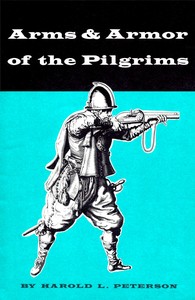
Public-domain ebook
Arms and Armor of the Pilgrims, 1620-1692
Language: en805 downloads on Project Gutenberg
Subjects
In: History - American·History - Warfare
Public-domain ebook sourced from Project Gutenberg #65335.
Public-domain ebook
Language: en805 downloads on Project Gutenberg
Subjects
In: History - American·History - Warfare
Public-domain ebook sourced from Project Gutenberg #65335.
The opening · free to read
Of all the pieces of defensive armor, the most popular was the helmet. Almost everyone wore one when he prepared for trouble. Most of those worn at Plymouth were undoubtedly open helmets which left the face uncovered, although it is possible that a few completely closed helmets were also used. These open helmets were of three principal types: the cabasset, the morion, and the burgonet. The cabasset was a simple, narrow brimmed helmet with a keeled bowl and a tiny apical peak pointing to the rear. The morion had a larger crescentic brim pointed at the front and back and a high comb along the center-line of the bowl. The better specimens of both these helmets were forged from a single billet of steel, and both were very efficient defenses. The curving lines of the bowls caused most blows to glance off without imparting their full impact, and the comb of the morion presented an extra buffer of metal through which a sword would have to cut before it reached the bowl. Inside each helmet was a quilted lining held in place by a row of rivets around the base of the crown which acted much like the modern helmet liner in holding the steel shell away from the wearer’s head.
The burgonet was a slightly more complicated helmet than the morion or cabasset, and it was made in a variety of styles. Basically, it was an open-faced helmet which covered more of the head than the other two. Usually it had a peak or umbril somewhat like the visor of a modern cap over the eyes, a comb on the bowl, and movable plates to protect the cheeks and ears. Often there was a defense for the face in the form of a single adjustable bar which passed through a hole in the umbril or by three bars fashioned like a muzzle and attached to the umbril which was pivoted at the sides so it could be raised or lowered. One form of the burgonet which became popular in the second quarter of the 17th century was known as the lobster tail burgonet because the wearer’s neck was protected by a series of overlapping plates which somewhat resembled those on a lobster’s abdomen or “tail.”
A fourth and final type of helmet was known as a “pikeman’s pot.” This greatly resembled the morion, but had a broad flat brim instead of a narrow crescentic one. As its name indicates, it was worn primarily by pikemen in conjunction with a specific type of corselet which was generally designated pikeman’s armor.
This armor consisted of five elements in addition to the helmet. There was a gorget to protect the neck and to support the weight of a back plate and a breastplate which were fastened together by straps which passed over the shoulders and attached by hooks at the front and by a belt that passed around the waist. At the lower edge of the breastplate were fastened two hinged plates called tassets which protected the thighs. Although each of these plates was made from a single sheet of metal they were embossed to resemble a series of overlapping plates, complete with false rivets.
Of all the forms of body armor worn in America during the early 1600’s, the pikeman’s suit was undoubtedly the most popular. There are numerous references to it in the contemporary documents. A tasset from such a suit was found behind the fireplace in the John Howland house near Plymouth and is now preserved in Pilgrim Hall. In the Massachusetts Historical Society in Boston there are a helmet, a back plate and a tasset from another suit which belonged to an early colonist, and portions of similar suits have been found in Pennsylvania and at Jamestown, Virginia.
Men armed with muskets might sometimes wear pikeman’s armor, but more often they wore simpler corselets consisting only of breast and back-plates. With these corselets they wore either a cabasset, a morion or a burgonet.
The weight of the corselets worn by the Pilgrims depended largely on the quality of the breastplate. The helmets and other pieces were sufficient to stop a sword blow or turn an Indian’s arrow but still quite light. Breastplates, however, were made according to three standards depending on what weapons they were supposed to offer protection against. The lightest forms were labeled pike proof or high pike proof; the next heavier were called pistol proof, and the heaviest were musket proof. The musket proof breastplates are quite scarce. Often they are ⅜ of an inch thick and bear a dent caused by a bullet fired at them as a test when they were made. Pistol proof plates are much lighter and are much more plentiful. They also often bear a testing dent and sometimes the letter “P” as a proof mark.
Most modern Americans tend to think of armor in terms of brightly polished steel. Sometimes it was finished bright, but by the 17th century it was more often black, brown, or dark blue. This was especially true of those suits destined for active service in the field. A brightly polished piece of armor needed constant care to guard it from rust and maintain a good appearance. Blacking, russeting or bluing it helped protect it and made it easier to maintain. The black finishes were sometimes obtained through the use of soot and oil, sometimes by paint. The russet and blue finishes were produced by artificial oxidation.
This defensive armor, though popular at first, was soon discarded by the Pilgrims. The men who set out on the first exploring expedition when the Mayflower touched at Cape Cod were all armed with corselets. They found them efficient protection against the arrows of the Indians, but when they at length discovered a quantity of Indian corn, they were so encumbered and weary from the weight of their arms that they could not carry back as much of the booty as they desired. Soon they found that they could usually dodge arrows unless taken by surprise, and so gradually they began to decide in favor of freer movement and less weight. The corselet retained its popularity for the first ten years, but a compromise in the form of a heavy buff leather or quilted coat began to make its appearance. By the time of the Pequot War in 1637, the presence of “unarmed” men, as those without armor were called, became more and more frequent. The helmet was the last piece of plate armor to be discarded, but following King Philip’s War (1675-1678) that too was abandoned, and plate armor disappeared from the scene except for ceremonial occasions.
The edged weapons brought to America by the Pilgrims were of four principal types, swords, daggers, pikes and halberds. The bayonet was almost unknown on this continent at the time. Of all these arms, swords were by far the most plentiful. Every soldier, whether he was armed with a musket, pike or halberd or served a cannon, was required to carry a sword. Thus, since almost every able-bodied man was supposed to perform military service, all had to be familiar with the weapon, and a large supply was necessary.
Both thrusting and cutting swords were used. The thrusting swords, known as rapiers, had long straight blades, diamond-shaped in cross section, with sharp points and only rudimentary edges. Some had guards fashioned of numerous bars bent in graceful curves and loops, and these are called swept-hilted rapiers. Others had a solid cup-shaped plate between the hand and the blade augmented by extra bars and branches. These are called cup-hilted rapiers.
Fortunately, one of the cup-hilted rapiers used by the Pilgrims has survived. It belonged to Captain Miles Standish, the doughty military advisor of the colony, and it is now preserved in Pilgrim Hall. It is a very good example of the Dutch-English style of cup hilt, the shallow iron cup and supplementary branches, the knuckle-bow, and the pommel are decorated with crudely incised designs of leaves and masks. The grips are covered with black leather. Originally they were wound with twisted wire in the spiral grooves, but the wire is now missing. The scabbard also has been preserved, and that is most unusual for swords of this period. It is made of wood, almost cylindrical, covered with black leather. There is an iron ferrule at the throat (which has now slipped several inches down the scabbard) and an iron tip. Interestingly, Standish is known to have been a short man whose enemies sometimes called him “Captain Shrimp,” and this sword is about six inches shorter than the average rapier, which would have made it easier to handle for a small man.
Probably even more plentiful than the rapiers were the cutting swords. Most of these were shorter weapons with single-edged blades, sometimes straight and sometimes slightly curved. Two of these weapons have survived and are preserved in Pilgrim Hall. The older and more spectacular of these belonged to Gov. John Carver and was made near the beginning of the century. It has a massive hilt with guard and pommel of iron encrusted with floral decorations of silver. The decoration and workmanship are typically English. The blade is straight with a single edge and a narrow fuller or groove along the back. The second sword is considerably smaller and later. It came from the Brewster family and may have belonged to Elder William Brewster, although he must have purchased it late in life. It has a lighter iron guard without ornamentation and a slightly curved singled-edged blade, also with a narrow fuller at the back. This sword, too, is typically English.
A third surviving cutting sword preserved at Pilgrim Hall is a broad-sword which belonged to John Thompson who came to Plymouth in 1623. Like the Carver sword, this weapon also dates from the opening years of the 17th century. The hilt is smaller, but the metal parts are of iron decorated with the same typically English floral sprays in silver. The blade on this specimen, however, is what sets it apart. It is much longer and double-edged, a sword suitable for use on horseback as well as on foot.
These swords were more than mere military decorations. They were highly necessary weapons. In a period when firearms were inaccurate and loading and firing were time-consuming operations, the outcome of most battles was determined largely by hand-to-hand combat. The musket, once it had been fired, was then of no use for it had no bayonet. At such times the sword became the principal weapon, and a soldier’s life depended upon his skill with it.
There are numerous records indicating the use of swords by the Pilgrims. On their first expedition ashore, they used them to “hew and carve the ground a foot deep.” In one interesting coincidence, a sword’s hilt figured in the death of two persons. In 1646 a privateer commanded by Captain Thomas Cromwell put into Plymouth. While there, one of the sailors assaulted the captain who had been trying to restore order during a brawl. In the course of the struggle, Cromwell seized the man’s rapier and struck him on the head with its hilt. The cross guard pierced his skull and killed him. Since the man had been a notorious trouble-maker, Cromwell was acquitted in a trial by a council of war. Some three years later, however, Cromwell fell from his horse and landed upon the hilt of his own rapier which so injured him internally that he died shortly thereafter.
The book keeps going
Reading is free forever. Sign up and watch scenes appear while you read.



Scenes Storieta drew for other classics.
New illustrated classics
Once or twice a month: the latest books to get full character casts, scene art, and free comic editions. No account needed.