Public-domain ebook
Barnstormer
Language: en373 downloads on Project Gutenberg
Subjects
In: Science-Fiction & Fantasy·Adventure·Novels
Public-domain ebook sourced from Project Gutenberg #65348.
Public-domain ebook
Language: en373 downloads on Project Gutenberg
Subjects
In: Science-Fiction & Fantasy·Adventure·Novels
Public-domain ebook sourced from Project Gutenberg #65348.
The opening · free to read
Murph was a man to be admired, Pete knew, for Murph had a silver rocket and a passport to the stars. Now Murph had promised him a ride....
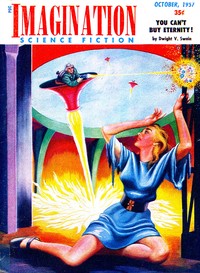
[Transcriber's Note: This etext was produced from Imagination Stories of Science and Fantasy October 1957 Extensive research did not uncover any evidence that the U.S. copyright on this publication was renewed.]
Careful to keep trees and bushes between himself and the cottage, the boy legged it across the fields toward the glass rocket poised in Johnson's pasture, glittering and slim like a dark, slender dancer. To Pete it was all the promise in the world distilled into a pointed black glass bottle. But to the women in the cottage....
He glanced back. Apparently they hadn't seen him. He had to hurry, because he had something to ask Murph Vanderpool, the rocketman, and sometime tomorrow the rocket would be gone.
His grandmother and his mother would be glad when it was gone. To them it was a monstrous and terrible symbol of something, and, like an evil woman, most terrible because of its beauty.
"Just can't get away from them," his grandmother had said at lunch, gazing irefully out the window toward where it stood. She was a stiffbacked old lady with a valentine face where something wintry mixed with something mild. "I moved out here on the edge of a little town and thought I'd got away from 'em--and the television's full of 'em--and the magazines full of 'em--and now this barnstormer sets one down practically in the backyard!"
Pete curled his brows in a way that made the women remember his father. "What's wrong with rockets, Grammy?"
"No reason for them! No reason for men to want to go way off hundreds of miles from earth, getting lost, getting killed! We had jets--we should have been satisfied."
She sighed, and her daughter-in-law echoed it. Looking out the window their thoughts ran to space and rockets and their men, who had been rocketmen and who would never come back. What was left of them was still out there, moving eternally through lonesome space in straight lines or circling some dead moon or planet. The gray-haired woman's thoughts ran to the husband torn and destroyed when the early test ship burst on the moon-run, and the other woman's mind reached grieving toward her own husband, the gray-haired woman's son, whose ship had turned in an instant to a molten glob when its white metal coating suddenly peeled and it took the full, brutal hammer of the sun.
The younger ran her fingers through Pete's spiky hair. "Petey, you're not to see that barnstormer any more."
"Aw--fooher! Fooner!"
His grandmother raised her hands. "Where do they pick up that awful slang?"
Pete scowled out the window, thinking of the rocket, the knobs and slings and dials within it, the feel of speed and space and war about it, the slash-grinned young god who rode it. He had something to ask Murph.
"Aw fooner," he muttered.
His mother swung him to her lap. "Shall we tell him about the surprise?"
Pete thought he caught something odd--a nearly invisible craft or knowingness--in the glance they traded.
"You didn't get much for your birthday last week, Pete," his mother beamed, "so we decided to give you a kind of late birthday party. You're going to have that picnic on Indian Hill. It'll be an all-day picnic, with all the youngsters you know, hunting for arrowheads and relics. We're going in Mr. Fobey's copter."
"Oh boy! Indian Hill! At last!" Then he sobered, thinking of paunchy, bland-faced, nervous Mr. Fobey.
"Will Fobey bring his air sluice?"
"He says he will."
"All right then. Indian Hill! Whoopee!"
He kissed them, and went larking toward the door but his mother snagged him.
"I hope you aren't forgetting your chores, young man."
"Yeah--weeding. I don't see why we don't have all ponics, like everybody else. Gee whiz, can't I skip it just today. It's the next to the last day for the Hester."
"What's the Hester, for goodness sake?"
"Why, the rocket! The glass rocket!"
She held her son's head between her hands and held her eyes on his. "Pete, we told you not to go near that rocket. I mean it. Stay ... away ... from ... it! I know what I'm saying. Stay away from it!"
He scuffled his feet. "Okay mom. Okay then. Okay."
Half an hour later he was legging it across the fields, keeping trees and shrubs between himself and the cottage, and three quarters of an hour later he was handing a crescent wrench to Murph Vanderpool, who had found a loose bolt in the rig of the doube-slung pilot's cradle. Weeding was forgotten. His nostrils were full of hexadrine, his eyes were full of dials and levers and words like "parsecs" and "off ram--on ram," and his head was full of dreams.
The Hester. Ever so slightly scored along her sides with the nailhead meteorites she had brushed rushingly aside. An imperceptible waver in her hull where a Panasia heat shell had nearly downed her. Glamorous witch of space. Cleopatra's needle of outer gulfs.
He knew about her. The Federation had won the war when they began casting rockets of the new, light, tough glass, mass-producing swarms to oust Panasia in the battles fought in the black deeps beyond the bounds of earth with weapons that would have destroyed both sides if used on the home planet. And after the war thousands of the rockets had been sold, and many had gone to the young men like Murph whom the war had made into spacemen before they had a chance at any other business and who did not want now, ever, to be anything but spacemen, rocketmen. They went about the country selling rocket rides. Tradition had given them a name from another postwar epoch: barnstormers.
Pete handed the wrench to the barnstormer. "Which are the dark-light controls?"
"Holy tubes," grinned Murph, pushing the black hair from his eyes, "If you weren't such a handy kid you'd be a nuisance. Here." He pushed a button, and the dark hull grew clear, letting in the sunlight. Murph pushed deeper and the hull darkened. He twirled and a long, clear porthole appeared along the rows of seats.
"Polaroid can keep radion or light--sunlight can be enough to kill you. Or you can clear a place to look through."
"Can I work it, huh?"
"Just once."
Pete manipulated the button. Then he held his breath, glanced at Murph, and slipped into the pilot's cradle. It was too wide and deep but he imagined that he filled it. He imagined the switchboard alive and winking and his body weighing a thousand tons, then weighing nothing at all. The Hester had passed escape velocity, cast off gravity, and earth lay already ten thousand miles behind her. The board showed she had slewed a little because of the slight warp in the hull. He corrected course. Then he cut power, and the ship went driving on with nothing to stop it at thirty thousand miles an hour.
Murph let him sit there a full minute. Then he lifted him down.
"Let's go outside, see if there's any business."
There wasn't, and they lounged on a piece of canvas in the blackened blast area.
The book keeps going
Reading is free forever. Sign up and watch scenes appear while you read.



Scenes Storieta drew for other classics.
New illustrated classics
Once or twice a month: the latest books to get full character casts, scene art, and free comic editions. No account needed.