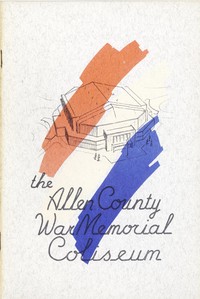
The story of the Allen County War Memorial Coliseum began ten years ago. The progression of events between the first consideration of the memorial in 1944 and its completion in 1952 was by no means smooth and uninterrupted. The account of the solution of the problems involved in planning, financing, and constructing the memorial constitutes a community accomplishment.
The source material for this publication originated in a speech delivered by Otto H. Adams at a meeting of the Quest Club, November 6, 1953. Mr. Adams, recently elected president of the Coliseum Board of Trustees, reviewed the history of the Coliseum and discussed its value to city and county in his paper entitled “Coliseum—Asset or Liability?” James R. Fleming, the past president of the Board of Trustees, A. M. Strauss, the architect, and Don L. Myers, the coliseum manager, have supplied supplementary information.
The Boards and the Staff of the Public Library of Fort Wayne and Allen County present this pamphlet in the hope that it will interest and inform the citizens of Allen County.
In 1944 the Fort Wayne Junior Chamber of Commerce first proposed the construction of a coliseum as a memorial to the men and women of Allen County who had lost their lives in both World Wars. Such a structure was envisioned as serving a twofold purpose; it would honor our heroic dead and would greatly increase recreational facilities. A Russell Sage Foundation study was made after World War II; the report indicates a definite trend among memorial planners to erect “living memorials,” which serve the people while honoring their heroes, rather than ornamental arches, statues, and monuments. The Foundation believes that this trend is commendable and hails it as a “triumph of common sense over sentimentalism.” Contemporary opinion seems to be that construction of a useful memorial in no way detracts from the honor paid to the dead. On the contrary, it is felt that the utility of the monument demonstrates our regard for them more forcibly by benefiting that society for which they died.
The members of the Junior Chamber of Commerce conducted a survey of city residents and concluded that 78 per cent were in favor of the proposed coliseum. Two independent occurrences in 1944 added impetus to the movement. First, Psi Iota Xi Sorority sponsored an analysis of recreational facilities estimated to be needed by the city for a twenty-year period. The sorority submitted to the mayor a plan drawn up by Elwood Allen and George Nesbitt of the National Recreation Association. A memorial field house was one of the major recommendations of the plan. A memorial honoring General Anthony Wayne, the founder of the city, was also proposed in 1944. This memorial, too, was envisioned as a practical structure, and a field house was one of the suggestions. Both state and national funds could be employed to construct an Anthony Wayne memorial.
The Junior Chamber of Commerce survey determined that popular opinion supported the project. Accordingly, that association hired Mr. Allen, who had drawn up general recreational plans for Fort Wayne, to make a further investigation of possible sites and building plans. It was immediately evident that a coliseum would be a costly construction; the cost would probably exceed two million dollars. The acquisition of funds was the first problem that had to be solved. James R. Fleming presided over the meeting at which the survey results were first discussed. He suggested building a coliseum as a memorial both to the dead of the two World Wars and to Anthony Wayne. He believed that financial aid could be obtained from the federal government in this way.
Despite general popular sentiment in Allen County favoring the erection of a coliseum, the planners faced and overcame many obstacles before their dream became a reality. In 1945 plans were announced for a sports arena, which was to be built by private enterprise in the Quimby Village area. Had these plans been realized, the sports arena would have been in direct competition with the Memorial Coliseum. The next impediment was in the form of objections to the proposed site; the residents of the Lawton Park area, which was the first site recommended, were vocal in their opposition.
Since at least a portion of the cost of a coliseum would be financed by property taxes, in 1946 it was decided to submit the question to the electorate of Allen County in the form of a referendum. After the county commissioners had agreed to place the question on the ballot, the Junior Chamber of Commerce organized and carried out an extensive publicity campaign to secure public approval. The War Memorial Commission, a group organized with the encouragement of the Junior Chamber of Commerce, assumed responsibility for the planning and co-ordination of the campaign. Don Myers was elected chairman. Conventional advertising media were utilized: newspapers, radio broadcasts, direct mail, and bus placards. In addition, public attention was dramatically captured by dropping thousands of leaflets over the city from a plane and by holding a torchlight parade on election eve. A special appeal was made to high school students. Commission speakers addressed student assemblies and explained how the coliseum could enlarge school sports programs. Buttons in school colors, advertising the coliseum, were distributed at football games, and publicity appeared in school newspapers. Although the planning of this well-integrated program must be credited to the War Memorial Commission, the Junior Chamber of Commerce continued to give active support and co-operated to carry out all phases of the fight.
Both major political parties endorsed the issue. The chairmen of the Democratic and Republican central committees signed a joint statement which advocated voting “yes” on a project that would benefit every person in Allen County. The average annual cost to the taxpayer would be only fifty-five cents, it was stated. Many civic organizations pledged their support. The Zollner Pistons played an exhibition game and donated all proceeds to the War Memorial Commission. The check for $1,700 was used for publicity to win the support of the voters. The Civic Theatre also gave a benefit performance for the cause. The Fort Wayne Civic Association paid for advertisements explaining the benefits of the proposed coliseum.
About this time, fearing that the sports arena function of the coliseum was being overemphasized, the president of the Junior Chamber of Commerce reiterated its primary purpose: “War memorials should be for the living, not for the dead alone. The living must be enabled to derive a spiritual lift from them. There must be a shrine to which one may go to commune with the missing and to pay tribute to the returned. A mere building does not serve this purpose. The true memorial building has a heart, a focal point. Some symbol within it must tell why the building was built, and this must be the center of interest.”
The results of the referendum of November 6, 1946, must have gratified the commission; that organization had endeavored to stimulate the public interest and approval and had succeeded admirably. The vote was five to one in favor of floating a bond issue to finance the memorial.
After the first World War, a law had been passed by the state legislature permitting the county councils to issue bonds for memorial purposes to the extent of ½ per cent of the total property valuation of the county. Based on the property valuation of Allen County in 1947, this proportion would have been approximately one and one-half million dollars, but it was evident that the cost of the proposed coliseum would far exceed this amount. Public subscription and federal aid were among the several sources considered for obtaining the additional funds necessary to build the structure. But these auxiliary sources were discarded in favor of raising the ceiling of bonded indebtedness. A change in the statute was proposed. A bill was formulated and sponsored by the American Legion legislative committee. The War Memorial Commission warmly praised Robert Gaskill, chairman of the legislative committee, for his valuable assistance. The bill was enacted, and in March, 1947, Governor Ralph F. Gates signed the amended law increasing the ceiling from ½ per cent to 1 per cent of the assessable property in the county.
The majority of the voters of Allen County gave their support to the planners of the War Memorial Coliseum and were eager to have the preliminary work completed and the construction begun. But a small minority argued that increasing the indebtedness of the county was unjustifiable and that the Coliseum would impose too heavy a burden on the taxpayer. Some members of the minority attempted to thwart the coliseum plans; they contended that the law permitted the county to issue bonds for only one memorial and that Fort Wayne already had a memorial in Memorial Park. Both contentions were correct; if that memorial had really been built with funds secured from a county bond issue, it would have been illegal to finance the Coliseum by that means. Investigation disclosed that the theory that the old memorial was paid for by the county could not be substantiated. Apparently, funds were secured largely through the generous donations of individuals and were augmented by public subscription. Again the commission turned to the Indiana General Assembly, and this time the legislature unanimously passed a bill declaring a bond issue for a memorial coliseum legal.
The passage of the bill raising the amount of the bond issue assured approximately three million dollars for the memorial. The first decision facing the county commissioners thereafter was the final selection of a site. On May 19, 1947, a joint meeting of the commissioners and the War Memorial Commission heard Elwood Allen recommend the Municipal Beach area. Mr. Allen cited the following sound reasons for his choice: the tract is well drained, high, and adequate in size to allow for future expansion; at the present time, two thirds of the rural population of Allen County have easy access to it; within the next few decades the center of population probably will shift toward the north of the city.
For a brief period there was some dissension between the county commissioners and the War Memorial Commission. The members of the commission had accomplished much of the preliminary work and felt that the commissioners were not giving sufficient consideration to their recommendations. Legally, the commissioners had the power of final decision; as elected officials they could not delegate authority to another group. The commissioners realized that any rift between the groups would be detrimental to the progress of the Coliseum; therefore, they offered the War Memorial Commission the status of “a public body to advise and counsel with” them. The commission unanimously accepted this proposal, and full accord was re-established between the two groups. The commission set up a planning committee to work in close co-operation with the commissioners and with Alvin M. Strauss, the architect for the Coliseum.