Public-domain ebook
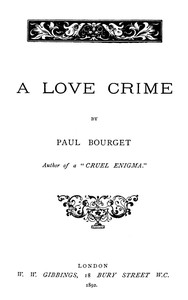
A Love Crime
by Paul Bourget
Language: en477 downloads on Project Gutenberg
Subjects
In: Romance·Novels·French Literature
Public-domain ebook sourced from Project Gutenberg #65407.
Public-domain ebook
by Paul Bourget
Language: en477 downloads on Project Gutenberg
Subjects
In: Romance·Novels·French Literature
Public-domain ebook sourced from Project Gutenberg #65407.
The opening · free to read
The little drawing-room was illuminated by the soft light of three lamps--tall lamps standing on Japanese vases and bearing globes upon which rested flexible shades of a pale blue tint. The door was hidden by a piece of tapestry; two walls were hung with another piece, which was covered with large figures. Both windows were draped with curtains--drawn just now--of deep red colour and heavy of fold.
The apartment thus closed in had a homelike air, which was heightened by the profusion of small articles scattered over the furniture: photographs set in frames, lacquered boxes, old-fashioned cases, a few Saxon statuettes, books stitched in covers of antique stuff, such as were coming into fashion in the year 1883. The wreathing foliage of an evergreen plant showed in one corner. Close beside it, an open piano displayed its white keys. An English screen with coloured glass and a shelf on which tea-cups, books, or work might be laid, stood in folds on one side of the fire-place. The fire burned with a peaceful crackling noise which formed an accompaniment to the sound proceeding from the tea-pot as the latter received the caresses from the flame of its lamp on the low table designed for such service.
The furniture of the somewhat crowded drawing-room presented that composite appearance which is characteristic of our time, together with the peculiarity that everything in it seemed to be almost too new. At a first glance, certain slight indications would have seemed to show that its Parisian aspect had been voluntarily aimed at. Objects were contrasted here and there; there were, for instance, little old-fashioned silver spoons; on the walls were two excellent copies of small religious pictures, to which memories of childhood were certainly linked, and which could have come only from an old country house. The photographs, also, witnessed, by the dress and demeanour of the relatives or friends represented, to altogether provincial relationships. The feeling of contrast would have become still more perceptible to one visiting the other rooms and finding everywhere evident tokens that the persons dwelling in them had lived but a very short time at Paris.
This small-sized drawing-room belonged to a small-sized house situated at No. 3½, Rue de La Rochefoucauld. The lower part of this street, which descends in a very steep slope to the Rue Saint-Lazare, comprises several private houses of very varied build, and a few retired dwellings surrounded by gardens. The house containing the little drawing-room was built for an actress by a celebrated financier under the Empire, at a period when the Rue de la Tour des Dames harboured many princes and princesses of the footlights. Too small to suit a wealthy family, too inconvenient, owing to certain deficiencies in accommodation, for tenants accustomed to the completeness of English comfort, it must have proved quite seductive to persons accustomed to a semi-country life by its attraction as a "home," as well as by the quiet pervading the end of the street, which is rarely affronted by vehicles on account of the difficulty of the ascent.
During this November evening, although the windows of the little drawing-room looked upon the courtyard, and the latter opened upon the street, only a dim and distant murmuring penetrated from without, broken by occasional gusts of the north wind. Judging by the whistling of this north wind the night must have been a cold one. So, at least, opined a fairly young man, one of the three persons assembled in the drawing-room, as he rose from his chair, set down his empty cup on the tea-tray with a sigh, and looked at the time-piece.
"Ten o'clock. Must I really go to see the Malhoures this evening? What a disaster it is to have a sensible wife who thinks about your future! Never get married, Armand. Listen to that wind! I was so comfortable here with you. Look here, Helen," he went on, leaning on the back of the easy-chair in which his wife was seated, "what will happen if I do not put in an appearance this evening?"
"We shall be discourteous to some very kind people, who have always behaved perfectly towards us since we came to Paris a year ago," replied the young woman; she stretched out to the fire her slender feet, in the pretty patent leather shoes and mauve stockings, the latter being of the same colour as her dress. "If I had not my neuralgia!" she added, putting her fingers to her temple. "You will make all my excuses to them. Come, my poor Alfred, courage!"
She rose and held out her hand to her husband, who drew her to him in order to give her a kiss. Visible pain was depicted on Helen's handsome face for a minute, during which she was constrained to submit to this caress. Standing thus, in her mauve-coloured, lace-trimmed dress, the contrast between the elegance of her entire person and the clumsiness of the man whose name she bore was still more striking.
She was tall, slender, and supple. The delicacy with which her hand joined the arm which the sleeve of her dress left half uncovered, the fulness of this arm, on which shone the gold of a bracelet, the roundness of her dainty waist, the grace of her youthful figure,--all revealed in her the blooming of a bodily beauty in harmony with the beauty of her head. Her bright chestnut hair, parted simply in the centre, half concealed a forehead that was almost too high--a probable sign that with her feeling predominated over judgment. She had brown eyes, in a fair complexion, such eyes as become hazel or black according as the pupil contracts or dilates; and everything in the face declared passion, energy, and pride, from the rather too pronounced line of the oval, indicating the firm structure of the lower part of the head, to the mouth, which was strongly outlined, and from the chin, which was worthy of an ancient medal, to the nose, which was nearly straight, and was united to the forehead by a noble attachment.
The pure and living quality of her beauty fully justified the fervour depicted on the face of her husband while he was kissing his wife, just as the evident aversion of the young woman was explained by the unpleasing aspect of her lord and master. They were not creatures of the same breed. Alfred Chazel presented the regular type of a middle-class Frenchman, who has had to work too diligently, to prepare for too many examinations, to spend too many hours over papers or before a desk, at an age when the body is developing.
Although he was scarcely thirty-two, the first tokens of physical wear and tear were abundant with him. His hair was thin, his complexion looked impoverished, his shoulders were both broad and bony, and there was an angularity in his gestures as well as an awkwardness about his entire person. His tall figure, his big bones, and his large hand suggested a disparity between the initial constitution, which must have been robust, and the education, which must have been reducing. Chazel carried an eye-glass, which he was always letting fall, for he was clumsy with his long, thin hands, as was attested by the tying of the white evening cravat, so badly adjusted round his already crumpled collar. But when the eye-glass fell, the blue colour of his eyes was the better seen--a blue so open, so fresh, so childlike, that the most ill-disposed persons would have found it hard to attribute this man's weariness to any excess save that of thought.
His still very youthful smile, displaying white teeth beneath a fair beard, which Alfred wore in its entirety, harmonised with this childlike frankness of look. And, in fact, Chazel's life had been passed in continuous, absorbing work, and in an absolute inexperience of what was not "his business," as he used to say. Son of a modest professor of chemistry, and grandson of a peasant, Alfred, having inherited aptitude for the sciences from his father, and tenacity of purpose from his grandfather, had, by dint of energy, and with but moderate abilities, been one of the first at the entrance to that École Polytechnique which, in the estimation of many excellent intellects, exercises, by its overloaded and precocious examinations, a murderous influence upon the development of the middle-class youth of our country.
At twenty-two, Chazel passed out twelfth, and three years later first from the School of Roads and Bridges. Sent to Bourges, he fell in love with Mademoiselle de Vaivre, whose father, having married a second time, could give her only a very slender dowry. The unexpected death, first of Monsieur de Vaivre, then of his second wife and of their child, suddenly enriched the young household. Appointed the preceding year to a municipal post at Paris, the engineer found that he had realised a hundredfold the most ambitious hopes of his youth. His wife's fortune amounted to about nine hundred thousand francs, to the returns from which were added the ten thousand francs of his own salary and the small income which had been left by his father. But this competency, instead of blunting the young man's activity, stimulated it to the ambition of compensating in honour for the inequality of position between himself and his wife. He had, accordingly, gone back to mathematical labours with fresh ardour. Admission to the Institute shone on the horizon of his dreams, like a sort of final apotheosis to a destiny, the happiness of which he modestly referred to his father's wise maxim: "To keep to the high road."
Add to this that a son had been born to him, in whom he already discerned a reflection of his own disposition, and it cannot fail to be understood how this man would congratulate himself daily for having taken life, as he had done, with complete submission to all the average conditions of the social class in which he had been born.
Did these various reflections pass through the mind of the third individual--the man whom Alfred Chazel had called Armand, as he contemplated the conjugal tableau through the smoke from a Russian cigarette which he had just lighted--a liberty which revealed the extent of his intimacy with the family? The same contrast which separated Alfred from Helen separated him also from Armand. The latter looked at first younger than his age, though he too had passed his thirty-second year. If Alfred's carelessly-worn coat revealed rather the leanness and disproportion of his body, the frock of the Baron de Querne--such was Armand's family-name--fitted close to the shoulders and bust of a man, small but robust, and evidently devoted to fencing, riding, tennis, and all the sporting habits which the youths of the richer classes have contracted in imitation of the English, now that political careers--diplomacy, the Council of State, and the Audit Office--are denied them by their real or assumed opinions.
The quiet jewellery with which the young baron was adorned, the delicacy of his hands and feet, and everything in his appearance, from his cravat and his collar to the curls in his dark hair, and to the turn of his moustache, drawn out over a somewhat contemptuous lip, disclosed that deep attention to the toilet which assumes the lengthened leisure of an idle life. But what preserved De Querne from the commonplaceness usual to men who are visibly occupied with the trifles of masculine fashion was a look, in a generally immovable face, of peculiar keenness and unrest. This look, which was not at all like that of a young man, contradicted the remainder of his person to the extent of imparting an appearance of strangeness to one who looked in this way, although a desire to evade remark, and to be above all things correct, evidently influenced his mode of dress.
The book keeps going
Reading is free forever. Sign up and watch scenes appear while you read.



Scenes Storieta drew for other classics.
New illustrated classics
Once or twice a month: the latest books to get full character casts, scene art, and free comic editions. No account needed.