Public-domain ebook
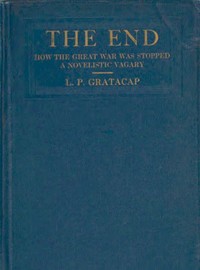
The End: How the Great War Was Stopped. A Novelistic Vagary
Language: en487 downloads on Project Gutenberg
Subjects
Public-domain ebook sourced from Project Gutenberg #65463.
Public-domain ebook
Language: en487 downloads on Project Gutenberg
Subjects
Public-domain ebook sourced from Project Gutenberg #65463.
The opening · free to read
It is a pretty village, Saint Choiseul, perched on a hillside whose slopes, undeviatingly smooth and moderate, subside into a flowing land of streams and fields and white roadways. Its narrow streets are decorous with straight lines of prim poplars that have a military stiffness, and while the wind stirs their hedged leaves into audible protest--the flutter of a restrained salutation or a salute simply--it seems hardly able to extort from their braced branches the tribute of an obeisance.
The houses are generally simple things of two and sometimes only one story, built of limestone blocks that have weathered into an undecipherable composition of brown blotches, staring white strips, mossy crevices, little pits of black, and crannies of nutritious decomposition, where tiny grass blades have sprouted. Under favorable skies--and they are almost always favorable at St. Choiseul--their uneven walls become fascinating studies of minor-color harmonies, and rising as they do amid beds of flowers, or just grazed grass, from which they seemed in the broad sunshine to gather subtle tints of gayety, by some evanescent reflexion, they become fascinatingly pretty, and commodious, so to say, to an artist's fancy.
The clustered chimneys in some larger villa formed occasional and well-spaced visual incidents that broke the monotony of the low cottages and added a keenly valued distinction to our pleasant hamlet. It was delightful. You felt its persuasive loveliness the moment you came up the road from far-away Paris--Ah! not so far away that we could not see the Eiffel Tower on fair days, and on all days, or rather nights, note the dull flare of its lights in the sky. The road you came by crossed a stone bridge that threw its moss-covered span over a clear deep brook, running all the way from Briois, with pollarded willows on rushy banks, and drooping wistarias wildly clinging to white birches in the meadow lands of rich farmers, where the brook, loitering, made pools in which the cattle stood for hours in cream and russet dabs over the half glittering rippled water. Mon Dieu! Comme il était beau!
Our house was the second in the village on the right hand side of the road, as you came from Paris, just next to Privat Deschat, an old carpet-weaver whose back-yard was as many colored as a flower garden with bright rugs, green, and yellow, and blue, and red, and brown, hung out on lines that webbed the air like a spider's nest, in the spring. And a very pleasant, inviting house ours was with its staid look of reserved happiness, I might say. There it was with its deep-silled windows, filled with geraniums and heart's ease, its wide black door, and big brass knocker, that was a dragon's tongue lolling out of a dragon's scaly jaw, its long slanting shingled roof, with two dormer windows, and its pastiche red bricks peeping in ruddy streaks through the dense ampelopsis that climbed up to the eaves, and then lurked in the dark, to make its way into the house, and lingering there, became pale and white.
There was no veranda or piazza, but just a covered porch with four wooden pillars and two bench seats, where sister Gabrielle and I sat long hours in the evenings in summer time, when we were afraid sometimes to enter the house because--Ah, but I must not tell that now, for just that fear and what it led to, and how it helped us to end the WAR, is the sole reason of my telling this story at all. No, no, that is a long way towards the end, and here I've hardly begun.
Well, as pleasing and welcoming as the house seemed on the outside, it was even more lovely within. I don't wonder the spirits--Ah, _bête encore_--Yes, most lovely. You see there was a wide hall in soft yellow and china-blue tile, with the Privat Deschat's rag-carpet in short strips over it, and a big Holland clock against the wall, and prints in black and white framed in mahogany, and an old narrow carved table with tall porcelain candle-sticks on it, from Dresden, and then some straw-bottomed chairs in gilded frames, and the garden of blooms, seen through the door on the other side, which opened on a walk covered with a vine-trellis, and bordered by smart gillyflowers, and hollyhocks, and sunflowers, and cushions of pansies.
Then there was a good big square room on the right of the hall full of books, and friendly chairs, and pictures, with a big desk-table in the centre, where rose toweringly a superb old bronze French lamp, that even then we burned with whale oil. You wound it up, and the oil was pumped on the wicks and--the light was soft and charming and companionable. The windows were high and low; they reached up to the ceiling, and they left spaces for window seats at the floor, and white tapestry curtains shaded them, and then at night--we did it in the winter mostly--there could be drawn over them soft, thick folds of green baize, and we seemed softly entombed in a delicious seclusion--so delicate, so sure. My sister loved the long evenings that way, of winter, and if it stormed and the snow stung the windows with sharp taps, she would laugh almost, with the happiness of security.
And there was a big fire-place on the west side of the room--you see this library was on the west side of the house too--but it was the whole width of the house also, and the southern outlook swept over the low land and gazed straight to Paris. That chimney corner was delightful, and the wisps of light from the soft coal lit up the mantel and played grotesquely over the row of Peruvian Inca figures and face-jars that filled it--I brought them from America--so that they seemed to squint and grin, or just look glum and melancholy. Gabrielle said they came to life in the half dark, and she made them talk to me--for she interpreted them in her odd way--the old Inca warriors and the medicine men and the priests, and the little beggar with a stump for a leg, and the squinting big-toothed demon in red and black.
All that in the winter, but in summer and early fall, with the windows all open, the cooling night air came in, and brought with it odors of the ground and perfumes--O! so delicate and ravishing--of the flowers; St. Choiseul loved flowers; there was not a home without them--and so mixed with these, as if sound and smell had run together in a composite, half of each, the murmur of insects, the endless roundelay of the peeping tree toads, a twittering of birds, and the shivering of leaves in the trees. How we loved it!
I am rambling dully, but you see, kind friend, such strange weird things happened in that house afterwards, and such sorrow came to me after all the blessed joy of years, now lost, forever lost, that I cannot stop my thought picturing everything about it, as if I would leap back into the arms of other days, and let them caress and soothe me and banish my grief.
On the east side of the hall-way was our dining room, a simple room with just straw-bottomed chairs, an immense oak side-board, royally set out with glass and blue plates, and on the walls quaint expressionless portraits of our people, including mother and father, a fat uncle with a pipe, and half closed eye, and a great grandfather in the regimentals of the Revolution--very brave looking and handsome--and some very staring aunts, and great aunts in starched finery, that made them look like owls.
Back of the pantry was the kitchen, with old Hortense, as the high priestess and oracle--our own dear Hortense, with such a kind heart, and a ready ear, and a generous hand--Ah! how we children loved her, and how she loved us, and how she packed our napkins for school, or our baskets for picnics--as the Americans say. She used to shake her wise old head slyly at us when we looked in at the kitchen door, with that little hungry grin on our faces:
"_Certainement_, you are veery hungree. Oh I know--it is a great pity and there is nothing, _Vraiment_--nothing--but See! I do so," and her long fingers snapped, and she waved them in an appeal to space, and then she cautiously raised a big bowl and Voila! a nest of crisp, aromatic, yellow buns, or cookies, or gateaux aux raisins, so good, so inexpressibly good!
And upstairs were the pleasant bed-rooms, so inviting to repose in their demure neatness, with high posters and pavilions, and their broad bottomed rockers, and their rainbow wallpapers, and rag carpet strips, over the bronzed, aged, and russety black wooden floors.
My own room was over the library; it looked north and west, and I would hang out of its window for half an hour at a time, watching the red sun quench itself behind the golden and flaming horizon, whose secrets I yearned to know, whose untrodden wonders I dreamed to penetrate. Those wistful hours awoke the unconfessed but sleepless passion of my heart to sail out over the Atlantic, a passion too of unrest, linked in my disposition with ecstacies and imaginations.
Sister Gabrielle was in the next room to mine, and in her sweet, tasteful, fresh and white bed-room, rose the chimney from the library fire-place below--so that she had her own chimney corner too, in the second story of the house and THERE--Well, wait, that comes later.
Our parents were nervously alert in nature, intelligent and conscientious. In them a strain of Huguenot puritanism was combined with an intellectual appetite that seemed to create in each a physical activity that made them restless in manner, and weak in health. They watched my sister and myself too suspiciously, and their affection became almost an aggravation of kindness, and solicitude, and curiosity, which made me more eager to escape that protecting roof-tree, and see the world. On my sister, as I shall explain, it exercised the most unfortunate influence, and accentuated that peculiar neurosis whose roots--as I was to learn later--were enlaced in a sub-conscious sensitivity to occult and invisible agencies, which indeed I helped to strengthen.
We were provided with neighbors and friends, and while the village of St. Choiseul was sufficiently democratic to tolerate and encourage friendly intercourse with everyone, as a matter of congeniality and temperamental tastes, we knew intimately but five persons in St. Choiseul. These five composed a contrasted and picturesque group, and when all were assembled in our big library, father and mother seemed to me most attractive, for in converse that was stimulating and personal, they attained a serenity of feeling and manner, that made them really delightful. Let me quickly describe our friends.
There was the rug-maker and carpet weaver, Privat Deschat, an elderly, robust Norman, who worked hard at his tasks in the mornings--and his mornings began very early--read as steadily for three or four hours in the afternoon, napped two hours, ate supper with his housekeeper and hunted up a friend with whom he smoked and chatted, or played Demi Rouge for the remainder of his day, which never extended over midnight, and more customarily closed at ten.
Privat Deschat was unquestionably very good company, quiet, attentive, observant, and spasmodically conversational, when his suppressed gift of speech awoke a momentary admiration. He was a short, strong man, with large cheeks, a massive head, an expressive mouth, made more so by very good teeth, and what might be called reticent eyes, in which his delicate and studious self retreated, under the guise of inexpressiveness. Again these quiet eyes would light up with enthusiasm, or it might be with distrust and defiance. His speech accompanied his roused spirit, and no one dared--no one wished--to interrupt, lest the rebuke might return him to silence. You see, he thoroughly delighted us. He was a bit quaint in his way of saying things.
The book keeps going
Reading is free forever. Sign up and watch scenes appear while you read.



Scenes Storieta drew for other classics.
New illustrated classics
Once or twice a month: the latest books to get full character casts, scene art, and free comic editions. No account needed.