Public-domain ebook
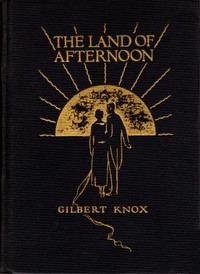
The Land of Afternoon: A Satire
by Gilbert Knox
English462 downloads on Project GutenbergDownload EPUB
Public-domain ebook sourced from Project Gutenberg #65560.
Public-domain ebook
by Gilbert Knox
English462 downloads on Project GutenbergDownload EPUB
Public-domain ebook sourced from Project Gutenberg #65560.
The opening · free to read
Byward Market had been freshened during the night by a heavy fall of powdery snow, that knew no peace from a bitter wind which drove it, in stinging clouds, up and down the street. The thermometer had made its record drop of the season.
Marjorie Dilling stood on the outskirts of a tight-packed group and shivered. The strangeness of the scene struck her afresh; the sense of loneliness was almost overpowering. She simply could not bring herself to push and jostle as the other women did—and a few men, too!—consequently she was always thrust away from the curb and prevented from seeing what lay beneath the furs and blankets and odd bits of cloth in the carts. Only now and again could she catch a glimpse of a tower of frozen beef, or rigid hogs which were trundled by their hind legs through the thronged streets, in a manner strongly suggestive of a wheelbarrow. Or, as the crowds broke and parted, she could occasionally see a stiff fringe of poultry and rabbits strung across the ends of the wagons. Eggs, butter, vegetables and cream were well covered, and spared in so far as possible, the rigours of the morning.
Byward was an open market which attracted farmers from districts as remote as the Upper Gatineau—across the river, in the Province of Quebec. Behind the line of carts or sleighs—automobiles, now!—there ran a row of nondescript buildings that rarely claimed the attention of the marketers; a confusion of second-hand stores, an occasional produce shop, and third-rate public houses, whose broad windows revealed a cluster of dilapidated chairs flanked by battered crachoirs, which had seen many years of unspeakable service. Behind these, a narrow passage led to the abode of spirits, of the kind latterly and peculiarly called departed. Here, the farmers gathered for warmth in winter and coolness in summer, and to slake—or intensify—their thirst in either season, while their women-folk remained in discomfort outside, and attended to the practical issues of the day.
The sigh that fluttered from Marjorie’s lips took form like a ghostly balloon and floated away on the frosty air. Her basket was light and her spirits were heavy. She found it incredibly difficult to shop in the Ottawa market. She simply dreaded Saturday mornings.
At the corner, where the wind whipped down the street and few people cared to linger, she found herself standing before an ancient crone, who sat amid an assortment of roughly-cured hides, and under a huge, weather-stained umbrella. At her feet lay a rusty pail overflowing with a curious mass that looked like bloated sausages in the last stages of decay.
“What—what is that?” asked Marjorie, in her soft timid voice.
The old woman made unintelligible sounds from between toothless gums.
“I beg your pardon?”
“I tol’ you, it is sang pouding. ’Ow much you want?”
“I don’t want any, thank you,” answered Marjorie. “I was looking for some sweetbreads. Have you any?”
“Sweet bread?” echoed the ancient, grumpily. “Well, why you don’ look on de store, hein? W’at you t’ink I am—de baker’s cart?”
Although unaware of the complexities of the French tongue and the French character, Marjorie perceived a rebuff in the old woman’s words. She apologised hastily and moved away. What, she kept asking herself, could she substitute for sweetbreads? Chickens were expensive and eggs, a fabulous price. Nobody in Ottawa seemed to keep hens . . .
“Have you any sweetbreads?”
She began to feel a little hysterical. It was a funny question! No wonder the old woman answered her crossly. Have you any sweetbreads? How many times had she asked it? She thought of the game the children played—_Black sheep, black sheep, have you any wool?_ And what on earth should she get in place of sweetbreads? Raymond was so difficult about his food. He had such a tiny and pernickety appetite . . .
By wriggling, she gained the curb before another cart.
“Have you any sweetbreads?”
No one paid her the slightest heed. The centre of the stage was held by a tall, spare woman with a stridulous voice. Marjorie knew her slightly. Two weeks ago she had called—not as people called at home, in Pinto Plains—but sternly and coldly, neither giving nor receiving pleasure by the visit, save when she had laid three bits of pasteboard on the corner of the table and left the house. Mrs. Pratt was the wife of a cheerfully ineffectual professional man with political aspirations, and she felt her position keenly. So did Marjorie; and she backed away while summoning her courage to speak.
“A dollar and a half?” Mrs. Pratt was saying. “Outrageous! I can’t think what you people are coming to! I’ll give you a dollar and a quarter, and not one penny more.” She indicated a pair of frozen chickens, each with a large mauve face, that lay exposed on an old red blanket.
“Can’t do it, lady,” said the farmer, with chattering teeth, “it cost me mor’n that to feed them this three year,” and he winked heavily at the surrounding circle.
“Oh, they’re fowl! Well then, of course, they’re not worth that much! There’s a woman across the road,”—Mrs. Pratt swept her muff vaguely towards the horizon and unconsciously disarranged Marjorie’s hat,—“who is selling her fowl for eighty cents!”
“_I’ll_ take them,” cried a woman at this juncture. “It’s too cold to haggle over a few cents. Giv’um to me!” She thrust a dollar and a half into the man’s hand, seized the chickens and started off.
“Those are mine!” called Mrs. Pratt, in a tone that rivalled the sharpness of the atmosphere.
“You take the others at eighty cents,” returned the woman, amid a ripple of laughter.
“Impertinence!” snapped Mrs. Pratt, as she turned away.
Marjorie drifted on, her basket still empty. These awful Saturday mornings! They seemed to accentuate her loneliness. Of course, the cold discouraged long conversations and the exchange of tittle-tattle that makes shopping, to some people, so delightful, but she was aware of the greetings that passed between women as they met—a tip, perhaps, as to some bargain, or a brief reference to some impending social function—and she would have been grateful for even the smallest sign of friendly recognition. Frequently, she saw people who had called upon her, but evidently she had made too little impression to be remembered. How different from Pinto Plains, where everybody knew her and cordiality was mutual!
She noticed that many of the ladies who came into church richly dressed on Sundays, wore the most dreadfully shabby clothes at market, but it was not until long afterwards, she understood that this was part of a scheme for economy—for beating the farmers at their own game. They disguised themselves that they might give no hint as to the fatness of their bank account, thus implying that well-to-do shoppers were asked a higher price than those of obviously modest means. These same shabbily-clad ladies never seemed to buy very much, and Marjorie often wondered how it was worth their while to spend the morning with so little result. In those days, she didn’t realise that they had left their motors round the corner, and that their parcels were transferred, two or three at a time, to a liveried chauffeur who sat in a heated car and read stimulating items from the Eye-Opener.
Others, she learned, dragged overflowing baskets into one of the “Market Stores,” whose prices were known to be a few cents in excess of those demanded by the owners of the carts. Here, they made an insignificant purchase, thereby placing the onus of free delivery on the shoulders of the management. The degree to which this practice was employed varied with the temperament of the shopper. Those of a less sensitive nature, felt no hesitation in asking Lavalee, the aristocratic Purveyor of Sea Food and Game, to send home six dollars’ worth of marketing with a pound of smelts. Likewise, Smithson suffered the exigencies of trade, not only delivering the type of foodstuffs that he didn’t keep, but every week of the year he was asked to send home the very things that were purchasable in his own store and which had been bought for a few cents less, half a block away. Seeing the baskets of produce that were piled high on the sidewalk every Saturday morning, Marjorie wondered how it was worth while for him to carry on his business or maintain his livery, at all!
Having made a few purchases, she set off down Mosgrove Street for the tram as fast as her burden would permit, when she came for the second time upon Mrs. Pratt, still searching for a bargain in chickens.
“One seventy-five?” she was saying. “Sheer piracy! I refused a much better pair for a dollar fifty!”
“Call it a dollar fifty, ma’am,” agreed the farmer, between spasms of coughing. “The wife’ll give me the devil, but I’m ’most dead with cold, and I wanta go home.”
Pity for the man, coupled with a touch of innocent curiosity, tempted Marjorie to linger close at hand and see the end of the transaction.
“But that’s what I’m telling you,” cried Mrs. Pratt. “They’re not worth a dollar fifty. They’re miserable things. Half fed . . .” Her eyes rested upon the owner resentfully, as though emphasising a definite resemblance between him and his produce. “I’ll give you a dollar and a quarter and not one penny more!”
“Oh, lady! I’ve gotta live!”
Something in the man’s tone told the astute lady that he was weakening, that he needed the money, that the chickens were hers. She pushed a dollar and a quarter into his hand, seized her purchase, and disappeared round the corner, into a waiting limousine.
A little later that same morning, Marjorie, finding that the children were all right in the care of Mrs. Plum, who “charred” her on Saturdays, went down town to The Ancient Chattellarium. Her errand was simple. She wished to have a piece of furniture repaired. It had been broken in the moving, and one of her callers had given her this address.
The Chattellarium could not, even by the most vulgar, be called a shop. It was an opulent apartment where elegant furniture was displayed—and sold—at dignified prices. Marjorie Dilling paused uncertainly on the threshold, feeling that she must, through error, have strayed into someone’s residence.
But she hadn’t! A lady glanced over the rim of a lampshade she was making, and invited her to enter.
“Just looking around?” she asked, with the instinct of one who recognises the difference between a shopper and a buyer. “I’ve got some rather nice things just unpacked,” and she went on sticking pins into the dull-rose silk with which she was covering a huge wire frame.
“Thank you, very much,” answered Marjorie, stealing a timid glance over her shoulder, “but I haven’t a great deal of time, and I really came to see—if—if—to ask about getting a piece of furniture repaired. I was told that I might have it done, here.”
The young lady took several pins from her mouth and looked up. She was quite pretty and had a pleasant manner in spite of her way of addressing most people as though they were her inferiors, and a few very prominent people as though they were her equals. She talked incessantly, and it had become her custom to illumine her speech with Glittering Personalities.
The book keeps going
Reading is free forever. Sign up and watch scenes appear while you read.



Scenes Storieta drew for other classics.
New illustrated classics
Once or twice a month: the latest books to get full character casts, scene art, and free comic editions. No account needed.