Public-domain ebook
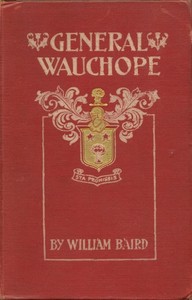
General Wauchope
by Baird, William, F.S.A. Scot.
Language: en1,018 downloads on Project Gutenberg
Subjects
In: Biographies·History - British·History - Warfare
Public-domain ebook sourced from Project Gutenberg #65570.
Public-domain ebook
by Baird, William, F.S.A. Scot.
Language: en1,018 downloads on Project Gutenberg
Subjects
In: Biographies·History - British·History - Warfare
Public-domain ebook sourced from Project Gutenberg #65570.
The work is a biographical tribute to Major‑General Andrew Gilbert Wauchope, a Scottish officer who fell at the Battle of Magersfontein during the Second Boer War. It opens on a December night in 1899, describing the thunder of rifles and cannon as the Highland Brigade, led by Wauchove, stumbles upon an unseen Boer force and is instantly swept by a murderous volley. The narrative immediately situates the tragedy within the larger British aim of relieving Kimberley, while portraying Wauchope as a steadfast leader whose personal qualities, courage, self‑denial, and a gentle spirit, are extolled. The author then promises a broader sketch of his life, tracing his lineage from the ancient Wauchopes of Niddrie Marischal through generations of soldiers, clergymen and scholars, and indicating that the biography will draw on extensive testimony from contemporaries.
Written in the formal, reverent style of late‑Victorian military history, the text blends vivid battlefield description with detailed genealogical research. Its language is ornate, with frequent asides and moral reflections, reflecting the period’s penchant for celebrating imperial virtue. Readers who enjoy thorough, almost hagiographic portraits of 19th‑century British officers, as well as those interested in Scottish family histories and the broader context of the Boer conflicts, will find this volume engaging.
The opening · free to read
On the 11th day of December 1899, amid the rattle of rifles, the fierce booming of cannon, and the sharp bang of exploding shells, a British force of Scottish Highlanders found themselves suddenly confronted in the darkness of an early African morning by an unseen enemy. All night they had been on the march, tramping the bare rocky veldt north of the Modder river, to attack, and if possible capture, the fortified and strongly entrenched position held by the Boer army of General Cronje among the rocks and cliffs of Magersfontein. This was full of difficulty and danger. But the relief of the beleaguered garrison of Kimberley was urgent, and if the work were to be done, it demanded the best the British army could achieve. Steadily and determinedly stepped out the men of the Highland Brigade, commanded by him they had long had reason to trust. As lieutenant, as captain, as colonel, they had followed him in many a well-fought battle, and now with Major-General Wauchope leading them in the darkness, no doubt or fear entered their breast.
But suddenly there was a flash of light from the rocks above, followed immediately by a long belching flame of fire from a thousand rifles in front. They had unexpectedly {10} stumbled on the enemy. There was no time for reorganisation, and in the midst of an entanglement of trenches and barbed wire fencing, and exposed the while to a withering fire against which nothing human could stand, the Highland Brigade was mown down. Here it was, but well in front of his men, endeavouring to the last to cheer on his followers, one of the most gallant and daring of modern British generals fought and fell, a martyr for his Queen and country.
General Wauchope's tragic end was no unfitting conclusion to a life of devoted, arduous service. He died as he had lived, ever in the midst of strife, an earnest, brave, and self-denying man, thinking more of others than himself; graced with the dignity that comes from inborn gentleness of spirit, and ever in his conduct exemplifying the faith he professed. No wonder that when such a man fell, there was a wail of lamentation, not merely around his own home in Edinburgh where he was best known and loved, but throughout the whole British Empire.
The story of his life is one of incident and hairbreadth escapes, and it deserves to rank high in the military annals of our country; for among those who have helped to raise Great Britain to the honourable position she holds among the nations of the world, as the vindicator of freedom, as the protector of the weak against the strong, as the pioneer of commerce, and the disseminator of Christianity, there are few who have laboured more zealously or fought more bravely than he whose career we shall in the following pages attempt to sketch.
In biography there is perhaps nothing more alluring than to trace out traits in remote kindred, and to watch them coming forth with new accompaniments in later generations, to work out, as it were, the full story of the race, and probably to mark a climax in some chosen individual. Though we have not space to follow this out in the present case, the distinguishing characteristics of General Wauchope's ancestors may easily be discerned throughout his career; to them he doubtless owed that simple manliness which looked upon every man--whatever his station--as a brother; that unswerving courage in time of danger, that unflinching devotion to duty, that cheerfulness of disposition, which made him a general favourite; all sobered by a sense of the unseen and eternal which entered into the very heart of his life.
The author's efforts to gather the scattered material of so chequered a career have been met on all hands by so willing a response from those who could in any way claim the General's acquaintance, that his task has been a pleasant and a comparatively easy one. For interesting details and incidents coming under their personal observation, his best thanks are due to Admiral Lord Charles W. D. Beresford, C.B.; General Sir Robert Biddulph, G.C.M.G., G.C.B., lately Governor of Gibraltar; Sir John C. M'Leod, G.C.B.; Colonel R. K. Bayly, C.B.; Colonel Brickenden; Colonel Gordon J. C. Money; Major A. G. Duff; Captain Christie, and other of his brother officers who shared with him the dangers and toil of naval and military service, in various parts of the world.
He cannot too gratefully acknowledge the kind assistance heartily given by the Rev. George Wisely, D.D., Malta; the Rev. John Mactaggart, Edinburgh; and the Rev. Alexander Stirling, York, army chaplains. Their contributions have been invaluable.
So fully indeed has material been placed at the author's disposal, that the volume might have been easily extended beyond its present limits. But enough, it may be hoped, has been said in illustration of General Wauchope's career as a soldier, and his character as a man, to enable his fellow-countrymen to realise that in his lamented death the nation has lost one of its bravest and best.
Andrew Gilbert Wauchope came of a long line of ancestry, who have distinguished themselves as soldiers, as churchmen, or in the more commonplace capacity of country gentlemen.
The family history can be traced back for several centuries at least, as occupying in the immediate vicinity of Edinburgh the estate of Niddrie Marischal; and throughout the various troubles in which Scottish history has been involved, the Lairds of Niddrie had their fair share, forfeitures and restorations being an experience not uncommon in their career.
Glancing over their genealogy, one might almost say with truth that the Wauchopes have ever been a fighting race, holding opinions strongly, and as strongly asserting them by word or deed when occasion arose.
The very name of their estate has a smack of the military in it, if it is true, as Celtic scholars say, that 'Niddrie' is derived from the Gaelic Niadh and _Ri_--signifying, in the British form of Celtic, the king's champion. Then the addition to the word, as distinguishing it from several other Niddries in Scotland, of Marischal, Marishal, or Merschell appears to have been given to the {14} estate from the fact that the Wauchopes of Niddrie were in early times hereditary bailies to Keith Lords Marischal, and later, Marischal-Deputies in Midlothian, in the reign of James v.
Whether it be true, as stated by Mackenzie in his Lives of Eminent Scotsmen, that the Wauchopes had their first rise in the reign of Malcolm Caenmore, and that they came from France, we shall not stay to discuss; but it is generally allowed that the name is a local patronymic, common in the south of Scotland, and that the Wauchopes of Niddrie Marischal belonged originally to Wauchopedale in Roxburghshire, where they were for long vassals of the Earls of Douglas.
The records of the earlier generations of the family having been lost, one cannot with accuracy say who was its founder, or when he lived. In James the Second's reign, for making an inroad into England, and again in Queen Mary's time, for espousing the cause of that unfortunate sovereign, the estate of Niddrie was confiscated and passed for a time into the hands of others, while the feu-charters that remained were afterwards destroyed when the English under Oliver Cromwell came to Scotland. But notwithstanding these misfortunes, there are documents extant which go to show that as far back as the time of Robert III., who began to reign in 1390, there was one Gilbert Wauchope holding the lands of Niddrie from that king, who is supposed to be the grandson of Thomas Wauchope in the county of Edinburgh, mentioned in the Ragman Rolls of 1296.
One scion of the family, born about the year 1500, in the reign of James IV. attained to considerable distinction as an ecclesiastic. This was Robert, the famous Archbishop of Armagh, a younger son of Archibald, the Laird of Niddrie. Defective in his vision almost to blindness, he was, {15} notwithstanding this misfortune, possessed of great natural abilities, and by diligent study attained to high and varied accomplishments. So proficient did he become in the study of the Scriptures, the Fathers, and the Councils, that he was appointed Doctor of Divinity in the University of Paris; and in 1535, having attracted the notice of Pope Paul III., he was called to Rome, and employed by him as legate to the Emperor of Germany and the King of France, in both of which commissions he is said to have exhibited the highest qualifications as an ambassador. Some time after he was promoted to be Archbishop of Armagh, in Ireland. There he laboured with incredible pains to enlighten the ignorant natives, travelling about his diocese, and often preaching to them four or five times a week. Archbishop Wauchope found scope for his great talents at the Council of Trent. This famous council, called together by the Pope to counteract the influence of the Reformation initiated by Luther in Germany, met in March 1544, and continued its sittings till 1551. The archbishop not only took a part in its proceedings, but wrote a full account of them, a labour which, however, proved too much for his strength, for he died at Paris on his way home on 9th November 1551. He appears to have been held by his contemporaries in high admiration. Lesley says: 'Such was his judgment in secular affairs, that few of his age came near him,' and in his capacity as legate 'he acquitted himself so well that every one admired his wit, judgment, and experience.'
Sir James Ware, speaking of him in a similar strain, and alluding, like Lesley, to his having been born blind, says: 'He was sent legate a latere from the Pope to Germany, from whence came the German proverb, "a blind legate to the sharp-sighted Germans."'
Robert's elder brother, Gilbert Wauchope, was meanwhile Laird of Niddrie, acquiring more property, extending his borders, and getting himself involved in the local feuds peculiar to the time of James V.; that king on one occasion, April 1535, having to grant a letter of protection in favour of him 'and his wife and bairns' against Sir Patrick Hepburn of Wauchtonne and thirty-four others for 'umbesetting the highway for his slaughter.' In this quarrel, even the Pope was called upon to interfere in the interest of peace and safety. In 1539 Paul III. put forth a mandate to the Dean of the Church of Restalrig, stating that a beloved son, a noble man, Gilbert Wauchope, lord in temporals of the place of Niddriffmarschall, within the diocese of St. Andrews, had represented to the Pope that some sons of iniquity, whom he was altogether ignorant of, had wickedly brought many and heavy losses upon the said Gilbert Wauchope by concealing the boundaries and limits or marches of the piece of land or place called Quhitinche, feued to him by the Abbot and Convent of the Monastery of the Holy Cross (Holyrood).... Therefore the Pope intrusted to the discretion of the said Venerable Dean and Commissary to admonish publicly in churches, before the people, ... all holders, etc., and to discover and restore these to the said Gilbert Wauchope or to the Abbot of the Monastery, under a general sentence of excommunication against these persons, till suitable satisfaction was made.
The book keeps going
Reading is free forever. Sign up and watch scenes appear while you read.



Scenes Storieta drew for other classics.
New illustrated classics
Once or twice a month: the latest books to get full character casts, scene art, and free comic editions. No account needed.