Public-domain ebook
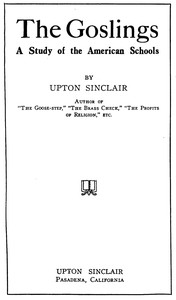
The Goslings: A Study of the American Schools
Language: en1,701 downloads on Project Gutenberg
Subjects
In: History - American·History - Schools & Universities·Politics
Public-domain ebook sourced from Project Gutenberg #65576.
Public-domain ebook
Language: en1,701 downloads on Project Gutenberg
Subjects
In: History - American·History - Schools & Universities·Politics
Public-domain ebook sourced from Project Gutenberg #65576.
The Goslings is a polemical study of American public education written by Upton Sinclair, the famed muck‑monger of the early twentieth‑century. It opens with a sweeping appeal to parents, framing every child as the repository of the nation’s past and future, then launches into a denunciation of the “invisible government” of Big Business that, Sinclair argues, has seized control of the school system. The author outlines a detailed roadmap for the reader, pages 1‑22 expose the hidden power structure, 22‑59 examine Los Angeles schools, 59‑93 turn to New York, and the subsequent sections survey Chicago, a dozen other cities, national agencies, corporate interests, and even the Catholic Church. Sinclair’s opening chapter situates his critique in Southern California, describing the region’s rapid growth, media sensationalism, and a secretive “Black Hand” of merchants and bankers that he claims manipulates education, labor law, and public opinion.
Sinclair’s voice is that of a fervent reformer, blending journalistic reportage with the fiery rhetoric of a social activist. The prose is dense, richly detailed, and peppered with the era’s colloquialisms, reflecting its 1922 origin and the progressive‑era concerns about corporate influence and civic corruption. Readers who enjoy investigative narratives, historical examinations of education policy, or the gritty social criticism for which Sinclair is known will find this work compelling. It offers a window into the cultural and political anxieties of the Roaring Twenties while delivering a relentless argument that still resonates with anyone questioning who really shapes America’s schools.
The opening · free to read
Life has given you one of its precious treasures, a child; a body to nurture, a character to train, a mind with endless possibilities of growth, a soul with hidden stores of tenderness and beauty—all these are Nature’s gifts. Modern science has shown that within the child’s soul lies magically locked up all the past of our race; also, it is evident that within it lies all the future of our race. What our children are now being made is what America will be.
You send these little ones to school. Twenty-three millions of them troop off every week-day morning, with their shining faces newly washed, their clothing cleaned and mended. You bear them, you rear them, with infinite pains and devotion you prepare them, and feed them into the gigantic educational machine.
You do not know much about this machine. You have turned it over to others to run. Every year you pay to maintain it a billion dollars of wealth which you have produced by real and earnest toil. You take it for granted that this billion dollars is competently used; that those who run the machine are giving your twenty-three million children the best education that forty-three dollars and forty-seven cents per child will buy.
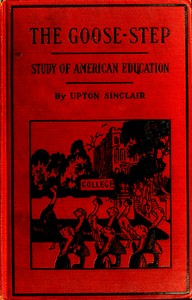
The purpose of this book is to show you how the “invisible government” of Big Business which controls the rest of America has taken over the charge of your children. In the course of a public debate with the writer, in the Civic Club in New York City, May, 1922, Dr. Tildsley, district superintendent of the public school system of that city, made the statement: “I do not know any school system in the United States which is run for the benefit of the children. They are all run for the benefit of the gang.” This statement, made upon high authority, is the thesis of “The Goslings.” Come with me and let me show you what is this “gang” which runs the school system of the United States; how they got their power, what use they make of it, and what this means to the bodies and minds of your twenty-three million little ones.
To assist the reader in finding his way through a big book, I give traveling directions:
Pages 1 to 22 take you behind the scenes of that “invisible government” which is now ruling America, including its schools. Pages 22 to 59 show in detail what this “invisible government” is doing to the schools of one large American city—Los Angeles. Pages 59 to 93 study the schools of New York, and 94 to 109 those of Chicago. Pages 109 to 224 deal with school conditions in a score of other large cities. I realize that this is a large number; but then, many people are interested in these cities. You will find both melodrama and humor in the stories; and if there is too much, you can skip!
Beginning at page 224 is a study of the state and national machines of the school world; and whatever else you miss, do not miss the National Education Association, and how it was stolen from the teachers of America—there is no drama on Broadway to equal that for thrills. From 275 to 329 you will find a score of powerful Big Business organizations which have assumed to take control of our schools. From 330 to 349 comes the Catholic Church in relation to the schools—this in addition to details given in a number of cities. From 349 to 417 you will find a general survey of the school situation from the point of view of both pupils and teachers. The concluding chapters discuss “The Goose-step” and its critics, and developments in the college world since its publication.
------------------------------------------------------------------------
I begin this study of the American school system with Southern California, because that is the part of the country in which I live, and which therefore I know best. It is a representative part, being the newest and most recently mixed. We have all the races, white and black and yellow and red; but the great bulk of the population is of native stock, farmers from the Middle West who have sold or rented their homesteads and moved to this “roof-garden of the world.” It is our fashion to hold reunions and picnics for the old home folks, and there are few states that cannot gather thousands of representatives.
We have the most wonderful climate in the world, and soil which is fertile under irrigation. Our leading occupation is selling this soil and climate to new arrivals from the East. We are eager traders, and everything we have is for sale; you can buy the average house in Southern California for two hundred dollars more than the owner paid for it, and I know people who have sold their homes and moved several times in one year. Also, we have struck oil, and this sudden wealth has fanned our collective greed. We boast ourselves “the white spot on the industrial map.” Hard times do not touch us, we build literally whole streets of new houses every week, and labor agitators are banished from our midst.
The intellectual tone of the community is set by a great newspaper, the Los Angeles “Times,” created by an unscrupulous accumulator of money. The “Times” has now grown enormously wealthy, but it still carries on in its founder’s spirit of hatred and calumny. It boasts of being the largest newspaper in the world—meaning that it prints the most advertisements. You pay ten cents for the Sunday edition, and have two or three pages of Associated Press dispatches with the life censored out of them; after that, you grope your way through a wilderness of commercialism. I stop and wonder, how can I give the reader an idea of the intellectual garbage upon which our Southern California population is fed. I pick up this morning’s paper, and find a cartoon on the front page, our daily hymn of hate against Soviet Russia; the cartoon is labeled in large letters: “Out of the Fryingpansky into the Fireovitch.” As the naturalist Agassiz could construct a whole animal from a piece of fossil bone, so you may comprehend a culture from that piece of wit.
We have several hundred churches of all sects, and our “Times” prints pages of church news and sermons, and double-leaded two-column editorials invoking the aid of Jehovah in all emergencies. But the real spirit of the staff breaks out on the other pages; when it is necessary to represent Los Angeles in a cartoon, their symbol is a sly young prostitute with sparkling black eyes and naked limbs. Once upon a time such pictures were purchased surreptitiously and handed round by naughty little boys; but now they are delivered every morning by carrier to everybody’s home. One of the features of our life is “bathing beauties”; young ladies in thin tights parading the boardwalks of the beaches, winning prizes from chambers of commerce and lending gayety to Sunday supplements. Any new stunt is worth a fortune to one of these ladies; one day a lady has gilded her legs, and the next day a lady has butterflies painted on her back, and next—most elegant of all—a lady appears with a bathing-suit and a monocle.
The men, thus summoned, come in droves. Competition is keen, and the ladies are strenuous in defense of their meal-tickets, and when one trespasses upon another’s rights, we have a thrilling murder story. Our lady murderesses are a leading feature of Southern California life; sometimes they shoot, and sometimes they poison, and sometimes they go to the nearest five- and ten-cent store and buy a hammer, and beat out the other lady’s brains. Then they are sent to jail, which is a career of glory, with photographs and interviews in every edition of the newspapers, and a sensational trial with full details of their many lovers and their quarrels. Autobiographies written in prison are featured in Sunday supplements and advertised on billboards; and finally comes the climax—a magical jail delivery. We know, of course, that nowhere in America can the jails hold the rich, but out here in Southern California the rich don’t even wait to be pardoned by presidents and governors—they tip their jailers twenty-five hundred dollars and walk right out. “Stone walls do not a prison make, nor iron bars a cage!”
Fifteen years ago the writer had haunting his mind what he thought was to be a great blank verse tragedy. The scene of one act was to be laid several hundred years in the future, and the crowning achievement of that time was an invention whereby music could be made audible to people all over the world. The scene was to show a great musician, whose inspiration was being thus conveyed to humanity. And now we have this invention—somewhat ahead of time! Our radio in Southern California is presided over by the “Times,” and the invisible government decides what is safe for our hungry masses to hear.
Our plutocracy has just built for itself a new hotel, a sultan’s dream of luxury, costing several million dollars. The opening of this hotel became the great historical event of Southern California; there were several pages about it in the newspapers, and it was announced that a certain prominent person, would convey his inspiration to the multitude over the “Times” radio. In a hundred thousand homes the hungry “fans” put on their ear-caps and awaited the sublime moment; and meanwhile in the Hotel Biltmore a great part of the guests got royally drunk. The orator had his share, and his inspiration over the radio took the form of obscenities and cursing; the horrified “fans” heard his friends trying to stop him, begging him to come and have one more drink; but he told them they were a set of blankety blank blank fools, and that he knew what he was going to say, and it was nobody’s blankety blank blank business. This continued until suddenly the radio was shut off, and the fans were left to silence and speculation!
Also, we have Hollywood; Hollywood, the world’s greatest honey-pot, with its thousands of beautiful golden bees swarming noisily; Hollywood, where youth and gayety grow rotten before they grow ripe. If you say that Hollywood is not America, I answer that you have only to wait. Hollywood is young America.
Of course our hundreds of churches are not entirely inactive. We have revivalists, who furiously denounce the sins of Hollywood, using the most up-to-date slang; and groups of men and women, instead of going to the movies, gather in Bible classes and learn the history of the Hittites and the succession of the kings of the Jebusites. You can hear sermons over the radio—that is, if you have a high-priced set, and can tune out the jazz orchestras. The cheaper sets hear everything at once, and you can dance to the sermons or pray to the jazz, as you prefer.
Who runs this new empire of the Southwest? It is run by a secret society, which I have named the Black Hand; consisting of a dozen or so of big bankers and business men, hard-fisted, cunning and unscrupulous profiteers of the pioneer type, a scant generation removed from the bad man with a gun on each hip. They are the inner council and directing circle of the Merchants’ and Manufacturers’ Association; with a propaganda department formerly known as the Commercial Federation of California, and now camouflaged as the Better America Federation. Concerning this latter organization, you will find much information in “The Goose Step,” pages 129-132. It occupies the entire floor of a large building, and has raised a fund of a hundred and sixty thousand dollars a year for five years for its campaign of terrorism. Like all criminals, it operates under many aliases: the American Protective League, the Association for Betterment of the Public Service, the Associated Patriotic Societies, the Taxpayers’ Association, the People’s Economy League, the Tax Investigating and Economy League, the Americanization Committee, the Committee of One Thousand, the Committee of Ten Thousand, the Parent-Teachers’ Associations, the Board of Education, the District Attorney’s Office, and the Police Department of the City of Los Angeles.
The book keeps going
Reading is free forever. Sign up and watch scenes appear while you read.



Scenes Storieta drew for other classics.
New illustrated classics
Once or twice a month: the latest books to get full character casts, scene art, and free comic editions. No account needed.