Public-domain ebook
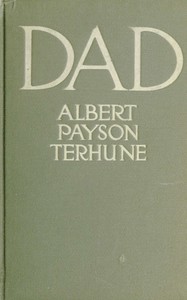
Dad
Language: en558 downloads on Project Gutenberg
Subjects
In: Historical Novels·Novels·American Literature
Public-domain ebook sourced from Project Gutenberg #65641.
Public-domain ebook
Language: en558 downloads on Project Gutenberg
Subjects
In: Historical Novels·Novels·American Literature
Public-domain ebook sourced from Project Gutenberg #65641.
The opening · free to read
Across the plaza, under the white sun-glare, marched and countermarched the crack regiment’s bronzed men in their heavy high caps and the rest of the odd regimentals of the late Forties.
From walls and roofs hung a myriad of more or less soiled American flags. On the plaza band stand a group of Mexican musicians were wrestling with “Columbia, the Gem of the Ocean.”
This last feature of the celebration was a bit of tragic irony attributed to no less a humorist than the arch-victor, the hero of the day--Major-General Winfield Scott. The native musicians were in no wise loath, on patriotic grounds, to play “Columbia, the Gem of the Ocean.”
They were professional performers. One tune meant as much, and as little, to them as another.
They had not the faintest notion that they were playing a national air of their nation’s conquerors. The pained looks on their simian little faces and the sad havoc they wrought upon a noble melody were due solely to the fact that the tune was new to them, unlike anything they had ever before heard; and that they had had insufficient time to rehearse it.
But the effect was there.
At the first halting notes, a grin of wondering delight twisted the faces of the marching regiment. The episode appealed to their Yankee humor. The grin was reflected on the visages of the crowd of officers and civilians who filled the dais at the plaza’s northern end.
The onlooking Mexicans--from peon to hidalgo--who fringed the square’s edges, listened in stark apathy. Most of them were ignorant of the air’s import. To them it was but a gringo melody; far inferior to “La Paloma.”
The few who recognized it showed no resentment. To their Spanish-Indian minds it was but natural that the victors should thus crow.
They themselves were beaten; hopelessly beaten. They and their country. They were glad enough to get off as easily as they seemed like to.
A little vaunting--the playing of their new masters’ national song--was nothing to what they would have done had the conditions been reversed.
General Scott sat at the center of the dais-front. Portly, his round, red face framed by white chin-whiskers and thin white hair, he was decked out in all the blue-and-gold glory of a United States major-general’s dress uniform.
This was perhaps the crowning day of his career. At all events he was celebrating it in accord with that idea.
Mexico had fallen. The hectic, iniquitous war was at an end. Vera Cruz and Popocatepetl had become names of new meaning. The capital city itself had surrendered.
To-day, the United States, in the person of its armies’ commander, was to receive formal notification of the fall of the last native stronghold.
And Scott had turned the war-drama’s last scene into a pageant.
To the strains of “Columbia, the Gem of the Ocean,” the local army’s best regiment was going through wondrous evolutions before coming to a halt opposite the dais. The local Mexican authorities, their speeches ready, stood waiting to step forward to the dais and deliver them.
Among the dais’s civilian occupants, a Congressman and a foreign chargé d’affaires were to follow with suitable addresses. And General Scott himself was to reply with a few well-chosen remarks; his military secretary having done the choosing.
Altogether, it was an affair worthy of full-page accounts in all the administration newspapers throughout the United States, and for a paragraph or two in history.
(That neither the newspapers nor history made much if anything of it was wholly due to a dusty man in fatigue uniform who was just then riding a very tired horse toward the plaza.)
Mexico had fallen.
More than a decade earlier the gringo pioneers in Texas had clashed with the Mexican lords of the soil. And, after many a bloody conflict, red with mediæval barbarity, they had seized Texas from Mexico and made a republic of it.
Later the Lone Star republic had been annexed to the United States. Mexico had protested. Then our government had declared that Texas not only belonged to the United States, but that its southern boundary was the Rio Grande, instead of the Nueces River.
Again Mexico had protested.
Whereat, President Polk had sent an old Indian fighter, Zachary Taylor, to the Rio Grande with four thousand troops, to maintain the frontier. Taylor, with his handful of men, had calmly plowed his way southward, thrashing Mexican armies double the size of his own, until all northern Mexico was his.
President Polk, “viewing with alarm” the repute that Taylor, a political foe of his own, was gleaning, hustled the army’s commander-in-chief, General Scott, south to snatch any remaining laurels.
Scott stripped Taylor’s little band of its best officers and men and continued the war to a triumphant end; Taylor, meantime, at Buena Vista, opposing his own remnant of an army to a Mexican force five times its size and nearly annihilating the enemy in the most important and spectacular battle of the whole war.
But now that the conflict was over, Scott was in his element. He was the ideal god of war; a far more impressive figure on this climax day than down-at-heel, tobacco-chewing old Zachary Taylor could have hoped to be.
The regiment came to a halt. At a barked order, eight hundred cumbrous muzzle-loading muskets clicked to the “present,” then, with a double click, to the “carry.”
The last off-key strains of “Columbia” moaned out, and the sweating musicians laid aside their instruments.
A gold-laced Mexican, whose uniform coat bore as many decorations as a champion swimmer’s, stepped into the open space in front of the platform, unrolled a terrifying parchment document that jingled with seals, cleared his throat and prepared to read. General Scott folded his plump arms across his plumper chest, assumed an air of gracious dignity, and prepared to listen.
His staff and the civilians on the dais stood in impressive attitudes to hear a document in a tongue few of them had troubled to master; and prepared to be bored.
None of the three sets of preparations was destined to ripen into fulfillment.
For just then, riding unceremoniously through the close-packed crowd of natives at the left of the dais, appeared a horseman in the fatigue uniform of a colonel of cavalry. His uniform was stained and old, and was further disfigured by a coating of white dust and foam-fleck. The big sorrel horse was sweat-streaked and evidently half-exhausted.
The man took in the scene in a single quick look. Touching his tired horse with the spur, he rode straight up to the dais, almost tramping the Mexican dignitary under foot; saluted mechanically, and then sat blinking in moody reverie at General Scott.
There was a moment’s hush through which a bugle call was drifted, faint but wholly audible from the American camp far to the east of the plaza. Scott squinted in annoyed perplexity at the newcomer.
The latter suddenly straightened in the saddle, saluted again and rasped out:
“Lieutenant-Colonel James Brinton of General Taylor’s personal staff. Present in reply to General Scott’s request that General Taylor send a representative to this celebration.”
Real pleasure effaced the annoyance in Scott’s face. Even as no Roman triumph was complete without the presence of humbled rivals, so his day of glory was immeasurably sweetened by the fact that the general whose prowess had all but overshadowed his own was, by proxy at least, a witness to the scene.
Scott beamed with lofty graciousness on Lieutenant-Colonel James Brinton. He would vastly have preferred that his rival’s delegate should have looked more like a military tailor’s dummy, on this day of days, and less like a dust-sprinkled scarecrow.
The book keeps going
Reading is free forever. Sign up and watch scenes appear while you read.



Scenes Storieta drew for other classics.
New illustrated classics
Once or twice a month: the latest books to get full character casts, scene art, and free comic editions. No account needed.