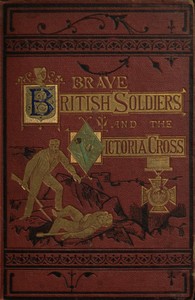
BRAVE BRITISH SOLDIERS AND THE VICTORIA CROSS.
A GENERAL ACCOUNT OF THE REGIMENTS AND MEN OF THE BRITISH ARMY.
AND STORIES OF THE BRAVE DEEDS WHICH WON THE PRIZE “for Valour.”
EDITED BY S. O. BEETON.
With Sixteen Full-Page Engravings and Illustrations in the Text.
LONDON: WARD, LOCK AND TYLER, WARWICK HOUSE, PATERNOSTER ROW.
BEETON’S BOY’S OWN LIBRARY, COLOURED ILLUSTRATIONS.
Handsomely-finished bindings in cloth, plain edges, 5s.; gilt edges, 6s.
1. STORIES OF THE WARS. 2. HOW I WON MY SPURS. EDGAR. 3. CRESSY AND POICTIERS. Ditto. 4. RUNNYMEDE AND LINCOLN FAIR. Ditto. 5. WILD SPORTS OF THE WORLD. 6. CURIOSITIES OF SAVAGE LIFE. 7. HUBERT ELLIS. 8. DON QUIXOTE. 300 Illustrations. 9. GULLIVER’S TRAVELS. 10. ROBINSON CRUSOE. 11. SILAS THE CONJURER. 12. SAVAGE HABITS AND CUSTOMS. 13. REUBEN DAVIDGER. 14. BRAVE BRITISH SOLDIERS AND THE VICTORIA CROSS. 15. ZOOLOGICAL RECREATIONS. By W. J. BRODERIP, F.R.S. 16. WILD ANIMALS IN FREEDOM AND CAPTIVITY. 17. THE MAN AMONG THE MONKEYS. 18. THE WORLD’S EXPLORERS.
The best set of Volumes for Prizes, Rewards, or Gifts to English Lads. They have all been prepared by Mr. Beeton with a view to their fitness in manly tone and handsome appearance for presents for Youth, amongst whom they enjoy an unrivalled degree of popularity, which never flags.
LONDON: WARD, LOCK, AND TYLER.
TO THE READER.
This book is written for Boys. The majority of the articles were expressly prepared for the “Boys’ Own Magazine,” and the interest which their appearance excited, coupled with the favourable notices they won, encouraged the Editor to publish them in a connected form.
Boys—worthy to be called Boys—are naturally brave. There is not, so far as we are aware, any etymological connexion between the words boy and brave; but there is an association of ideas, which if it does not make the terms interchangeable, is still strongly suggestive of their being one and the same. The expression brave man is easily understood, but to us, brave BOY looks like a pleonasm. A man has experience. He has tested—if there be any good thing in him—his courage in the rough exploits of the world’s campaign. He has tilted, mayhap, with Quixotic chivalry against windmills, and in the encounter has been discomfited; he has awakened from his bright dream to a sad reality; he has been tempted to turn prosaic—inclined sometimes to beat his sword into a sickle, to gather in for his own special use the golden wheat from anybody’s cornfield, and to make those late foes of his—the windmills—grind up the corn to make his bread. Now he is no longer brave. His views of life are taken from a new point of sight. He smiles at the boy’s enthusiasm, and counts himself wise in his man’s selfishness. But a man who has done battle, who has been thrown in the lists, who has been ready to mount and splinter lance again, who in the gaining of experience has lost nothing of the Boy’s boldness—such a man is brave.
The drift of these remarks is that experience may ruin a Boy’s “pluck”—may give him the vulpine sagacity of Reynard in place of the courage of Leo Africanus.
But a Boy is brave. Youth is the season of confidence. “Your young men shall _see visions_” while our “_old_ men shall dream dreams.” What visions are those which rise up before the young—what brave words to speak, what brave actions to do—how bravely—if need be—to suffer! “The young fellows,” said an old soldier to the writer, “are always pushing forward in a battle charge—they are in a mighty hurry to smell powder—_the veterans fall into the rear_!” Do they?—ah, well, ’tis the lesson, perhaps of experience! But is it better than the Boy’s eagerness to be foremost?—is it not—answer brave hearts—better to die planting the colours on the wall, than to share the spoil which others have won?
This is the leading thought in this book about Soldiers—it is meant to keep alive the bravery of youth in the experience of manhood. The editor of the book is very sensible of the incompleteness of the work. He knows that it is defective in many places, but it is honest. A good many of the papers were written by one who was then far away on a foreign station doing brave service; some of the papers are the work of dead hands. The articles have been put together as carefully as circumstances would allow, but there has been an anxious care on the Editor’s part to retouch as little as possible the work of absent contributors. He offers the book to the Boys of England—not as the best piece of work that can be done—but as a volume they will read with delight and keep as a souvenir of pleasant hours. He is of opinion that anything which helps to make Boys more in love with true courage is good work done—he believes that bravery excites bravery, just as iron sharpeneth iron; and so he has confidence in this book being useful—a record of brave deeds that shall make its readers echo the words of King Harry—
“If it be a sin to covet honour I am the most offending soul alive.”
CONTENTS.
The book keeps going
Keep reading, and see it illustrated
Reading is free forever. Sign up and watch scenes appear while you read.
Scenes Storieta drew for other classics.