A great many years ago, when I was quite a small child, I was taken with some other children over Westminster Abbey by Dean Stanley, who was then the Dean of Westminster.
Some of you may have read a book called “Tom Brown’s School Days,” and if so you will remember Tom’s great friend, Arthur, who began his school life a lonely and home-sick little boy, but who as the years went on came to be looked up to and liked almost more than any other boy at Rugby. “George Arthur” this boy is called in the book, but his real name was Arthur Stanley, and when he grew up he became a clergyman, and was for many years Dean of Westminster. He wrote a great many books, and one all about Westminster Abbey; for he knew every corner and part of this great church, and was full of stories about the great people who are buried here, and the kings and queens who were crowned here. There was nothing he liked better than taking people over the Abbey, and any one who had the happiness of going with him, as I did, and of hearing him, would always remember some, at any rate, of the stories he told.
He died in 1881, and as none of you can ever see or hear him, standing in the Abbey surrounded by children, and telling them all that he thought would interest them, I am going to take out of my memory, and out of this book of his,[1] just as much of what he used to say as I hope will help you to enjoy what you will see there.
When one goes to visit any place for the first time, there is always a great deal that one wants to have explained; and what I myself most enjoy is to read or be told beforehand something about what I am going to see, and then I understand it much better--I do not waste so much time in asking questions, and have all the more time to look about.
If we go and stand at the great West Door, as it is called, of Westminster Abbey, and look down Victoria Street, it is difficult to believe that this very same place was, hundreds of years ago, quite wild country. Where there are now houses and streets and churches, there used to be only marshy land and forests. Where there are now endless streams of carriages, carts, and omnibuses, and people hurrying along, there were in the far-off time, when the Abbey Church of Westminster was first begun, only wild oxen or huge red deer with towering antlers which strayed from the neighbouring hills and roamed about in this jungle. It used to be called “the terrible place,” so wild and so lonely was it.
Dotted about in the marsh were many little islands, one of which was called Thorney Isle, because there were so many wild thorn trees growing there, and on this spot Westminster Abbey now stands.
For as the forests in this part of London were gradually cut down, this island looked so pretty and quiet with the water flowing all round it, and nothing to be seen from it but sunny green meadows, that King Edward the Confessor chose it as the place to build a great church, which he called the Church of St. Peter. At that time there were not many large churches in England, and the Church of St. Peter was thought to be one of the most splendid that was ever seen. It took fifteen years to build, but at last it was finished, and on Christmas Day, 1065, King Edward the Confessor, wearing his crown, as was the custom in those days on great occasions, came with all his bishops and nobles to the first great service in the Abbey Church which he himself had built. He was then a very old man, and a few days after the great service he was taken ill and died, and was buried in his own church. He is called the Founder of the Abbey, and you will see, when you go round it, the shrine of King Edward and of his queen, who was afterwards buried at his side.
Now, there is only one more thing to be remembered before we begin to look round inside and decide what are the most interesting things to see, and that is that this Abbey we are in to-day is not the actual Church of St. Peter which King Edward the Confessor built. Of that church there is now left only a little bit of one pillar, which perhaps a guide will show you, within the altar-rail, in what is called the “Sacrarium.” I do not mean that the church was pulled down all at once, and this Abbey built instead, but bit by bit, as years went on, it was added to and altered. New parts were built on by different kings--for Westminster Abbey is a church that has been all built by kings and princes--and as the new parts were added, the old were gradually pulled down.
Of all the kings who helped to build and beautify the Abbey, Henry III. was the one who did most, and he spent on it such enormous sums of money that he is often spoken of as one of the most extravagant kings England ever had. He made up his mind that the Abbey of Westminster was to be the most beautiful church in the world, and he used to invite the best foreign artists and sculptors to come and help to make plans and paintings and carvings for it. He it was who built the shrine where Edward the Confessor is now buried, in the part of the choir behind where the communion table (formerly the high altar) now stands. It was when he was growing to be an old man that he thought the founder of the Abbey ought to be treated with special honour and respect, and so almost the last thing he did in his life was to build this shrine, which stands in what is called Edward the Confessor’s Chapel.
The king sent all the way to Rome--and in those days the journey was a very much longer and more difficult one than it is now--for the mosaics and enamels which are still to be seen on the shrine; the workmen who made it came from Rome, where the best workmen were then to be found; and the twisted columns round the shrine were made in imitation of the columns on some of the tombs in the great churches in Rome.[2]
When it was finished, in 1269, the old king himself, his brother Richard, and his two sons, Edward and Edmund, carried the coffin of Edward the Confessor on their shoulders from the place where it had been buried in 1065 to the new chapel, and there it has rested to this very day.
Years afterwards a great and magnificent chapel was added by Henry VII. at the east end of the Abbey, which was called after him. He was buried there when he died, and so were his grandson, Edward VI., and Queen Elizabeth, and Mary Queen of Scots, and many others whose tombs you must look at by-and-by.
It was in the year 1509 that Henry VII. was buried in Westminster Abbey, just four hundred and forty-four years after the burial of King Edward the Confessor. But in these four hundred and forty-four years the Abbey had been so much altered, the old parts so pulled down and rebuilt, that King Edward, could he have seen it again, would hardly have believed that this great Abbey, as we see it to-day, had grown up from his first Church of St. Peter on Thorney Isle.
And now, as I have said enough about the building of the Abbey, we can go inside and begin to see some of the monuments and tombs of which it is full.
This chapter on the geography of the Abbey, as I call it, has nothing to do with the stories which begin in the next chapter, and the only reason that I have written it at all is this. In the days when I first heard many of the stories which I am going to tell you now, they were told to us by Dean Stanley in the Abbey. As we walked about with him he explained to us what part of the church we were in, and pointed out the tomb or monument of the man, or woman, or child about whom he was telling us. But some of you may read this little book before you have ever been to Westminster Abbey, and others may have been there, but may not know the names of the different parts of the church, or where any particular monument or tomb is.
So, instead of trying to explain at the beginning of every story whereabouts we are supposed to be standing, I am putting all such explanations in this chapter; and this will, I hope, help you to find your way about in the Abbey for yourselves. If you only want to hear the stories, you must miss this chapter and go on to the next one.
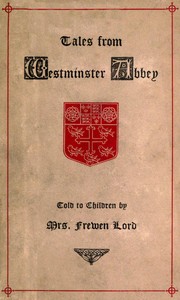
Just as we have maps to understand the geography of countries, so we have maps, which are called plans, to understand the geography of churches and houses, and the drawing you see on the opposite page is a map or plan of the inside of Westminster Abbey. The picture at the beginning of this book is a view of the outside.
We will now suppose we have just come into the Abbey at the great west door, the door between the two towers (see frontispiece). The name is marked on the plan.[3] We should then be standing in what is called the nave, and right in front of us and through those iron gates underneath the organ is the choir. That is where service is held every morning and every afternoon, and where all the Westminster School boys sit on Sundays when they come to church, for as Westminster school has no chapel of its own, the boys have all their services in the Abbey. Through the choir gates you can see the communion table in front of you, and behind that, again, are all the chapels where the kings and queens are buried. The nave and transepts are full of the monuments and graves of great men. The numbers 1, 2, 3, etc., on the plan mark those about which you will find stories later on.
A. Chapel of Edward Confessor. B. „ St. Benedict. C. „ St. Edmund. D. „ St. Nicholas. E. Henry VII. Chapel. F. Chapel of St. Paul. G. „ St. John Baptist. H. „ St. Erasmus. I. „ Abbot Islip. J. „ St. John Evangelist. K. „ St. Michael. L. „ St. Andrew.
1. Lord Shaftesbury. 2. General Gordon. 3. Edward Mansell. 4. Edward de Carteret. 5. Sir Isaac Newton. 6. Lord Lawrence. 7. Sir James Outram. 8. David Livingstone. 9. Henry Fawcett. 10. Sir John Franklin. 11. Geoffrey Chaucer. 12. Alfred Tennyson. 13. Shakespeare. 14. Handel. 15. Lord Beaconsfield. 16. George Canning. 17. Earl Canning. 18. Lord Stratford de Redcliffe. 19. Lord Chatham and William Pitt. 20. Wilberforce. 21. Henry III. 22. Queen Eleanor. 23. Edward I. 24. Edward III. 25. Richard II. 26. Henry V. 27. Henry VII. and Queen. 28. Queen Elizabeth and Queen Mary Tudor. 29. Mary Queen of Scots. 30. Oliver Cromwell. 31. Edward VI. 32. Dean Stanley.
And now, if you look at the plan, you will see exactly where everything is. The whole Abbey is built on a piece of land which has the shape of a cross laid upon the ground. The nave and choir represent the stem of the cross, and the two transepts form the two arms.
In the part of the choir beyond the communion table are the chapels. Altogether there are eleven, and they are arranged like a wreath round the shrine of Edward the Confessor. They are marked on the plan by the letters A, B, C, etc., and their names you will find on the plan, beginning with A, which is the Chapel of Edward the Confessor.
One last thing I must explain before we begin the stories, and that is--how this great church came to be called an Abbey, and not a Cathedral. It is not at all difficult to remember when you have once been told.
The Church of St. Peter did not stand, as you may have supposed, all by itself on Thorney Isle, but was only one part of a mass of buildings called the Monastery of St. Peter.