Public-domain ebook
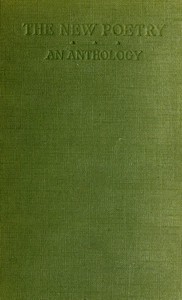
The New Poetry: An Anthology
Language: en2,217 downloads on Project Gutenberg
Subjects
In: Poetry
Public-domain ebook sourced from Project Gutenberg #65807.
Public-domain ebook
Language: en2,217 downloads on Project Gutenberg
Subjects
In: Poetry
Public-domain ebook sourced from Project Gutenberg #65807.
The New Poetry: An Anthology gathers the work of contemporary poets who, in the eyes of early‑twentieth‑century editors, are forging a “new poetry” that departs from Victorian excess and the rigid iambic conventions that dominated English verse for centuries. The opening essay explains how this movement seeks concrete realism, simple diction, and an individual rhythm, while still honoring tradition. It traces the lineage from the Irish revival through Whitman’s free verse to the influence of French Symbolists and Eastern forms, positioning the collection as a response to the growing demand for fresh, vital verse.
The volume reflects the experimental spirit of the 1910s and 1920s, blending formal experimentation with a conversational tone that aims to capture everyday speech. Readers who appreciate poetry that balances respect for the past with a drive toward immediacy, students of modernist literature, members of literary societies, or anyone curious about the transition from Victorian lyricism to modern free verse, will find this anthology rewarding. Its emphasis on sincerity, “exteriority,” and cross‑cultural influences makes it a compelling entry point into the early modernist re‑imagining of English poetry.
The opening · free to read
The editors of this anthology wish to present in convenient form representative work of the poets who are to-day creating what is commonly called “the new poetry,”—a phrase no doubt rash and most imperfectly descriptive, since the new in art is always the elder old, but one difficult to replace with any form of words more exact. Much newspaper controversy, and a number of special magazines, testify to the demand for such a book; also many letters to the editors of Poetry asking for information—letters not only from individual lovers of the art, but also from college professors and literary clubs or groups, who have begun to feel that the poetry of to-day is a vital force no longer to be ignored. Indeed, many critics feel that poetry is coming nearer than either the novel or the drama to the actual life of to-day. The magazine Poetry, ever since its foundation in October, 1912, has encouraged this new spirit in the art, and the anthology is a further effort on the part of its editors to present the new spirit to the public.
What is the new poetry? and wherein does it differ from the old? The difference is not in mere details of form, for much poetry infused with the new spirit conforms to the old measures and rhyme-schemes. It is not merely in diction, though the truly modern poet rejects the so-called “poetic” shifts of language—the deems, ’neaths, forsooths, etc., the inversions and high-sounding rotundities, familiar to his predecessors: all the rhetorical excesses through which most Victorian poetry now seems “over-apparelled,” as a speaker at a Poetry dinner—a lawyer, not a poet—put it in pointing out what the new movement is aiming at. These things are important, but the difference goes deeper than details of form, strikes through them to fundamental integrities.
The new poetry strives for a concrete and immediate realization of life; it would discard the theory, the abstraction, the remoteness, found in all classics not of the first order. It is less vague, less verbose, less eloquent, than most poetry of the Victorian period and much work of earlier periods. It has set before itself an ideal of absolute simplicity and sincerity—an ideal which implies an individual, unstereotyped diction; and an individual, unstereotyped rhythm. Thus inspired, it becomes intensive rather than diffuse. It looks out more eagerly than in; it becomes objective. The term “exteriority” has been applied to it, but this is incomplete. In presenting the concrete object or the concrete environment, whether these be beautiful or ugly, it seeks to give more precisely the emotion arising from them, and thus widens immeasurably the scope of the art.
All this implies no disrespect for tradition. The poets of to-day do not discard tradition because they follow the speech of to-day rather than that of Shakespeare’s time, or strive for organic rhythm rather than use a mold which has been perfected by others. On the contrary, they follow the great tradition when they seek a vehicle suited to their own epoch and their own creative mood, and resolutely reject all others.
Great poetry has always been written in the language of contemporary speech, and its theme, even when legendary, has always borne a direct relation with contemporary thought, contemporary imaginative and spiritual life. It is this direct relation which the more progressive modern poets are trying to restore. In this effort they discard not only archaic diction but also the shop-worn subjects of past history or legend, which have been through the centuries a treasure-trove for the second-rate.
This effort at modern speech, simplicity of form, and authentic vitality of theme, is leading our poets to question the authority of the accepted laws of English verse, and to study other languages, ancient and modern, in the effort to find out what poetry really is. It is a strange fact that, in the common prejudice of cultivated people during the four centuries from just before 1400 to just before 1800, nothing was accepted as poetry in English that did not walk in the iambic measure. Bits of Elizabethan song and of Dryden’s two musical odes, both beating four-time instead of the iambic three, were outlandish intrusions too slight to count. To write English poetry, a man must measure his paces according to the iambic foot-rule; and he must mark off his lines with rhymes, or at least marshal them in the pentameter movement of blank verse.
The first protest against this prejudice, which long usage had hardened into law, came in the persons of four or five great poets—Burns, Coleridge, Keats, Shelley, Byron—who puzzled the ears of their generation with anapæsts and other four-time measures, and who carried into their work a certain immediacy of feeling and imagery—a certain modern passion of life—which even Cowper, Thompson and a few others of their time, though they had written of things around them, had scarcely attained. Quarterly critics and London moralists blinked and gasped, but at last the bars had to go down for these great radicals. And before long the extreme virtuosity of Swinburne had widened still further the musical range of the English language.
By the time Whitman appeared, the ear of the average reader—that formidable person—was attuned to anapæsts, dactyls, choriambics, sapphics, rhymed or unrhymed. He could not call them by name, but he was docile to all possible intricacies of pattern in any closely woven metrical scheme. But Whitman gave him a new shock. Here was a so-called poet who discarded all traditional patterns, and wove a carpet of his own. Once more the conservatives protested: was this poetry? and, if so, why? If poetry was not founded on the long-accepted metrical laws, then how could they distinguish it from prose, and thus keep the labels and catalogues in order? What was Whitman’s alleged poetry but a kind of freakish prose, invented to set forth a dangerous anarchistic philosophy?
It would take too long to analyze the large rhythms of Whitman’s free verse; but the mere fact that he wrote free verse and called it poetry, and that other poets—men like Rossetti, Swinburne, Symonds, even the reluctant Emerson—seemed to agree that it was poetry, this fact alone was, in the opinion of the conservatives, a challenge to four centuries of English poets. And this challenge, repeated by later poets, compels us to inquire briefly into the origins of English poetry, in the effort to get behind and underneath the instinctive prejudice that English poetry, to be poetry, must conform to prescribed metres.
Chaucer, great genius that he was, an aristocrat by birth and breeding, and a democrat by feeling and sympathy—Chaucer may have had it in his power to turn the whole stream of English poetry into either the French or the Anglo-Saxon channel. Knowing and loving the old French epics better than the Norse sagas, he naturally chose the French channel, and he was so great and so beloved that his world followed him. Thus there was no longer any question—the iambic measure and rhyme, both dear to the French-trained ears of England’s Norman masters, became fixed as the standard type of poetic form.
But it was possibly a toss-up—the scale hung almost even in that formative fourteenth century. If Chaucer’s contemporary Langland—the great democrat, revolutionist, mystic—had had Chaucer’s authority and universal sympathy, English poetry might have followed his example instead of Chaucer’s; and Shakespeare, Milton and the rest might have been impelled by common practice to use—or modify—the curious, heavy, alliterative measure of Piers Ploughman, which now sounds so strange to our ears:
In a somer seson, When softe was the sonne, I shoop me into shroudes As I a sheep weere; In habite as an heremite Unholy of werkes, Wente wide in this world Wondres to here.
Though we must rejoice that Chaucer prevailed with his French forms, Langland reminds us that poetry—even English poetry—is older than rhyme, older than the iambic measure, older than all the metrical patterns which now seem so much a part of it. If our criticism is to have any value, it must insist upon the obvious truth that poetry existed before the English language began to form itself out of the débris of other tongues, and that it now exists in forms of great beauty among many far-away peoples who never heard of our special rules.
Perhaps the first of these disturbing influences from afar to be felt in modern English poetry was the Celtic renascence, the wonderful revival of interest in old Irish song, which became manifest in translations and adaptations of the ancient Gaelic lyrics and epics, made by W. B. Yeats, Lady Gregory, Douglas Hyde and others.
This influence was most powerful because it came to us directly, not at second-hand, through the English work of two poets of genius, Synge and Yeats. These great men, fortified and inspired by the simplicity and clarity of primitive Celtic song, had little patience with the “over-appareled” art of Tennyson and his imitators. They found it stiffened by rhetoric, by a too conscious morality leading to pulpit eloquence, and by second-hand bookish inspirations; and its movement they found hampered, thwarted of freedom, by a too slavish acceptance of ready-made schemes of metre and rhyme. The surprises and irregularities, found in all great art because they are inherent in human feeling, were being ruled out of English poetry, which consequently was stiffening into forms too fixed and becoming more and more remote from life. As Mr. Yeats said in Chicago:
“We were weary of all this. We wanted to get rid not only of rhetoric but of poetic diction. We tried to strip away everything that was artificial, to get a style like speech, as simple as the simplest prose, like a cry of the heart.”
It is scarcely too much to say that “the new poetry”—if we may be allowed the phrase—began with these two great Irish masters. Think what a contrast to even the simplest lyrics of Tennyson the pattern of their songs presents, and what a contrast their direct outright human feeling presents to the somewhat culture-developed optimism of Browning, and the science-inspired pessimism of Arnold. Compared with these Irishmen the best of their predecessors seem literary. This statement does not imply any measure of ultimate values, for it is still too early to estimate them. One may, for example, believe Synge to be the greatest poet-playwright in English since Shakespeare, and one of the great poets of the world; but a few more decades must pass before such ranking can have authority.
At the same time other currents were influencing progressive minds toward even greater freedom of form. Strangely enough, Whitman’s influence was felt first in France. It reached England, and finally America, indirectly from Paris, where the poets, stimulated by translations of the great American, especially Bajazette’s, and by the ever-adventurous quality of French scholarship, have been experimenting with free verse ever since Mallarmé. The great Irish poets felt the French influence—it was part of the education which made them realize that English poetry had become narrow, rigid, and insular. Yeats has held usually, though never slavishly, to rhyme and a certain regularity of metrical form—in which, however, he makes his own tunes; but Synge wrote his plays in that wide borderland between prose and verse, in a form which, whatever one calls it, is essentially poetry, for it has passion, glamour, magic, rhythm, and glorious imaginative life.
The book keeps going
Reading is free forever. Sign up and watch scenes appear while you read.



Scenes Storieta drew for other classics.
New illustrated classics
Once or twice a month: the latest books to get full character casts, scene art, and free comic editions. No account needed.